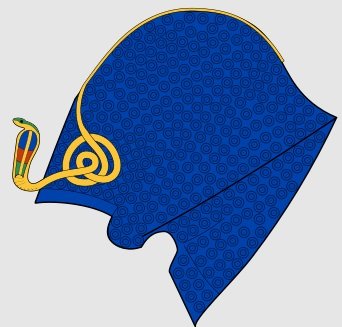
The khepresh, or blue crown, was an Egyptian royal headdress for battles and ceremonies.
The khepresh, also referred to as the “blue crown” or “war crown,” was a prominent symbol of royal authority in ancient Egypt, particularly during the New Kingdom period. It holds a significant place in the artistic and ceremonial depictions of pharaohs. Despite its frequent depiction in military contexts, modern historians avoid strictly labeling it as a war crown due to its diverse applications in both ceremonial and religious settings.
Physical Characteristics and Construction
Although no physical example of the khepresh has survived, its depictions in ancient art have provided valuable insights into its probable construction. Egyptologists speculate that the khepresh was crafted from either leather or stiffened cloth. This material base was then adorned with a meticulously arranged array of sequins, discs, bosses, or rings, creating a distinct visual effect.
Some scholars propose that the circular patterns seen in depictions may represent hexagonal holes in an open triaxial weave, akin to plant-fiber constructions used for other crowns, such as the deshret (red crown) and hedjet (white crown). As with other royal crowns, the khepresh featured the uraeus—a stylized cobra—at its front, symbolizing divine protection and royal authority.
Historical Origins and Evolution
The earliest references to the khepresh date back to the Second Intermediate Period. Pharaoh Neferhotep III’s reign provides the first textual evidence of the khepresh, as seen on the stela Cairo JE 59635. This early depiction included a determinative symbolizing a simpler “cap crown.” A visual depiction of the khepresh can also be found on the stela Cairo CG 20517, from the reign of Snaaib. Here, the pharaoh is shown wearing the khepresh while venerating the god Min, underscoring its association with divinity.
The New Kingdom marked the height of the khepresh’s prominence. Pharaohs such as Ahmose I and Hatshepsut elevated its importance, incorporating it into military and ceremonial iconography. During this period, the khepresh underwent stylistic changes, becoming taller and more angular before achieving its most recognizable form under the reigns of Hatshepsut and Thutmose III. By the time of Amenhotep III, the khepresh had become a fashionable and widely recognized symbol of royal power.
In later periods, depictions of the khepresh extend to Roman rulers such as Augustus and Tiberius, signifying their adoption of Egyptian royal traditions to legitimize their rule.
The khepresh was not solely a military symbol. Some scholars interpret its use as a marker of divine kingship, positioning pharaohs as earthly manifestations of gods. The crown’s frequent appearance in religious ceremonies supports this view.
The khepresh fell out of favor during the Kushite Dynasty (747–656 BCE). However, it reappeared during the Twenty-Sixth Dynasty and was occasionally worn by early Roman rulers depicted as pharaohs. This continuity highlights the enduring symbolic power of the khepresh in connecting rulers to the divine and royal traditions of ancient Egypt.
Symbolism and Meaning
The khepresh served as a versatile symbol, transcending its initial association with military contexts. Its use in religious ceremonies and depictions alongside gods reinforced its role as an emblem of the pharaoh’s divine mandate. By wearing the khepresh, pharaohs communicated their dual identity as both military leaders and spiritual intermediaries between the gods and their people.
The uraeus, prominently placed at the crown’s front, further accentuated its symbolic significance. Representing the goddess Wadjet, the uraeus symbolized protection, legitimacy, and the unassailable power of the ruler.
Cultural and Artistic Depictions
The khepresh is depicted in various artistic media, from statues and stelae to tomb paintings. These representations provide valuable insights into its evolving form and its integration into royal iconography. Notable examples include:
- Ahmose I: Early depictions show a taller and more angular khepresh.
- Hatshepsut and Thutmose III: The crown reached its most iconic design during their reigns.
- Amenhotep III: The khepresh became a key symbol of royal power and divine authority.
- Tutankhamun: There are some depictions of the young king wearing the khepresh, highlighting its ceremonial significance.
Frequently Asked Questions
What materials might have been used to make the khepresh?
The khepresh may have been made of leather or stiffened cloth, covered with sequins, discs, or rings, resembling a triaxial weave.
When was the khepresh first mentioned and depicted?
The earliest mention is from Pharaoh Neferhotep III’s reign during the Second Intermediate Period, while the first depiction is on a stela showing Pharaoh Snaaib wearing it.
What was the symbolism of the khepresh during the New Kingdom?
It symbolized divine power, linking pharaohs to gods, and was used in both military and religious contexts.
How did the khepresh evolve during the New Kingdom?
Under Ahmose I, it was taller and more angular, reaching its iconic form during the reigns of Hatshepsut and Thutmose III, becoming a prominent crown.
Why is it called the “war crown,” and is this term accurate?
It was historically called the war crown due to its association with military depictions, but modern historians avoid this label, as it was also worn in non-military contexts.
Was the khepresh used after the New Kingdom?
It disappeared during the Kushite Dynasty but reappeared in the Twenty-sixth Dynasty and was occasionally depicted during the Roman period.





