The Latin Alphabet
The Latin alphabet, also referred to as the Roman alphabet, is the writing system originally developed and employed by the ancient Romans to document the Latin language.
Over the centuries, this alphabet has undergone several transformations and has been widely adopted to accommodate various languages across the world.
Today, it forms the basis of the Latin script, which serves as the writing system for most European, American, African, and Oceanic languages. The Latin alphabet’s standardized modern version is recognized as the ISO basic Latin alphabet.
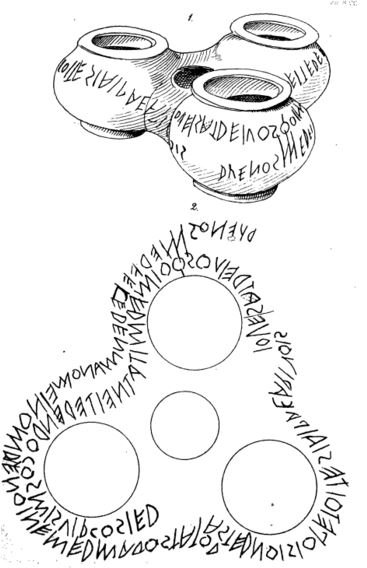
American archaeologist, Heinrich Dressel’s recording of the Duenos inscription.
READ MORE: The Origins of Language
Etymology and Definition
The term Latin alphabet can be used in two primary contexts. It either describes the original set of letters used to transcribe Latin or refers more broadly to the multitude of alphabets derived from the Latin script. These derived alphabets, such as the English alphabet, retain the core structure of the Latin alphabet but may include modifications, exclusions, or additional symbols. For instance, the Rotokas alphabet eliminates several letters, while the Danish and Norwegian alphabets introduce new ones. Over time, letter shapes evolved, particularly in Medieval Latin, leading to the emergence of lowercase forms that were absent in the Classical period.

Historical Evolution
The Latin alphabet did not develop in isolation but emerged through a process of adaptation from earlier scripts. Its ancestry can be traced back to the Etruscan alphabet, which was itself derived from the Cumaean Greek variant of the Greek alphabet. The Greek alphabet, in turn, evolved from the Phoenician writing system, which had origins in Egyptian hieroglyphs. The influence of these preceding scripts significantly shaped the development of the Latin alphabet as it was gradually refined by the Romans.
The earliest known form of the Latin alphabet appears in the Duenos inscription from the 6th century BCE. During this period, Latin writing utilized the Old Italic script, which contained letters adapted from Greek. The early Latin alphabet originally consisted of 21 letters, with certain letters representing multiple sounds. For example, the letter C served as both a /k/ and /g/ sound, possibly due to influences from the Etruscan language, which lacked voiced plosives. To distinguish these sounds, the letter G was later introduced by modifying C, a change that solidified the Latin alphabet’s structure.
READ MORE: What was the Etruscan Civilization?
Following Rome’s conquest of Greece in the 1st century BCE, two Greek letters—Y and Z—were incorporated into the Latin alphabet to accommodate Greek loanwords. The final structure of the Classical Latin alphabet thus contained 23 letters. Emperor Claudius attempted to introduce three additional letters (Ↄ, Ⅎ, Ⱶ), but these did not gain widespread acceptance. The evolution of Latin script continued through the centuries, with various adjustments in spelling and orthographic conventions.
During the Medieval period, scribes developed lowercase letters as a more fluid and practical way of writing. This shift was particularly pronounced in the Carolingian minuscule, a script that gained prominence in the 8th and 9th centuries. The widespread use of lowercase letters contributed to the establishment of modern typographic conventions. Additionally, diacritical marks, such as the apex, were sometimes used in Latin inscriptions to denote vowel length.
Expansion Beyond Europe
The Latin script expanded beyond its original geographic boundaries due to European colonialism and missionary activities. As European nations established colonies in Africa, the Americas, and Asia, the Latin alphabet was adopted for numerous indigenous languages. Christian evangelism further propelled the spread of Latin-based writing systems, as religious texts were translated into local tongues. In the modern era, linguistic standardization efforts, such as the African reference alphabet, have reinforced the Latin script’s status as a global writing system.
Signs, Abbreviations, and Writing Conventions
Although Classical Latin did not employ diacritics, the use of signs and abbreviations was widespread. Truncated words often appeared in inscriptions, either to conserve space on stone surfaces or to optimize parchment usage. Abbreviations were common in official documents, leading to the development of specialized shorthand notations. These conventions persisted throughout the Middle Ages, evolving into more sophisticated abbreviation systems.

Development of the Modern Latin Alphabet
The Emergence of J, U, and W
The Latin alphabet underwent further modifications during the Renaissance and early modern periods. One of the most notable changes was the differentiation of I and J as separate letters. Previously, J had been merely a variant of I, but it eventually came to represent a distinct consonantal sound. Similarly, U was separated from V to indicate vowel and consonant distinctions more clearly. The introduction of W, originally formed as a ligature of two V characters, further expanded the alphabet to accommodate Germanic languages.
Typography and Printing Innovations
With the advent of the printing press in the 15th century, the Latin alphabet became more standardized. This technological innovation facilitated mass literacy and the consistent reproduction of texts. Printing houses developed refined letterforms, which influenced modern typefaces. The establishment of grammatical and orthographic rules also contributed to the stabilization of Latin-based writing systems.
Capitalization and Punctuation
The use of capital letters and punctuation marks evolved over time. In early manuscripts, capitalization conventions varied widely, and punctuation was often minimal. However, by the 17th and 18th centuries, English and other European languages began to systematize capitalization rules. For instance, in historical documents such as the United States Constitution, nouns were frequently capitalized, a practice that has since declined in English but remains in use in modern German orthography.
Latin Alphabet in Contemporary Linguistics
Today, the Latin alphabet remains the most widely used writing system in the world. Its modern form, as defined by the International Organization for Standardization (ISO), consists of 26 letters. The script is employed for hundreds of languages, from English and Spanish to Swahili and Vietnamese. Additionally, the Latin alphabet forms the basis of the International Phonetic Alphabet (IPA), a system designed to transcribe the sounds of spoken languages with precision.
The Latin alphabet has been adapted to write numerous languages beyond its European origins. In many cases, additional diacritical marks or modified letters have been introduced to accommodate specific phonetic distinctions. For example, Vietnamese extensively employs diacritics to denote tones, while Turkish replaced the Arabic script with a Latin-based system in the early 20th century as part of language reforms.
The digital revolution has further cemented the Latin alphabet’s ubiquity. With the advent of computers and the internet, Latin-based characters are universally supported in digital communication. Unicode, the global encoding standard, ensures that Latin script is compatible across all technological platforms, facilitating seamless text processing and online content creation.

Frequently Asked Questions
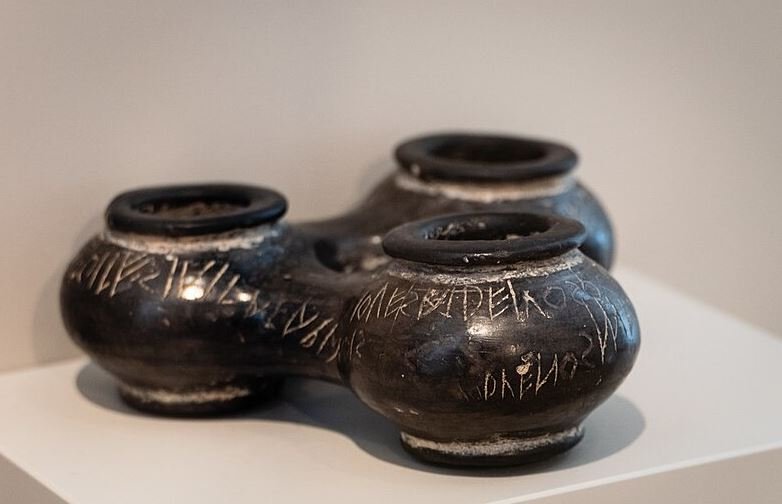
The Duenos Inscription engraved on a kernos vase.
How did the Latin alphabet expand beyond Rome?
Through Roman conquest, European colonialism, and Christian evangelism, the Latin script spread across Europe, the Americas, Africa, and Oceania, becoming the dominant writing system in many regions.
What modifications were made to the Latin alphabet over time?
Letters such as J, U, and W were later introduced, lowercase letters were developed in the Middle Ages, and diacritical marks were added in various languages to represent unique sounds.
Why were Y and Z added to the Latin alphabet?
These letters were incorporated during Rome’s conquest of Greece in the 1st century BCE to accommodate Greek loanwords.
How did the printing press influence the Latin alphabet?
The advent of the printing press in the 15th century standardized letterforms, improved literacy rates, and contributed to consistent spelling and grammatical conventions.
What role did the Latin alphabet play in linguistic standardization?
The Latin script became the basis for many modern writing systems and is used in international phonetic transcription, including the International Phonetic Alphabet (IPA).
How did digital technology impact the Latin alphabet?
The widespread adoption of computers and the internet ensured that the Latin script became universally supported through Unicode, enabling seamless digital communication.
Why is the Latin alphabet the most widely used writing system today?
Its adaptability, simplicity, and historical spread have made it the preferred script for hundreds of languages worldwide, reinforcing its continued global dominance.
FACT CHECK: At World History Edu, we strive for utmost accuracy and objectivity. But if you come across something that doesn’t look right, don’t hesitate to leave a comment below.





