Ancient Languages that Existed before 1000 BCE
The study of ancient languages provides invaluable insights into the early development of human communication, culture, and civilization. Among these, the oldest recorded languages with complete sentences hold a special significance, as they represent some of the earliest instances of structured written expression.
In the compilation below, World History Edu focuses on languages arranged by the age of their oldest existing texts that record complete sentences. The list excludes undeciphered writing systems and inscriptions that consist solely of isolated words or names. It is important to note that the existence of a written record does not imply that the language was not spoken or even written earlier; often, oral traditions or lost manuscripts precede the surviving written evidence.
List of the Oldest Recorded Languages with Complete Sentences

The oldest recorded languages with complete sentences represent significant milestones in the history of human communication and written expression. Image: The Ahiram sarcophagus in its original discovered state.
Sumerian
Oldest Text: Kish Tablet (circa 3100–2900 BCE)
Description:
Sumerian is recognized as one of the earliest known written languages, developed in ancient Mesopotamia. It employed the cuneiform script, a system of wedge-shaped marks made on clay tablets using a stylus.
The Kish Tablet, dating back to approximately 3100–2900 BCE, is among the oldest surviving examples of written Sumerian. This tablet primarily contains administrative records, providing valuable insights into the early use of the language for bureaucratic and economic purposes.
The text on the Kish Tablet includes complete sentences that illustrate the foundational grammar and syntax of Sumerian, highlighting its structured and complex nature even in its nascent stages.

Image: Limestone tablet featuring pictographic script from Kish, Sumer, circa 3500 BC, housed in the Ashmolean Museumin England.
Significance:
Sumerian literature is immensely significant, encompassing a diverse range of genres such as myths, epics, administrative documents, and legal codes. Notably, the “Epic of Gilgamesh,” one of the oldest known literary works, is written in Sumerian.
These literary pieces demonstrate the language’s richness and versatility, enabling the recording of intricate narratives, religious beliefs, and societal norms.
Beyond literature, Sumerian played a crucial role in the administration of one of the world’s first urban civilizations. It facilitated the management of resources, the execution of trade, and the establishment of legal frameworks, underpinning the sophisticated societal structures of ancient Sumer. The complexity of Sumerian language and its extensive use in various aspects of daily life reflect the advanced state of Sumerian civilization.
Additionally, Sumerian cuneiform script laid the groundwork for subsequent writing systems in the region, influencing languages such as Akkadian and Babylonian. The preservation of Sumerian texts through later Akkadian and Babylonian empires underscores its enduring legacy and pivotal role in the development of written communication and record-keeping in human history.
Egyptian Language
Oldest Text: Narmer Palette (circa 3100 BCE)
The Egyptian language, known in its native form as “r n kmt” or “speech of Egypt,” is an extinct member of the Afro-Asiatic language family. It was spoken in ancient Egypt and is primarily understood today through a vast collection of surviving texts. These texts became accessible to modern scholars after the breakthrough decipherment of ancient Egyptian scripts in the early 19th century, most notably the work of Jean-François Champollion on hieroglyphics.

Early hieroglyphic inscriptions on ceremonial palettes like the Narmer Palette include complete sentences that depict royal iconography and historical narratives. Image: The front and back of the Narmer Palette.
Ancient Egyptian is one of the earliest known written languages, with its first records appearing in the hieroglyphic script during the late 4th millennium BCE. This script utilized intricate symbols and pictographs to represent sounds, words, and concepts. Remarkably, Egyptian holds the distinction of being the longest-attested human language, boasting a continuous written record that spans over four millennia.
The classical form of the language, referred to as “Middle Egyptian,” emerged during the Middle Kingdom of Egypt (circa 2055–1650 BCE). Middle Egyptian served as the everyday spoken language during this period and continued to function as the primary literary language well into the Roman era, demonstrating its enduring significance in Egyptian culture and administration.
As time progressed, the spoken form of Egyptian evolved into Demotic by the time of classical antiquity. Demotic was a more simplified script and language used for daily purposes and administrative tasks.
By the Roman period, the language further diversified into various Coptic dialects. Coptic represented the final stage of the Egyptian language, incorporating elements from Greek and other languages.
Although Coptic gradually fell out of everyday use following the Muslim conquest of Egypt, Bohairic Coptic persists as the liturgical language of the Coptic Orthodox Church, preserving a vital link to Egypt’s ancient linguistic heritage.
Elamite
Oldest Text: Anshan Texts (circa 2500 BCE)
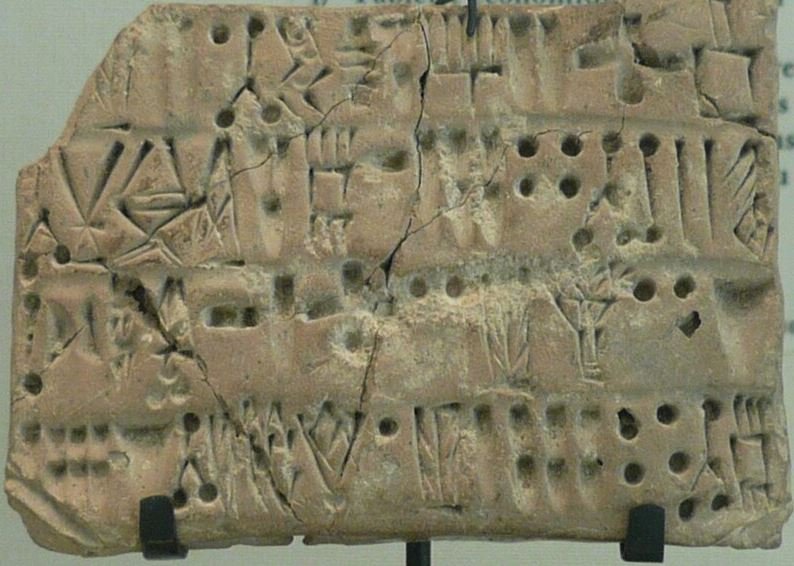
Elamite, written in cuneiform script, includes administrative and legal texts with complete sentences. Elamite texts offer insights into the administration, law, and culture of the Elamite civilization, which interacted closely with Mesopotamian states. Image: Tablet inscribed with Proto-Elamite script.
Elamite, also known as Hatamtite and previously referred to as Scythic, Median, Amardian, Anshanian, and Susian, is an extinct language that was spoken by the ancient Elamite civilization. This language was documented in the region corresponding to present-day southwestern Iran, with records spanning from approximately 2600 BCE to 330 BCE. Elamite is typically considered a language isolate, meaning it has no identifiable relatives, which poses significant challenges for linguists attempting to interpret and understand it.
A considerable number of Elamite words have been identified through the Achaemenid royal inscriptions. These inscriptions are trilingual texts from the Achaemenid Empire era, where Elamite was written using the Elamite cuneiform script around the 5th century BCE. This particular script has been fully deciphered, facilitating a better understanding of the language. In 1987, scholars W. Hinz and H. Koch published the Elamisches Wörterbuch, a crucial dictionary that aids in the study and comprehension of Elamite.
However, another writing system used for Elamite, known as Linear Elamite, remains largely undeciphered. This script dates back to around 2000 BCE and has only recently seen some progress in its interpretation. The elusive nature of Linear Elamite continues to hinder a complete understanding of the language, making Elamite one of the more enigmatic languages of the ancient Near East.
Despite these challenges, ongoing research and discoveries are gradually unveiling more about Elamite, contributing valuable insights into the linguistic and cultural dynamics of ancient Mesopotamia.
Akkadian
Oldest Text: Administrative Tablets from Nippur (circa 2500 BCE)
Akkadian is an extinct East Semitic language that was once spoken across ancient Mesopotamia, including regions such as Akkad, Assyria, Isin, Larsa, Babylonia, and possibly Dilmun. It was in use from the third millennium BCE until it gradually fell out of common usage in favor of Old Aramaic among Assyrians and Babylonians starting in the 8th century BCE.
As the earliest documented Semitic language, Akkadian derives its name from Akkad, a prominent city during the Akkadian Empire (circa 2334–2154 BCE). The language was written using cuneiform script, which was originally developed for Sumerian but adapted to various languages in the region, including Eblaite, Hurrian, Elamite, Old Persian, and Hittite. The close interaction with Sumerian, a prestigious language, significantly influenced Akkadian’s phonology, vocabulary, and syntax, creating a linguistic Sprachbund.
Akkadian names first appear in Sumerian texts around the mid-3rd millennium BCE, with inscriptions intended for East Semitic reading dating to approximately 2600 BCE. Complete Akkadian texts emerged around the 25th century BCE. By the 20th century BCE, Akkadian had split into two main dialects: Assyrian and Babylonian. The majority of Akkadian texts, encompassing religious narratives, legal documents, scientific works, and personal correspondence, date from the Near Eastern Iron Age.
Following the decline of the Akkadian Empire, Akkadian remained the native language of subsequent Mesopotamian empires and became a lingua franca in the Ancient Near East until the Bronze Age collapse around 1150 BCE. Its decline accelerated in the Iron Age when Imperial Aramaic was introduced as the dominant language. By the Hellenistic period, Akkadian was largely restricted to scholarly and religious contexts, with the last known cuneiform document dating to the 1st century CE.
Today, Neo-Aramaic languages spoken by Assyrians and Mandeans retain some Akkadian vocabulary and grammatical structures. Akkadian was a fusional language with grammatical cases and utilized consonantal roots typical of Semitic languages. Notably, the Kültepe texts in Old Assyrian include Hittite loanwords, representing the earliest records of any Indo-European language.
Hittite Language
Oldest Text: Laws of the Hittites (circa 1650 BCE)

Hittite was one of the earliest Indo-European languages to be written, offering valuable information about the legal and administrative practices of the Hittite Empire. Written in cuneiform script on clay tablets, these texts include complete legal sentences outlining laws and regulations. Image: Hittite Cuneiform Tablet.
Hittite, known natively as nešili (“the language of Neša”) or nešumnili (“the language of the people of Neša”), is an extinct Indo-European language that was spoken by the Hittite civilization during the Bronze Age. The Hittites established a significant empire centered in Hattusa, located in present-day Anatolia (modern-day Turkey), and extended their influence into parts of the northern Levant and Upper Mesopotamia.
The Hittite language is one of the earliest documented Indo-European languages, with evidence found in cuneiform inscriptions dating from the 17th century BCE, such as the Anitta text, up to the 13th century BCE. Additionally, Hittite loanwords and numerous personal names appear in Old Assyrian texts as early as the 20th century BCE, marking the earliest recorded use of Indo-European languages.
During the Late Bronze Age, Hittite began to decline in favor of its closely related language, Luwian. By the 13th century BCE, Luwian had become the dominant language in the Hittite capital, Hattusa. Following the collapse of the Hittite New Kingdom amidst the broader Late Bronze Age collapse, Luwian rose to prominence in the Early Iron Age. It became the primary language of the Syro-Hittite states, which were located in southwestern Anatolia and northern Syria, continuing the legacy of the Hittite linguistic and cultural influence in the region.
Hittite’s extensive use in administrative, diplomatic, and literary texts provides valuable insights into the political and social structures of one of the ancient Near East’s most influential civilizations.
Eblaite Language
Eblaite is an extinct East Semitic language that was prominent during the 3rd millennium BCE in Northern Syria. The language derives its name from the ancient city of Ebla, located in what is now western Syria. Variants of Eblaite were also spoken in other significant ancient cities such as Mari and Nagar, indicating its widespread use in the region.
According to the renowned linguist Cyrus H. Gordon, Eblaite likely functioned primarily as a written lingua franca rather than a commonly spoken language. This perspective suggests that while scribes and officials used Eblaite for administrative and diplomatic purposes, everyday communication among the populace may have favored other local languages. Eblaite exhibits features from both East and West Semitic languages, reflecting its role as a bridge language facilitating communication across diverse linguistic groups.
The discovery of Eblaite was made possible through the excavation of numerous cuneiform tablets in the ancient city of Ebla. These tablets provided the first substantial corpus of the language, allowing scholars to study its grammar, vocabulary, and syntax. The tablets reveal that Eblaite was used extensively for record-keeping, trade transactions, and official correspondence, underscoring the city’s significance as a major center of administration and commerce in the ancient Near East.
Eblaite’s unique blend of Semitic linguistic elements offers valuable insights into the interactions and cultural exchanges among early Semitic-speaking civilizations. Despite its extinction around the end of the Bronze Age, the study of Eblaite continues to enhance our understanding of the linguistic and socio-political dynamics of ancient Northern Syria. Ongoing research into the Eblaite tablets promises to further illuminate the complexities of this early Semitic language and its role in shaping the history of the region.

Inscriptions in the Eblaite language discovered at Ebla.
Chinese (Oracle Bone Script)
Oldest Text: Oracle Bone Inscriptions (circa 1200 BCE)
Old Chinese, also referred to as Archaic Chinese in older literature, represents the earliest known stage of the Chinese language and is the precursor to all modern Chinese dialects. The earliest evidence of Old Chinese comes from divinatory inscriptions on oracle bones dating back to around 1250 BCE during the Late Shang dynasty. These inscriptions were followed by numerous bronze inscriptions in the subsequent Zhou dynasty, a period that also saw the emergence of significant literary works such as the Analects, the Mencius, and the Zuo Zhuan. These classical texts became models for Literary Chinese, which remained the standard written form until the early 20th century, thereby preserving the vocabulary and grammar of late Old Chinese.
Old Chinese was written using early forms of Chinese characters, including oracle bone, bronze, and seal scripts. Each character typically corresponded to a single syllable and morpheme. Initially, characters were created using the rebus principle, where similar-sounding words were represented by existing characters. To reduce ambiguity, phono-semantic (xingsheng) characters were later developed by adding semantic radicals. Phonetic information from these characters, especially those in the xiesheng series from the late Shang dynasty, is crucial for reconstructing Old Chinese. Additionally, rhymes from early poems like those in the Classic of Poetry and the Chu Ci provide extensive phonological data.
Old Chinese differed from Middle Chinese by lacking retroflex and palatal sounds, featuring initial consonant clusters, and having voiceless nasals and liquids. It is generally considered to have no tones, although tonal distinctions emerged in Middle Chinese. The language had a rich derivational morphology with various affixes for verb formation and transitivity. While Old Chinese was largely uninflected, it retained some pronoun case and number distinctions during the Shang and early Zhou periods, which faded by the Classical period. Grammatical relationships were primarily indicated through word order and particles.

Early Chinese script found on oracle bones includes complete sentences used for divination purposes. These inscriptions are crucial for understanding the development of Chinese characters and the early history of Chinese civilization. Image: Oracle bone script.
Linear B (Mycenaean Greek)
Oldest Text: Tablets from Knossos and Pylos (circa 1450 BCE)
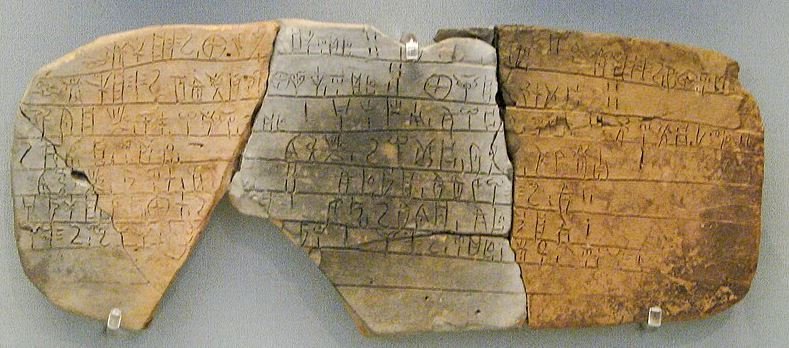
Linear B script records Mycenaean Greek with complete sentences in administrative and economic contexts. Deciphered in the 20th century, Linear B provides evidence of early Greek language and the bureaucratic practices of the Mycenaean civilization.
Mycenaean Greek is the oldest known form of the Greek language, spoken on the Greek mainland and the island of Crete during the Mycenaean civilization, which thrived from the 16th to the 12th centuries BCE. This ancient language is documented through inscriptions written in Linear B, a script that first appeared on Crete before the 14th century BCE. The majority of these inscriptions have been discovered on clay tablets in key archaeological sites such as Knossos in central Crete and Pylos in the southwestern Peloponnese. Additional tablets have been unearthed in Mycenae, Tiryns, Thebes, and Chania in Western Crete, underscoring the widespread use of Mycenaean Greek across these regions.
Named after Mycenae, one of the principal centers of Mycenaean Greece, the language remained undeciphered for many years. It was not until 1952 that Michael Ventris, building on the foundational research of Alice Kober, successfully deciphered Linear B, revealing the structure and vocabulary of Mycenaean Greek.
The content of the Linear B tablets primarily consists of lists and inventories, lacking any surviving prose narratives, myths, or poetry. Despite this limitation, these records provide valuable insights into the administrative practices, economic activities, and daily life of the Mycenaean people, offering a glimpse into the society that existed before the Greek Dark Ages.
Phoenician
Oldest Text: Ahiram Sarcophagus Inscription (circa 1000 BCE)
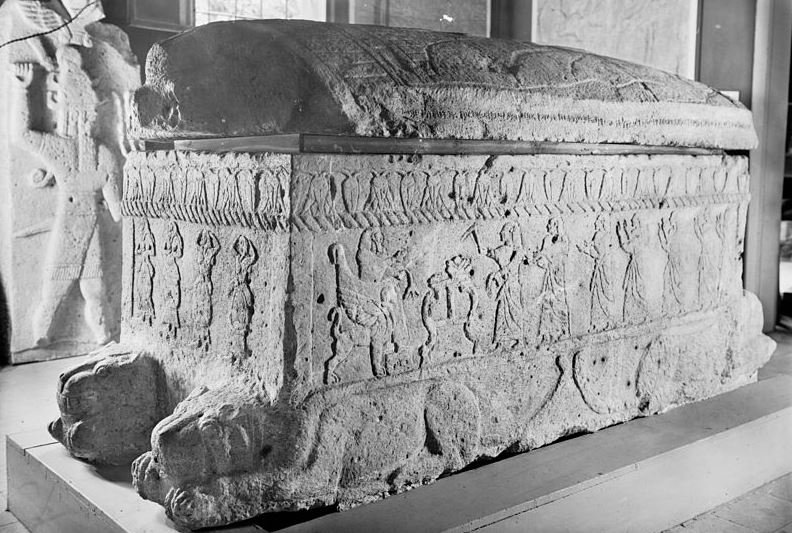
Phoenician inscriptions on tombstones and sarcophagi include complete sentences in an early alphabetic script. The language is significant for its role in the development of the alphabet, which influenced many modern writing systems. Image: Ahiram sarcophagus at Lebanon.
Phoenician is an extinct Semitic language that originated among the Canaanite people, primarily around the ancient cities of Tyre and Sidon in what is now southwestern Iran. Due to the extensive trade networks and commercial dominance of the Phoenicians, especially those from Tyre and Sidon, Phoenician became a widely used lingua franca across the maritime regions of the Mediterranean during the Iron Age. This widespread use facilitated the spread of the Phoenician alphabet to Greece, which eventually influenced the development of all modern European writing systems.
As a member of the Canaanite subgroup of Semitic languages, Phoenician closely resembles Biblical Hebrew and other related languages, particularly in its early stages, allowing for mutual intelligibility. The regions where Phoenician was spoken, referred to by the Phoenicians as Pūt, included the northern Levant areas such as present-day Syria, Lebanon, the Western Galilee, parts of Cyprus, and adjacent areas of Anatolia. Additionally, Phoenician was used in numerous colonies along the southwestern Mediterranean coasts, including modern Tunisia, Morocco, Libya, Algeria, Malta, western Sicily, southwestern Sardinia, the Balearic Islands, and southern Spain.
Phoenician was first deciphered in the 18th century by Jean-Jacques Barthélemy. He identified that the term “Phoenician” was initially coined by Samuel Bochart in his work Geographia Sacra seu Phaleg et Canaan, marking a significant milestone in understanding this influential ancient language.
Significance of Complete Sentences in Ancient Texts
Complete sentences in ancient texts are invaluable for understanding the linguistic structure of extinct languages. They provide clear examples of grammar, syntax, and vocabulary, allowing linguists to analyze and comprehend the language’s rules and evolution over time. This detailed linguistic information is essential for reconstructing how the language functioned and how it changed, offering insights into its complexity and relationship with other languages.
Beyond language, complete sentences offer profound cultural insights. They provide context that enables scholars to uncover details about daily life, administrative practices, religious beliefs, and societal norms of ancient civilizations. By examining these sentences, researchers can piece together aspects of governance, economic transactions, rituals, and social interactions, painting a vivid picture of the culture and its values.
Moreover, complete sentences serve as crucial historical records. They act as primary sources for reconstructing significant historical events, political structures, and economic activities. These texts help historians verify dates, understand power dynamics, and trace the development of societies.
In addition, complete sentences in literary works, such as epics and myths, highlight the narrative and artistic expressions of ancient peoples. They showcase storytelling techniques, moral lessons, and imaginative concepts, enriching our appreciation of ancient literary traditions and their role in shaping cultural identity.
What are some of the challenges in Dating and Interpretation?
Dating and interpreting ancient texts present significant challenges due to the reliance on oral traditions. Many ancient writings originated from oral storytelling, which can preserve linguistic elements for centuries before they are ever transcribed. This temporal gap complicates the accurate dating and interpretation of the language, as the written records may reflect an older stage of the language or incorporate modifications from oral transmission.
Another major challenge is the issue of manuscript copies. The earliest surviving manuscripts are often not the original texts but rather copies of older works that may have been lost over time. This introduces discrepancies in both dating and content, as errors or deliberate changes made during the copying process can distort the original meaning and historical context. Additionally, some ancient scripts remain partially or fully undeciphered, limiting our understanding of certain languages and their complete sentences, which hinders comprehensive linguistic analysis.
Cultural biases further complicate interpretation, as editorial modifications for political or ideological reasons can alter the original content. Distinguishing between authentic historical records and propagandistic narratives becomes difficult, potentially skewing our perception of historical events. Lastly, material degradation affects the preservation of ancient texts. Over time, environmental factors can deteriorate the readability and completeness of manuscripts, obscuring complete sentences and making it challenging to reconstruct the full scope of the original writings.
Conclusion
The oldest recorded languages with complete sentences represent significant milestones in the history of human communication and written expression. These languages not only showcase the ingenuity of early civilizations in developing writing systems but also provide a window into their complex societies, beliefs, and administrative practices.
While challenges such as oral traditions, manuscript copies, and decipherment issues exist, ongoing archaeological discoveries and advances in linguistic analysis continue to enhance our understanding of these ancient languages. Studying these texts enriches our knowledge of linguistic evolution, cultural development, and the interconnectedness of early human societies.
Frequently Asked Questions: Early Writing Systems and Languages
When and where did writing first emerge?
Writing first appeared in the Near East at the beginning of the 3rd millennium BCE, marking the onset of recorded communication in that region.
Which language isolates are attested in the Near East before the Bronze Age collapse?
Before the Bronze Age collapse, the Near East had a limited number of language isolates, including Sumerian, Hattic, and Elamite.
What language family does Hurrian belong to, and where was it spoken?
Hurrian belongs to the small Hurro-Urartian language family and was spoken in parts of the Near East during the early periods of writing.
Which Afro-Asiatic languages were present in the Near East during the early stages of writing?
In the Near East, the Afro-Asiatic languages present during the early stages of writing included Egyptian and Semitic languages.
What Indo-European languages were attested in the Near East before the rise of alphabetic writing?
Before the rise of alphabetic writing, the Indo-European languages attested in the Near East included the Anatolian languages and Mycenaean Greek.
Which language family was represented in East Asia towards the end of the second millennium BCE?
Towards the end of the second millennium BCE, the Sino-Tibetan language family was represented in East Asia by Old Chinese.
What is the Indus script speculated to represent?
The Indus script is speculated to record a language known as the “Harappan language,” although it remains undeciphered.
Which scripts are believed to encode a possible “Minoan language”?
Cretan hieroglyphs and Linear A are believed to encode a possible “Minoan language,” though they have not been fully deciphered.
What are the Jiahu and Vinča symbols considered to be, and why?
The Jiahu symbols and Vinča symbols are considered proto-writing rather than full representations of language because they do not encode complete sentences or structured linguistic information.





