The Nanda Empire
The Nanda Empire stands as a significant chapter in the annals of ancient Indian history. The empire reigned over the Magadha region during the 4th century BCE; although, some historians posit their influence extended into the 5th century BCE.
The Nanda dynasty succeeded the Shaishunaga Dynasty, expanding the empire’s reach and establishing a more centralized administrative framework. Renowned for their immense wealth and military prowess, the Nandas also faced substantial opposition due to their oppressive governance and the humble origins of their rulers.
Their eventual overthrow by Chandragupta Maurya marked the transition to the Maurya Empire, which would further shape the course of Indian civilization.
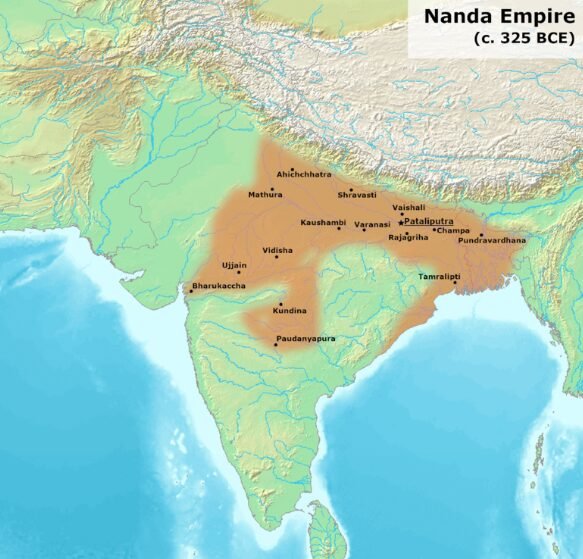
The Nanda Empire occupies a pivotal role in the history of ancient India, bridging the gap between the earlier Magadha dynasties and the rise of the Maurya Empire. Image: Territorial extent of the Nanda Empire in the 4th century BCE.
Origins and Ascendancy
The origins of the Nanda Dynasty are enveloped in both historical records and mythological narratives, presenting a complex picture of their rise to power. According to various sources, including Jain and Greco-Roman accounts, the dynasty’s founder emerged from a modest background, often depicted as the son of a barber or a courtesan. This portrayal starkly contrasts with the traditional Kshatriya lineage of other Indian dynasties, highlighting the Nandas’ unique position in the sociopolitical landscape of their time.
Greek historians like Diodorus and Plutarch recount that the Nandas seized power through cunning and possibly violent means, overthrowing the Shaishunaga Dynasty by eliminating the royal family. This narrative is supported by Jain traditions, which describe the founder’s ascent as a series of strategic maneuvers, culminating in the establishment of a dominant empire.
The Buddhist text Mahāvaṃsa refers to the founder as Ugrasena, a leader who rose from a group of robbers to overthrow the Shaishunaga rulers, further reinforcing the image of the Nandas as unconventional rulers who leveraged both military and political acumen to secure their position.
Regnal Period and Chronology
The precise duration of the Nanda Dynasty’s rule remains a subject of scholarly debate due to inconsistencies among ancient texts. The Matsya Purana attributes an 88-year reign to the first Nanda king, while the Vayu Purana suggests a total of 40 years for the dynasty. Modern historians, such as Irfan Habib and Vivekanand Jha, estimate the Nandas’ rule from approximately 344 BCE to 322 BCE, based on Sri Lankan Buddhist traditions that record a 22-year period. Other theories, supported by astronomical data and inscriptions like the Hathigumpha, propose earlier dates extending into the 5th century BCE.
Despite these variations, it is widely accepted that the Nanda Dynasty governed for several generations, with some traditions citing up to nine kings. Greek accounts, however, typically mention only a single Nanda ruler, Agrammes or Xandrames, who was contemporary with Alexander the Great.
Imperial Extent and Administration
Under the Nandas, the Magadha Empire reached new heights of territorial expansion and administrative sophistication. The empire’s capital, Pataliputra (modern-day Patna), served as the political and economic hub, strategically situated at the confluence of the Ganges and Son rivers. This prime location facilitated trade, communication, and defense, contributing to the empire’s stability and prosperity.
The reign of the Nanda Dynasty was marked by significant territorial expansion, administrative centralization, and economic prosperity, alongside widespread unpopularity due to oppressive governance and the humble origins of their rulers.
The Nandas expanded their territory from the Punjab region in the west to Odisha in the east, encompassing significant areas of the Ganges valley and possibly parts of Central India, including Avanti. Their military campaigns subdued various regional kingdoms, including the Maithalas, Kasheyas, Ikshvakus, Panchalas, Shurasenas, Kurus, Haihayas, Vitihotras, Kalingas, and Ashmakas. This extensive control over diverse regions necessitated a robust administrative framework, which the Nandas developed by building upon the foundations laid by their predecessors, the Haryanka and Shaishunaga dynasties.
The Nanda administration is characterized by a centralized governance model, marked by efficient taxation systems and the introduction of standardized currency. These measures not only facilitated economic growth but also ensured the effective mobilization of resources for both administrative purposes and military endeavors. The Puranic texts describe the Nanda king as an “ekarat” or single ruler, suggesting an integrated monarchy that managed to maintain control over a vast and diverse empire.
Military Prowess and Conflicts
The Nanda Dynasty is renowned for its formidable military strength, which played a crucial role in both their rise and maintenance of power. Ancient Greek accounts, although likely exaggerated, describe the Nandas as possessing a vast army, including hundreds of thousands of infantry, tens of thousands of cavalry, and thousands of war elephants and chariots. While these numbers are improbable, they reflect the Nandas’ reputation as a powerful military force in the ancient world.
The most notable military encounter involving the Nandas was their confrontation with Alexander the Great. In 326 BCE, as Alexander advanced into the Punjab region, he encountered the Nanda forces led by King Dhana Nanda. Despite the Nandas’ reputed military might, Alexander’s campaign in India was cut short by the mutiny of his troops at the Hyphasis River (now the Beas River). The soldiers, exhausted from prolonged campaigning and intimidated by the prospect of facing the formidable Nanda army, refused to march further east, forcing Alexander to retreat.
Wealth and Economic Policies
The Nandas are often credited with amassing immense wealth, a testament to their effective economic policies and administrative innovations. Ancient texts, including the Mahavamsa and Tamil poetry, highlight the dynasty’s opulence, describing vast treasure hoards and sophisticated economic management. The introduction of new coinage and standardized measures facilitated trade and taxation, contributing significantly to the empire’s wealth.
The Nandas’ economic policies likely included the establishment of efficient tax systems that collected revenues from various sources, including agriculture, trade, and natural resources. This wealth enabled the dynasty to sustain a large military and invest in infrastructure projects, such as canals and roads, which further enhanced economic productivity and connectivity within the empire.
Administration and Governance
The Nanda administration represents a significant advancement in the governance structures of ancient India. By centralizing authority and standardizing administrative practices, the Nandas created a cohesive and efficient state apparatus capable of managing a vast and diverse empire. The integration of local governance with centralized control allowed for both effective administration and the accommodation of regional diversities.
Greek accounts suggest a federated system of governance in the frontier regions, where local aristocracies maintained a degree of autonomy under the overarching authority of the Nanda ruler. This hybrid model of administration ensured stability while allowing for flexibility in managing different regions with varying cultural and political landscapes.
Ministers and Intellectual Contributions
The Nanda Dynasty is also noted for its contributions to intellectual and administrative advancements. Jain traditions highlight the role of ministers like Kalpaka, who advocated for expansionist policies, demonstrating the dynasty’s strategic governance. The period saw the presence of notable scholars and grammarians, such as Panini and Katyayana, who made significant contributions to Sanskrit grammar and linguistics. These intellectual advancements reflect the dynasty’s support for scholarly pursuits and the flourishing of cultural and educational activities during their reign.
Religious Patronage and Cultural Impact
The Nandas were patrons of religions that emerged from the Greater Magadha region, particularly Jainism and Ajivikism. Their reign coincided with the second urbanization of India, a period marked by the rise of new religious and philosophical movements. While the Nandas did not actively engage in converting their subjects, their support for religious institutions and intellectual discourse facilitated the growth and spread of these religions.
The decline in Brahmanical patronage during the Nanda period allowed Jainism and Buddhism to flourish, contributing to significant cultural and religious transformations in ancient India. This shift in religious patronage not only influenced the spiritual landscape but also paved the way for the subsequent Maurya Empire to continue supporting and expanding these religious traditions.
Architectural and Urban Development
Under the Nandas, significant advancements were made in architecture and urban planning, particularly in their capital city, Pataliputra. Archaeological discoveries, such as the fragments of the Pataliputra arch, suggest that the Nandas invested in monumental architecture, which served both symbolic and practical purposes. These structures showcased the dynasty’s wealth and power while facilitating the functioning of the administrative machinery.
Urban planning under the Nandas likely included the development of infrastructure like roads, canals, and public buildings, enhancing the empire’s connectivity and economic efficiency. The strategic location and well-planned layout of Pataliputra reflect the administrative sophistication and the emphasis on creating a thriving urban center.
The Nanda Era and Chronological Framework
The Nanda period is marked by the establishment of a distinct chronological framework, as evidenced by references to the Nanda era in various inscriptions and historical records. The Hathigumpha inscription of King Kharavela, for instance, mentions the construction of a canal during the 103rd year of the Nanda period. Additionally, astronomical calculations and interpretations of inscriptions like those at Kuntala suggest that the Nanda era was a significant chronological marker used for administrative and historical purposes.
Despite the existence of these references, establishing an exact chronology remains challenging due to the limited and sometimes contradictory sources. Nevertheless, the recognition of the Nanda era underscores the dynasty’s importance in the historical timeline of ancient India.
Decline and Overthrow
The Nanda Dynasty’s decline is attributed to widespread unpopularity among their subjects, stemming from oppressive taxation, excessive wealth accumulation, and the low social standing of the dynasty’s rulers. Ancient Greek and Buddhist sources consistently portray the Nandas as despised rulers, which created an environment ripe for rebellion.
Chandragupta Maurya, guided by his mentor Chanakya, capitalized on this discontent to overthrow the Nandas and establish the Maurya Empire. According to various accounts, including those from the Buddhist text Milinda Panha, the overthrow involved significant conflict, characterized by massive military engagements and the slaughter of vast numbers of soldiers and elephants. While these accounts likely exaggerate the scale of the conflict, they highlight the violent nature of the transition of power.
Legacy and Impact
The legacy of the Nanda Dynasty is profound, laying the groundwork for the Maurya Empire, which would become one of ancient India’s most powerful and influential states. The Nandas’ centralized administration, economic policies, and military strength set a precedent for effective governance and imperial expansion. Their contributions to intellectual and cultural developments also had lasting impacts, fostering an environment where scholarship and religious thought could flourish.
Moreover, the Nandas’ ability to manage a vast and diverse empire demonstrated the potential of unified governance in ancient India, influencing subsequent dynasties and shaping the political landscape of the region. Their support for religions like Jainism and Ajivikism contributed to significant cultural and religious transformations, which continued to evolve under the Mauryas and beyond.





