The Pythagorean Theorem: History & Facts
The Pythagorean Theorem is one of the most well-known mathematical principles in geometry. It asserts that in a right-angled triangle, the square of the length of the hypotenuse (the side opposite the right angle) is equal to the sum of the squares of the lengths of the other two sides.
This theorem is fundamental in mathematics and has far-reaching implications in various disciplines. However, when framed as “The Way of Truth,” the theorem invites a deeper exploration, not just of its geometric and algebraic significance, but also of its philosophical and historical dimensions.
The Mathematical Foundation

At its core, the Pythagorean Theorem is an equation:
a2+b2=c2
where a and b are the lengths of the two legs of a right triangle, and c is the length of the hypotenuse. This relationship holds in all right-angled triangles and forms the basis of much of trigonometry, calculus, and even physics.
A Geometrical Understanding
The theorem can be visualized geometrically. Imagine a square built on each side of a right triangle. The areas of the squares on the two shorter sides sum up to exactly the area of the square built on the hypotenuse. This simple yet powerful relationship between the sides of a triangle is one of the first major revelations in geometry that demonstrates the interconnectedness of shapes and numbers.
The geometrical proof of the Pythagorean Theorem has many variations, some dating back to ancient civilizations. One famous proof, attributed to Pythagoras himself, uses rearrangements of areas, while later mathematicians and thinkers have devised more sophisticated approaches, including algebraic proofs, coordinate geometry proofs, and even proofs using differential equations.
The Historical Context

A 1913 illustration depicts Pythagoras teaching women, reflecting that many prominent members of his school were women, and some scholars believe he advocated for teaching philosophy to both women and men.
The theorem is named after the ancient Greek philosopher and mathematician Pythagoras of Samos, though its discovery predates him by centuries. Evidence suggests that the Babylonians, Egyptians, and Chinese were aware of this relationship long before Pythagoras.
For example, in ancient Mesopotamia, clay tablets dating back to 1800 BCE contain calculations that align with the Pythagorean Theorem. The ancient Egyptians used a 3-4-5 triangle to create right angles for construction projects, including the pyramids.
Despite the theorem’s historical origins, Pythagoras and his followers, known as the Pythagoreans, were the first to systematize the knowledge and incorporate it into their broader philosophical and spiritual worldview. For Pythagoras, mathematics was not just a tool for measuring and understanding the physical world; it was a path to understanding the underlying order of the universe.
READ MORE: Most Famous Ancient Greek Philosophers
Pythagorean Philosophy: The Way of Truth
For Pythagoras and his followers, mathematics and geometry were closely tied to philosophy, ethics, and spirituality. They believed that numbers were the building blocks of the universe and that the relationships between numbers revealed deep truths about existence. The Pythagorean Theorem, in this context, was more than a geometrical fact; it was a symbol of the harmony and order of the cosmos.
The Pythagoreans held that reality could be understood through the study of numbers and proportions. They believed that everything in the universe, from the movement of celestial bodies to the structure of music, followed mathematical laws. The concept of harmony was central to their philosophy, and they saw mathematical relationships, such as those found in the Pythagorean Theorem, as expressions of universal harmony.
For the Pythagoreans, the theorem was a “way of truth” because it demonstrated the rational order of the universe. They saw it as a perfect example of how abstract mathematical principles could explain real-world phenomena. In this sense, the theorem transcended its mathematical origins and became a symbol of the Pythagorean worldview, where truth, beauty, and harmony were inseparable.
Proving the Theorem: Rational and Empirical Approaches
The Pythagorean Theorem, like many mathematical truths, can be proven in various ways. These proofs fall into two main categories: geometric proofs and algebraic proofs. Each approach offers a different perspective on the theorem and illustrates the versatility and depth of mathematical reasoning.
Geometric Proofs
One of the simplest and most intuitive proofs of the Pythagorean Theorem is a geometric one, attributed to Pythagoras. Consider a large square with side length ccc, inside of which four identical right triangles are arranged. The empty space in the middle forms a smaller square with side length a−ba – ba−b. By calculating the area of the large square in two different ways—first as the area of the entire figure, and second as the sum of the areas of the triangles and the smaller square—one arrives at the equation a2+b2=c2a^2 + b^2 = c^2a2+b2=c2.
Another famous geometric proof, often attributed to President James Garfield, involves constructing a trapezoid and using the properties of triangles to derive the theorem. These proofs highlight the elegance and simplicity of geometric reasoning.
Algebraic Proofs
Algebraic proofs of the Pythagorean Theorem use the properties of algebraic equations to establish the relationship between the sides of a right triangle. One common method is to place the triangle on a coordinate plane and use the distance formula, which is derived from the theorem itself, to show that the relationship holds.
These algebraic approaches not only confirm the truth of the theorem but also extend its applications. For example, the theorem plays a crucial role in the distance formula, which is used in analytic geometry to find the distance between two points in a coordinate plane. This algebraic perspective demonstrates how the Pythagorean Theorem serves as a bridge between geometry and algebra.
The Broader Implications of the Pythagorean Theorem
The Pythagorean Theorem is not just a theoretical result; it has practical applications in a wide range of fields, from architecture and engineering to computer science and physics.
In Architecture and Engineering
The theorem is fundamental in the design and construction of buildings, bridges, and other structures. Architects and engineers use it to calculate distances, angles, and slopes, ensuring that structures are built with precision and stability. The theorem is especially important in determining the proper alignment of right angles, which are essential for constructing strong and balanced buildings.
In Physics and Astronomy
The Pythagorean Theorem is also crucial in physics, particularly in the study of vectors, forces, and motion. For example, when calculating the resultant of two perpendicular forces, the theorem provides a straightforward way to determine the magnitude of the resultant vector. In astronomy, the theorem is used to calculate distances between celestial bodies and to understand the geometry of space.
In Computer Science and Digital Graphics
In the realm of computer science, the Pythagorean Theorem is applied in algorithms that involve spatial reasoning, such as pathfinding algorithms and computer graphics. In digital graphics, the theorem is used to calculate pixel distances and render images with accurate proportions. The concept of distance in multi-dimensional spaces, a generalization of the Pythagorean Theorem, is fundamental in many algorithms used in machine learning and data science.
Philosophical Reflections: The Way of Truth
In a philosophical context, the Pythagorean Theorem serves as a metaphor for the search for truth and understanding. The Pythagoreans believed that mathematical truths were eternal and unchanging, reflecting the deeper nature of reality. In this sense, the theorem represents a “way of truth” because it provides a reliable and objective way to understand the world.
The notion that mathematical principles can reveal fundamental truths about the universe has been a central theme in the history of philosophy and science. Plato, for example, was deeply influenced by Pythagorean thought, and he incorporated many of their ideas into his own philosophy. In Plato’s view, the world of forms—abstract, perfect entities—was more real than the physical world, and mathematics was the key to understanding this higher reality.
The Pythagorean Theorem, then, is not just a mathematical statement; it is a symbol of the rational order of the universe. It reflects the belief that the world can be understood through reason and that truth is not arbitrary but follows clear, logical principles.
The Legacy of the Pythagorean Theorem
The legacy of the Pythagorean Theorem extends far beyond the realm of mathematics. It has influenced the development of science, philosophy, and art, shaping the way we understand the world and our place in it.
In Art and Music
The Pythagoreans believed that music and mathematics were intimately connected. They discovered that the harmonic intervals in music—such as the octave, fifth, and fourth—corresponded to simple ratios of whole numbers. This insight led to the development of the field of musical theory and influenced the way music was composed and understood for centuries.
In art, the Pythagorean emphasis on proportion and harmony influenced the development of classical architecture and sculpture. The use of the golden ratio, a mathematical relationship closely related to the Pythagorean Theorem, became a guiding principle in the design of many famous works of art and architecture, from the Parthenon in Athens to the paintings of Leonardo da Vinci.
In Modern Science
The Pythagorean Theorem continues to play a vital role in modern science. In the theory of relativity, for example, the concept of spacetime involves a generalization of the theorem to four dimensions. In quantum mechanics, the relationships between different wavefunctions can be understood in terms of generalized versions of the theorem. The theorem’s influence extends to the deepest levels of physical reality, from the structure of atoms to the curvature of space.
Conclusion
The Pythagorean Theorem represents not only a mathematical truth but also a philosophical and spiritual insight into the nature of reality. For the Pythagoreans, the theorem was a manifestation of the harmony and order of the cosmos, a “way of truth” that revealed the underlying structure of the universe.
Today, the Pythagorean Theorem continues to be a cornerstone of mathematics and science, with applications in fields ranging from architecture and engineering to physics and computer science. Its enduring significance lies in its simplicity, elegance, and universality, reminding us that the search for truth is not only a mathematical endeavor but also a profound philosophical quest.
Questions and Answers

Pythagoras (c. 569-475 BCE) is often considered the world’s first mathematician. Image: Bust of Pythagoras of Samos in the Capitoline Museums, Rome
Where was Pythagoras born?
Pythagoras was born on the island of Samos around 569 BCE.
Under which philosophers is Pythagoras believed to have studied?
Pythagoras is believed to have studied under Thales and Anaximander, two of the earliest Western philosophers.
What did Pythagoras believe about numbers?
Pythagoras believed that numbers were not only a pathway to truth but were truth itself. He thought that through mathematics, one could achieve harmony and lead a better life.
What is Pythagoras’s most famous contribution to mathematics?
Pythagoras’s most famous contribution is the Pythagorean Theorem, which states that in a right-angled triangle, the square of the hypotenuse is equal to the sum of the squares of the other two sides.
Historians have noted that Pythagoras worked very hard at the arithmetical side of geometry and explored the problem of finding triangles where the square on one side equals the sum of the squares on the other two sides. He reportedly used stones arranged in rows to illustrate the truths he was investigating.
What is the formula for the Pythagorean Theorem?
The formula for the Pythagorean Theorem is a2+b2=c2a^2 + b^2 = c^2a2+b2=c2, where aaa and bbb are the two shorter sides of a right-angled triangle, and ccc is the hypotenuse (the longest side).
How does the Pythagorean Theorem apply to a triangle where a=3a = 3a=3 and b=4b = 4b=4?
For a triangle where a=3a = 3a=3 and b=4b = 4b=4, the hypotenuse ccc can be calculated as follows:
32+42=c2⇒9+16=25⇒c=53^2 + 4^2 = c^2 \quad \Rightarrow \quad 9 + 16 = 25 \quad \Rightarrow \quad c = 532+42=c2⇒9+16=25⇒c=5
Thus, c=5c = 5c=5.
How did Euclid prove the Pythagorean Theorem?

Euclid’s textbook the Elements was the standard teaching mathematics book, particularly for geometry, for more than two millennia.
The most well-known proof of the Pythagorean Theorem is provided by Euclid in his Elements, Book I.
Euclid’s proof involves dividing a right-angled triangle into smaller geometric shapes and comparing their areas. He demonstrated that the sum of the areas of the squares on the two shorter sides is equal to the area of the square on the hypotenuse.

For more than two millennia, Euclid’s Elements was also a standard for deductive reasoning and geometric instruction.
What is a simpler proof of the Pythagorean Theorem?
A simpler proof involves dividing a rectangle into three right-angled triangles. By comparing the sides of these triangles and performing calculations, the relationship a2+b2=c2a^2 + b^2 = c^2a2+b2=c2 is reaffirmed.
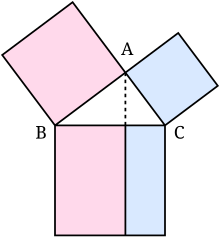
Illustration of Euclid’s proof of the Pythagorean theorem
Why is each element of the Pythagorean Theorem important?
Each element of the Pythagorean Theorem is important because it helps determine other sides or angles in a triangle, demonstrating how mathematical truth can be objectively known and proven.
What was Pythagoras’s ultimate goal in his work with mathematics?
Pythagoras’s ultimate goal was to show that truth, as expressed through numbers, could be understood and verified. The Pythagorean Theorem is one of his enduring contributions to the pursuit of objective truth through mathematics.