The Rise and Fall of Aztec and Mayan Society
The rise and fall of the Aztec and Mayan civilizations are among the most fascinating episodes in the history of Mesoamerica, showcasing the development of highly complex societies long before European colonization. Both civilizations achieved remarkable advances in architecture, art, astronomy, mathematics, agriculture, and governance. However, their decline came through different circumstances, from internal challenges to external conquests.
Below, World History Edu delves into the rise and fall of both societies in detail, exploring their political structures, cultural achievements, and the factors that led to their collapse.
The Rise of the Mayan Civilization
The Mayan civilization emerged as one of the most sophisticated pre-Columbian cultures in the Americas. It flourished primarily in the region that now encompasses southeastern Mexico, Guatemala, Belize, Honduras, and El Salvador. The Maya civilization began to take shape during the Preclassic period (c. 2000 BCE – 250 CE), with villages transitioning from simple agrarian communities to complex city-states with monumental architecture.
Early Development and the Preclassic Period (c. 2000 BCE – 250 CE)
The Preclassic period saw the formation of the foundations of Mayan society. The earliest settlements were small villages that relied on maize-based agriculture, and as farming techniques improved, the population grew. During this time, Mayan communities began to organize into larger political entities, leading to the construction of ceremonial centers and pyramidal structures. The Maya also developed hieroglyphic writing, which became one of the most advanced writing systems in the ancient Americas.
Key early cities such as Nakbé and El Mirador in present-day Guatemala became centers of political and religious power. These cities had massive pyramids and plazas that foreshadowed the grandeur of later Mayan cities.
The Classic Period (c. 250 CE – 900 CE): The Golden Age of the Maya
The Classic period marked the height of the Mayan civilization. During this time, the Maya built many of the impressive cities we associate with their culture, including Tikal, Palenque, Copán, and Calakmul. These cities were independent city-states, each ruled by a king (known as an “ajaw”) who claimed divine descent.
The Maya developed a sophisticated society during this period, characterized by remarkable achievements in architecture, mathematics, and astronomy. They constructed towering pyramids, palaces, and ball courts, with the Temple of the Giant Jaguar in Tikal and the Temple of the Inscriptions in Palenque being notable examples of their architectural prowess. The Maya also devised a complex calendar system based on their astronomical observations, which included the famous Long Count calendar, and they made significant advances in mathematics, including the concept of zero.
The Mayan social structure was hierarchical, with the king at the top, followed by nobles, priests, artisans, and farmers. Religion was central to Mayan life, with the belief that the gods controlled natural and celestial events. Mayan kings were seen as intermediaries between the gods and their people, and elaborate rituals, including human sacrifice, were performed to appease the gods.
Trade networks extended across Mesoamerica, allowing the Maya to obtain luxury goods such as jade, obsidian, and exotic feathers. The interconnection between the cities fostered both competition and alliances, with city-states often engaging in warfare to expand their influence.
The Decline of the Maya
The decline of the Classic Maya civilization is one of the great mysteries of pre-Columbian history. By the 9th century CE, many of the major cities in the southern lowlands had been abandoned, marking the end of the Classic period. Several factors likely contributed to the decline, including environmental degradation, overpopulation, prolonged droughts, internal political strife, and warfare.
One prominent theory suggests that deforestation and intensive agriculture may have led to soil exhaustion and ecological collapse. Additionally, climate data points to a series of severe droughts in the 9th century, which would have disrupted the agricultural base that supported the large urban populations.
Warfare between city-states may have exacerbated these problems, as competing rulers sought to dominate one another, draining resources and destabilizing regions. The collapse was not uniform, as northern cities like Chichen Itza continued to thrive for several more centuries, but the political fragmentation and urban abandonment in the southern lowlands marked the end of the Classic Maya civilization.
Despite this collapse, Maya culture and people persisted. Smaller settlements and regions in the northern Yucatán Peninsula, such as Uxmal and Mayapán, remained influential during the Postclassic period (c. 900 CE – 1500 CE). Even after the arrival of the Spanish in the 16th century, the Maya continued to resist colonization, maintaining their cultural identity to this day.
The Rise of the Aztec Empire
The Aztec Empire, known for its central city of Tenochtitlan, rose to prominence much later than the Maya, during the Postclassic period of Mesoamerican history (c. 900 CE – 1500 CE). The Aztecs, or Mexica, were a Nahuatl-speaking people who migrated into the Valley of Mexico from the north around the 13th century. Initially a small and relatively insignificant tribe, the Aztecs eventually built one of the most powerful empires in the Americas by the early 16th century.
Early Development and the Founding of Tenochtitlan (c. 1200 CE – 1325 CE)
According to Aztec legend, their ancestors came from a mythical land called Aztlán, and they were guided by their god Huitzilopochtli to settle on an island in the middle of Lake Texcoco. This site became the city of Tenochtitlan, founded in 1325 CE. The Aztecs initially lived as vassals under more powerful city-states in the region, such as the Tepanecs, but they steadily grew in power.
Tenochtitlan’s strategic location on the island gave the Aztecs a defensive advantage and allowed them to develop sophisticated agricultural techniques, including chinampas, or floating gardens, which increased their food production.
The Triple Alliance and the Formation of the Empire (c. 1428 CE)
The turning point in the rise of the Aztecs came in 1428 when they formed the Triple Alliance with the city-states of Texcoco and Tlacopan, defeating their former overlords, the Tepanecs. This victory marked the beginning of the Aztec Empire. The three cities dominated the Valley of Mexico, with Tenochtitlan emerging as the dominant partner.
Under successive rulers, the Aztecs expanded their empire through military conquest and diplomacy. They imposed tribute on conquered peoples, extracting wealth in the form of food, textiles, precious metals, and labor. This tribute system allowed Tenochtitlan to grow into a bustling metropolis, home to an estimated 200,000 people at its height.
Aztec society was highly stratified, with a ruling class of nobles and priests at the top, followed by warriors, artisans, and commoners. Religion played a central role in Aztec life, with the sun god Huitzilopochtli and the rain god Tlaloc among the most important deities. The Aztecs believed that the gods needed regular nourishment in the form of human blood to keep the universe in balance, leading to frequent rituals of human sacrifice.
The empire’s military power was crucial to its expansion. Aztec warriors were highly trained and motivated, driven by a combination of religious duty and the promise of social advancement. Successful warriors could rise in status, while those captured in battle often became sacrificial victims.
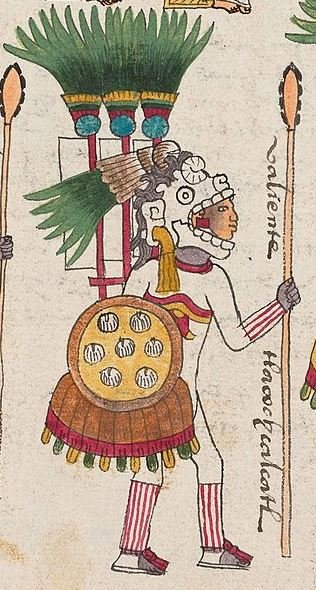
Image: An drawing depicting an Aztec soldier.
The Fall of the Aztec Empire
The fall of the Aztec Empire came swiftly and dramatically, primarily due to the arrival of Spanish conquistadors led by Hernán Cortés in 1519. Several factors contributed to the empire’s collapse, including internal strife, the strategic alliances Cortés forged with indigenous peoples hostile to the Aztecs, and the devastating impact of European diseases.

Hernán Cortés and the Conquest of Tenochtitlan (1519–1521)

Cortés regrouped, returned in 1521, and besieged Tenochtitlan with allies. Image: Cortés.
When Cortés and his men arrived in Mexico, they quickly recognized the discontent among the many city-states and peoples under Aztec rule. The Aztecs had maintained control through a combination of military might and heavy tribute demands, which left many subject peoples resentful. Cortés skillfully exploited these divisions, forming alliances with groups such as the Tlaxcalans, who provided crucial support in his campaign against the Aztecs.
Initially, the Aztec emperor Moctezuma II welcomed Cortés into Tenochtitlan, possibly believing that the Spaniards were divine or semi-divine figures foretold in prophecy. However, tensions quickly escalated, and after months of uneasy coexistence, the Spanish took Moctezuma hostage. This led to a series of violent confrontations between the Aztecs and the Spaniards, culminating in the Noche Triste (the “Night of Sorrows”) in 1520, when the Spaniards fled the city with heavy losses.
Despite this setback, Cortés regrouped and returned to lay siege to Tenochtitlan in 1521, with the support of thousands of indigenous allies. The siege lasted for several months, during which the city’s population was devastated by famine, disease, and the relentless assault. The arrival of smallpox, introduced by the Europeans, decimated the Aztec population, weakening their ability to resist. By August 1521, Tenochtitlan had fallen, and with it, the Aztec Empire came to an end.

Comparing the Mayan and Aztec Civilizations
Though both the Maya and the Aztecs built complex and influential civilizations, their societies were quite different in terms of structure, longevity, and the causes of their collapse.
- Political Organization: The Maya civilization was made up of independent city-states, each with its own ruler and often competing with one another. The lack of a centralized empire made the Maya more decentralized compared to the Aztecs, who built a vast and unified empire ruled from Tenochtitlan. The Aztec empire was more hierarchical, with a clear tribute system and a single dominant power.
- Religion and Sacrifice: Both the Maya and Aztecs practiced human sacrifice, but the scale and purpose differed. The Aztecs, especially, believed that human blood was essential to sustain the gods and maintain cosmic order, leading to large-scale sacrifices. The Maya also performed sacrifices but placed a stronger emphasis on ritualistic ceremonies and divination.
- Economy and Agriculture: The Maya relied heavily on maize agriculture, and their cities were supported by an extensive network of trade routes. They cultivated cacao, maize, beans, and squash, with trade playing a key role in their economy. The Aztecs developed chinampas, or floating gardens, to maximize agricultural productivity around Lake Texcoco, which supported the large population of Tenochtitlan.
- Writing and Mathematics: Both civilizations developed sophisticated writing systems, though the Maya’s was more advanced. The Maya had a fully developed hieroglyphic writing system and made significant contributions to mathematics and astronomy, including the use of zero and the development of a complex calendar system. The Aztecs also had a writing system but it was less developed, relying more on pictographs and symbols.Did you know…?
- The Florentine Codex is a twelve-volume, illustrated, bilingual (Spanish and Nahuatl) work created by the Franciscan friar Bernardino de Sahagún with the help of Indigenous informants. It provides a detailed account of Aztec life, culture, and society, and is one of the most important sources of knowledge about the Aztecs.
- Today, over 6.2 million Maya descendants live in the same areas their ancestors once did, primarily in southeastern Mexico, Guatemala, Belize, and parts of Honduras and El Salvador. They speak more than 28 Mayan languages.
The Legacy of the Maya and Aztecs
Despite their fall, the legacies of both the Maya and the Aztecs endure today. Mayan descendants still live in parts of Mexico, Guatemala, and Belize, where many aspects of traditional Mayan culture, including language, rituals, and art, continue. Similarly, the influence of the Aztecs remains visible in Mexican culture, from the Nahuatl language spoken by millions of people to the iconic imagery of Tenochtitlan on the Mexican flag.
The knowledge, art, and innovations of both civilizations continue to fascinate scholars and inspire admiration for the complex societies that once flourished in Mesoamerica. Through archaeological discoveries and historical study, modern society continues to uncover the depth and richness of these ancient cultures.
Questions and Answers about the Maya Civilization
Where did the Maya civilization develop?
The Maya civilization developed in the region that includes present-day southeastern Mexico, Guatemala, Belize, and parts of Honduras and El Salvador.
When did the early Maya period begin, and what were its key developments?
The early Maya period began before 2000 BCE, during the Archaic era, and saw the development of agriculture and the first villages.
What significant developments occurred during the Preclassic period?
During the Preclassic period (2000 BCE to 250 AD), more complex societies emerged, with the cultivation of staple crops like maize, beans, squash, and chili peppers. The first Maya cities appeared around 750 BC, and by 500 BC, monumental architecture, such as large temples, was being built.
When did the Maya begin using hieroglyphic writing?
The Maya began using hieroglyphic writing by the 3rd century BCE.
What characterized the Classic period of Maya civilization?
The Classic period (250 CE to 900 CE) was characterized by the widespread use of the Long Count calendar, the rise of powerful city-states like Tikal and Calakmul, and complex trade networks. This period also saw influence from the central Mexican city of Teotihuacan in Maya political affairs.

Image: Temple of Kukulcan in Chichen Itza.
What led to the decline of the central Maya region in the 9th century?
The decline of the central Maya region in the 9th century was caused by political collapse, civil wars, social unrest, and the abandonment of major cities, leading to a population shift toward the north.
When did the Maya civilization fall to the Spanish, and what was the last Maya city to fall?
The Maya civilization fell to the Spanish Empire in the 16th century, with the last Maya city, Nojpetén, falling in 1697.
What was the role of the king in Maya society during the Classic period?
The king in Maya society during the Classic period was seen as a divine mediator between the human and supernatural realms. Kingship was usually passed through the male line, and rulers were expected to be successful war leaders and political figures.

How advanced was the Maya writing system?
The Maya writing system was the most advanced in pre-Columbian Americas. It consisted of hieroglyphic writing used to record history and religious practices in screenfold books, stelae, ceramics, and monuments.
What were some of the Maya’s achievements in mathematics and calendars?
The Maya developed a complex calendar system and were among the earliest civilizations to use the concept of zero in their mathematics.
What role did religion play in Maya society?
Religion played a central role in Maya society, with human sacrifice being a key part of their rituals to appease gods and maintain cosmic order.
Questions and Answers about the Aztec Civilization

What language was primarily spoken by the Aztec people?
The Aztec people primarily spoke Nahuatl.
What was the political structure of the Aztec civilization?
The Aztec civilization was organized into city-states known as “altepetl.” Some of these city-states formed alliances or confederations, the most significant being the Aztec Empire, which was a coalition of three city-states: Tenochtitlan, Tetzcoco, and Tlacopan.
What event led to the formation of the Aztec Triple Alliance?
The Aztec Triple Alliance was formed in 1427 when the cities of Tenochtitlan, Tetzcoco, and Tlacopan allied to overthrow the Tepanec empire, which was previously dominated by the city of Azcapotzalco.

Image: The Spanish army, led by Cortés.
Who are the Mexica, and how does the term “Aztec” relate to them?
The Mexica were the people of Tenochtitlan, one of the three cities in the Aztec Triple Alliance. While “Aztec” often refers specifically to the Mexica, the term is also broadly used to describe the Nahua peoples of central Mexico in both pre-Hispanic and early colonial periods.
What were some shared cultural traits between the Aztecs and other Mesoamerican groups?
Some shared traits include maize cultivation, social divisions between nobles (pipiltin) and commoners (macehualtin), a pantheon of gods like Tezcatlipoca, Tlaloc, and Quetzalcoatl, and a complex calendrical system.
How did the Mexica rise to dominate the Aztec Triple Alliance?
The Mexica, who initially settled on islets in Lake Texcoco, rose to dominate the Triple Alliance through a combination of military conquest, trade, installing friendly rulers in client city-states, and forming marriage alliances with ruling families.
How did the Aztec Empire maintain control over its vast territories?
The Aztec Empire maintained control by limiting communication and trade between outlying regions, making them dependent on Tenochtitlan for luxury goods. Client city-states were required to pay taxes to the Aztec emperor, the Huey Tlatoani, and political control was maintained through alliances and imperial ideology.
The Aztec Empire extended as far south as Chiapas and Guatemala, spanning from the Pacific to the Atlantic coasts of Mesoamerica.