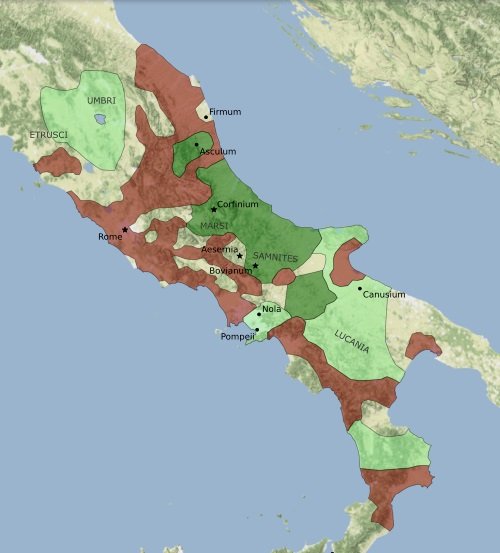
Roman territory is marked in red, with initial insurgent territories in dark green and later ones in light green.
The Social War, also known as the Italian War or Marsic War, was a conflict from 91 to 88 BC between the Roman Republic and several of its autonomous Italian allies (socii). Although largely concluded by 88 BC, some resistance persisted until 87 BC. The war arose due to grievances about Roman dominance and demands for political equality, culminating in significant socio-political changes in the Roman Republic. In the article below, World History Edu explores the war’s causes, events, and consequences.
Background and Pre-War Italy
During the second century BC, the Italian peninsula was dominated by the Roman Republic, supported by allied city-states through bilateral treaties. These treaties guaranteed territorial integrity and internal autonomy in exchange for military support. By the late Republic, allied contingents constituted a significant portion of Rome’s military might, with a ratio of three allied soldiers for every two Romans by 218 BC. However, increasing Roman interference in allied affairs bred resentment.
The Roman allies contributed to military campaigns and expected to share in the rewards of empire, including war spoils and land distributions. However, disputes over public lands and the unequal allocation of resources fueled dissatisfaction. Roman policies, such as the suppression of the Bacchanalia in 186 BC, highlighted the extent of Roman intrusion into allied autonomy.
Italian tribes retained distinct identities, despite gradual Romanisation. Citizenship policies were restrictive; allied soldiers were not granted Roman citizenship after their service, and individuals could not hold dual citizenship. This legal exclusivity maintained Rome’s dominance but alienated the Italian allies.
Causes of the Social War
One prevailing interpretation, supported by Appian’s Civil Wars, frames the allies’ demands as a struggle for Roman citizenship and political equality. Attempts to grant citizenship began as early as 125 BC with Marcus Fulvius Flaccus’ proposal and resurfaced in 91 BC under Marcus Livius Drusus. These efforts failed, intensifying allied grievances.
Henrik Mouritsen and others argue that the allies sought independence rather than citizenship. Allied elites viewed Roman land reforms, initiated by Tiberius Gracchus in 133 BC, as encroachments on their territory. The redistribution of public lands exacerbated tensions, leading to widespread discontent.
The assassination of Marcus Livius Drusus, a proponent of allied enfranchisement, in 91 BC served as a catalyst. Shortly thereafter, violence erupted in Asculum, where Romans were massacred, marking the formal outbreak of war.
The Course of the War
The rebellion began in Asculum and quickly spread across central and southern Italy. The Italian allies, notably the Marsi, Samnites, and others, formed a confederation with Corfinium as their capital. They established a senate and elected consuls, mirroring Roman governance.
Roman forces, initially unprepared, faced significant setbacks. In 90 BC, the consul Publius Rutilius Lupus was killed in battle, though his subordinate, Gaius Marius, achieved a decisive victory near the Fucine Lake. Rome’s strategy involved isolating the rebels into northern and southern sectors, gradually reclaiming lost territory.
By 89 BC, Roman commanders, including Sulla and Pompey Strabo, gained the upper hand. Sulla’s victories in Campania and Samnium were instrumental, while Pompey Strabo’s siege of Asculum ended in the town’s capture. Rome’s offer of citizenship to allies who surrendered, formalized through the lex Julia and subsequent legislation, weakened rebel support.
The war’s conclusion coincided with the First Mithridatic War, diverting Roman resources. By 88 BC, most resistance had been quelled, though remnants persisted in Samnium and Lucania. In 87 BC, amid a Roman civil war, these holdouts negotiated settlements, securing citizenship and ending hostilities.

Bust of Gaius Marius
Consequences of the Social War
The Social War led to the expansion of Roman citizenship across Italy, fundamentally altering the Roman political landscape. New citizens were enrolled in Roman tribes, initially limiting their voting power. Subsequent reforms integrated Italians more fully into Roman governance, though the process spanned decades.
The war devastated central and southern Italy, with widespread destruction of agricultural lands and infrastructure. The financial strain on Rome was immense, as evidenced by unprecedented levels of coinage production to fund military operations.
The conflict’s militarization of Italy and the concentration of power in generals like Sulla set dangerous precedents. Sulla’s eventual march on Rome in 88 BC marked the beginning of a series of civil wars that culminated in the Republic’s collapse.
Historiographical Perspectives
The primary accounts of the Social War, including those by Appian, Livy, and Diodorus Siculus, emphasize the allies’ demands for citizenship. These narratives, written during the imperial period, reflect anachronistic views of Romanisation.
Scholars like Mouritsen challenge the citizenship-centric narrative, arguing for a more nuanced understanding of the war as a struggle against Roman hegemony. Archaeological evidence supports the persistence of regional identities and the limited reach of Roman influence before the war.
Frequently Asked Questions
Why did the Social War start?
The immediate cause was the assassination of Roman officials in Asculum after Marcus Livius Drusus’ failed reform proposals. Underlying causes included demands for citizenship, equality, and autonomy, along with grievances over Roman encroachment on allied lands.
What were the Italian allies fighting for?
Historians debate whether Italians sought Roman citizenship, equality under Roman law, or independence. Some sources emphasize a desire for legal and political rights, while others argue the war aimed to end Roman hegemony.
How was the Social War fought?
The war had two main theaters: the north, centered on Asculum, and the south in Samnium and Campania. Rome eventually isolated and defeated the rebels through military campaigns and granting citizenship to loyal or surrendering allies.
What role did citizenship play in the war?
The promise of citizenship (via the lex Julia and lex Plautia Papiria) was key to weakening the rebellion. Granting citizenship helped integrate Italian communities but also created political tensions over voting rights and tribal assignments.
What were the outcomes of the Social War?
The war led to the extension of Roman citizenship across Italy, transforming autonomous allied communities into municipia. This legal and political unification reshaped Roman Italy but also destabilized the Republic.
How did the Social War impact the Roman Republic?
The conflict militarized Italy, blurred lines between Romans and allies, and set precedents for generals, like Sulla, to seize power. These factors contributed to the Republic’s eventual collapse.