The Third of May 1808: A Painting by Francisco Goya
Francisco Goya’s The Third of May 1808 is a groundbreaking painting that captures the brutal execution of Spanish rebels by Napoleonic troops during the Peninsular War. Completed in 1814, the artwork was commissioned by the Spanish provisional government to commemorate the resistance against French occupation. Along with its companion piece, The Second of May 1808, this painting is renowned for its emotional depth, dramatic composition, and break from traditional artistic conventions. Goya’s work is considered one of the first modern paintings, influencing generations of artists, including Édouard Manet and Pablo Picasso.
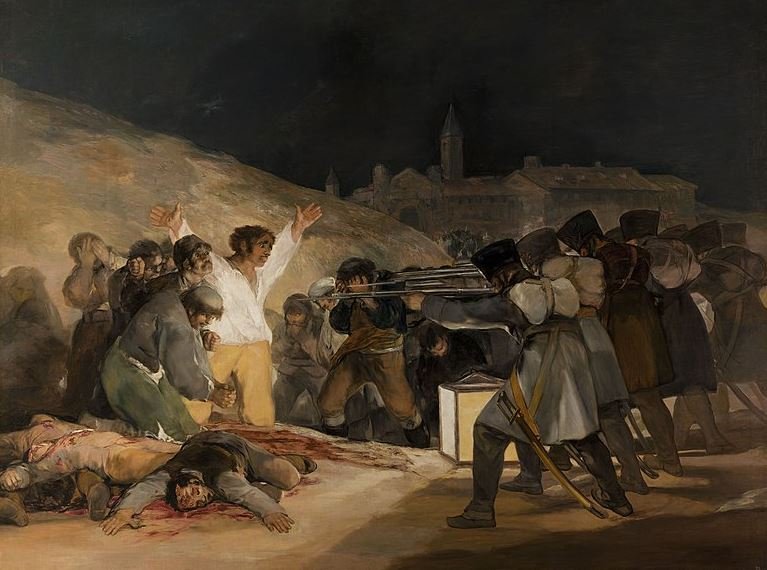
“The Third of May 1808” painting.
Historical Context
In 1808, Napoleon Bonaparte manipulated Spain’s weak leadership to facilitate a French takeover. King Charles IV was coerced into abdicating in favor of Napoleon’s brother, Joseph Bonaparte. The Spanish people, however, resisted foreign rule. On May 2, 1808, an insurrection broke out in Madrid against French occupation, known as the Dos de Mayo Uprising. In retaliation, French forces executed hundreds of Spanish civilians the following day. Goya’s The Second of May 1808 depicts the violent street battle, while The Third of May 1808 portrays the subsequent executions.

Goya’s Perspective and Motivation
Goya, though initially supportive of the French Revolution, became disillusioned with the brutality of war. Despite working as a court painter under both Spanish and French rule, he sympathized with the Spanish resistance. In 1814, after Napoleon’s forces were expelled, Goya proposed a series of paintings to document the events. His request to the Spanish government was approved, leading to the creation of The Third of May 1808 as an unflinching condemnation of war’s horrors.
Composition and Symbolism
The painting is set at night, with a stark contrast between light and shadow. The focal point is a terrified man in a white shirt with arms outstretched, evoking Christ’s crucifixion. His expression of fear and resignation highlights the painting’s emotional impact. The victims, depicted with individuality and raw emotion, contrast sharply with the faceless, mechanical French soldiers. A lantern on the ground illuminates the central figure and intensifies the drama, emphasizing the victim’s martyrdom. The background features a darkened cityscape, adding to the sense of isolation and doom.
By breaking away from traditional war paintings and focusing on the suffering of the innocent, Goya set a precedent for future artists who sought to depict the true horrors of conflict.
Innovations and Departure from Tradition
Goya’s painting diverges from traditional depictions of war, which often glorified heroism. Unlike neoclassical history paintings, The Third of May 1808 lacks idealization. The perspective is deliberately distorted to heighten the sense of chaos, and the brushwork is expressive rather than precise. The immediacy of execution, unposed figures, and emphasis on raw emotion make it a precursor to modern art.
Influence on Later Artists
Goya’s stark portrayal of violence influenced subsequent artists depicting war and oppression. Édouard Manet’s Execution of Emperor Maximilian (1867–1869) echoes The Third of May in its composition and theme of political execution. Similarly, Pablo Picasso’s Guernica (1937) references Goya’s dramatic lighting and emotional intensity in its depiction of the Spanish Civil War. Picasso’s Massacre in Korea (1951) also draws heavily from Goya’s masterpiece.
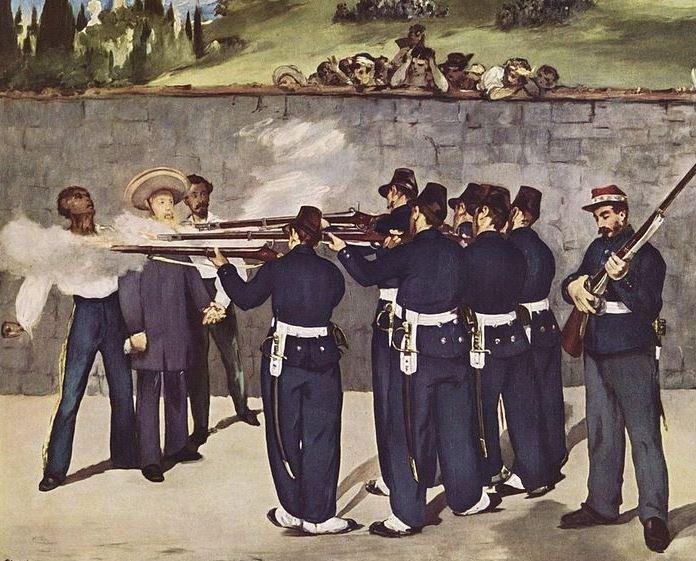
Édouard Manet’s “The Execution of Emperor Maximilian”
The Disasters of War and Related Works
Goya expanded on the themes of The Third of May in his print series The Disasters of War (1810–1820). These etchings depict the brutalities of the Peninsular War, reinforcing the themes of suffering and injustice. Prints like No se puede mirar (One Cannot Look) and Y no hay remedio (And There Is No Remedy) share compositional elements with The Third of May, highlighting the repetitive nature of war atrocities.
Goya’s The Third of May 1808 remains a defining work in the history of Western art. Its stark realism, emotional power, and condemnation of violence continue to resonate.
Interpretations and Critical Reception
Initially overlooked, The Third of May 1808 gained recognition in the mid-19th century. Its raw emotion and anti-war message contrasted with traditional historical paintings, leading to debates about its artistic merit. Some critics pointed to its distorted perspective and lack of refinement as weaknesses, while others praised its revolutionary approach. Today, the painting is regarded as a masterpiece, admired for its ability to evoke empathy and outrage.
Religious and Political Symbolism
The painting incorporates religious iconography, with the central figure resembling a crucified Christ. His stigmata-like wounds reinforce the theme of martyrdom. However, unlike traditional Christian art, where martyrdom signifies spiritual redemption, Goya’s victim faces a senseless, brutal execution. The lantern’s light, often symbolic of divine illumination, here serves only to expose the victims to their killers. This subversion of religious symbolism underscores the painting’s bleak message: war offers no glory, only suffering.
Provenance and Preservation
Despite its historical significance, The Third of May 1808 remained relatively obscure for decades. It was stored away, possibly due to King Ferdinand VII’s reluctance to celebrate popular revolts. The painting eventually entered the Prado Museum’s collection, where it was first publicly cataloged in 1872. During the Spanish Civil War, it was transported for safekeeping, suffering minor damage. In 2008, it underwent restoration to commemorate the bicentennial of the uprising.
Goya’s The Third of May 1808 has been referenced in political discourse, anti-war movements, and visual arts. It was even selected as one of the Prado Museum’s most important paintings for digital preservation in 2009.
Frequently Asked Questions
What is The Third of May 1808 and why is it significant?
It is a painting by Francisco Goya, completed in 1814, depicting the execution of Spanish civilians by French soldiers during the Peninsular War. It is considered one of the first modern paintings, breaking from traditional depictions of war to emphasize raw emotion and brutality.
What historical event does the painting depict?
It portrays the execution of Spanish rebels by Napoleon’s troops on May 3, 1808, as a reprisal for the Dos de Mayo Uprising in Madrid against French occupation.
How does Goya emphasize the emotional intensity of the scene?
He contrasts the rigid, faceless firing squad with the terrified, illuminated victims, particularly a man in white with arms raised in a Christ-like pose, symbolizing martyrdom and innocence.
What artistic influences and innovations does the painting showcase?
While inspired by Christian martyrdom imagery, Goya rejects idealized heroism, using stark realism, dramatic lighting, and asymmetry to heighten the horror and chaos, making it a revolutionary piece.
How does The Third of May 1808 relate to Goya’s The Second of May 1808?
The Second of May depicts the initial uprising against French troops, while The Third of May shows the brutal aftermath, forming a powerful narrative on resistance and repression.
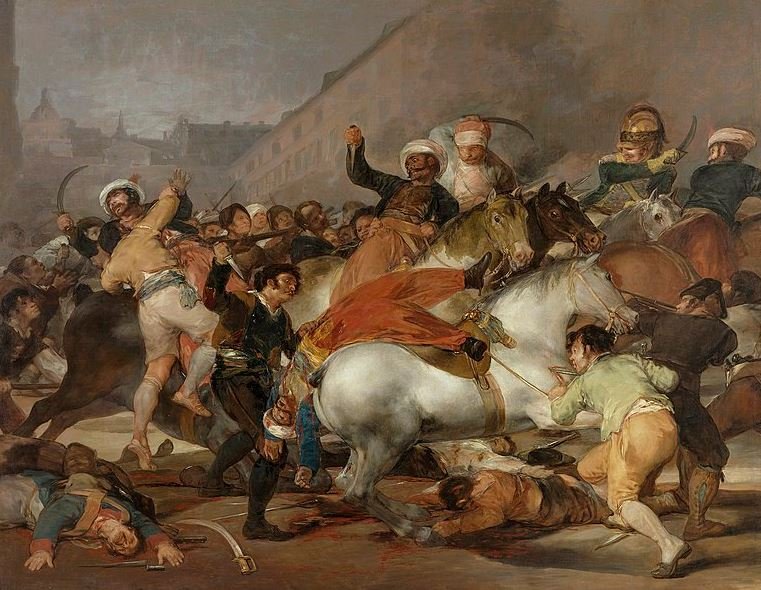
“The Second of May 1808” painting.
What impact did the painting have on later artists?
It influenced works like Édouard Manet’s Execution of Emperor Maximilian, Pablo Picasso’s Guernica, and Massacre in Korea, setting a precedent for anti-war art.
Why was the painting not immediately recognized or displayed?
It was likely suppressed due to Ferdinand VII’s preference for neoclassical art and his reluctance to commemorate revolts. It remained relatively obscure until the mid-19th century.
What broader message does Goya convey through this work?
It critiques the senseless brutality of war, portraying mass execution as a tragic, impersonal cycle rather than a heroic act, shifting the focus from individual sacrifice to collective suffering.





