The Three Kingdoms period (220–280 AD)
The Three Kingdoms period (220–280 AD) followed the collapse of the Han dynasty and was marked by a tripartite division of China into Cao Wei, Shu Han, and Eastern Wu. The era began with Emperor Xian’s abdication, signaling the end of Han authority. This fragmentation stemmed from internal political instability, economic decline, and social unrest during the Eastern Han’s final years. The chaotic environment from 184 to 220 AD, characterized by warlordism and the Yellow Turban Rebellion, set the stage for the emergence of the Three Kingdoms.
Below, World History Edu explores the origins, major developments, and lasting impact of this era.
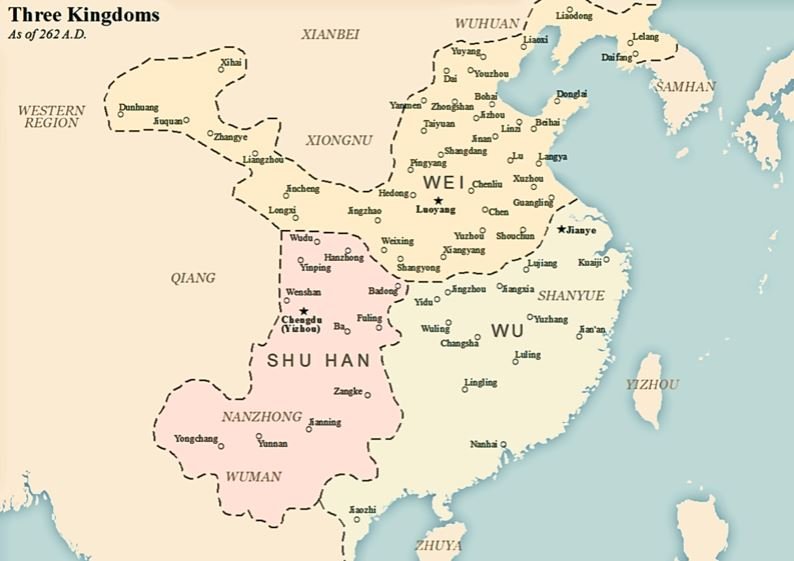
Map of Shu Han (in pink) and other states circa 260 A.D.
Key Players and Political Foundations
Cao Wei
Founded by Cao Pi in 220 AD, Cao Wei inherited much of its political and military structure from the powerful warlord Cao Cao. Concentrated in northern China, Wei controlled the heartlands of Chinese civilization, including the agriculturally rich North China Plain.

Portrait of Cao Cao.
Shu Han
Shu Han, established by Liu Bei in 221 AD, claimed legitimacy as the true successor of the Han dynasty due to Liu’s lineage within the imperial family. Centered in Sichuan and the upper Yangtze River region, Shu Han’s strategic location provided natural defenses but limited expansion opportunities.
Eastern Wu
Sun Quan declared himself Emperor of Eastern Wu in 229 AD. Situated in the lower Yangtze region, Wu leveraged its strong naval power and trade networks, developing a distinct identity and economy that enabled it to withstand external threats for decades.
Technological and Cultural Achievements
Despite political instability, the Three Kingdoms period witnessed significant technological advancements:
Zhuge Liang’s Innovations
The Shu chancellor developed the wooden ox (an early wheelbarrow) and refined the repeating crossbow, showcasing ingenuity in logistics and warfare.
Ma Jun’s Engineering
Wei’s engineer Ma Jun designed the south-pointing chariot, an early directional device using differential gears, and created hydraulic-powered puppet theaters.
Culturally, the era laid the groundwork for future literary and artistic traditions, including Chen Shou’s Records of the Three Kingdoms and the later Romance of the Three Kingdoms, a Ming dynasty novel that immortalized the period.
Socioeconomic Challenges and Population Decline
The Three Kingdoms period was marked by demographic collapse. Plagues, famines, and war drastically reduced the population:
Han Census vs. Jin Census
Han dynasty records listed over 56 million individuals, whereas the Jin census of 280 AD reported only 16 million.
Economic Shifts
The collapse of centralized governance led to a rise in manorial systems, local strongholds, and barter-based economies using silk and grain as currency.
Major Conflicts and Military Campaigns
Battle of Red Cliffs (208 AD)
A pivotal engagement where allied forces of Shu and Wu defeated Cao Cao’s numerically superior army. The victory secured the survival of the southern states and established the Yangtze River as a strategic barrier.
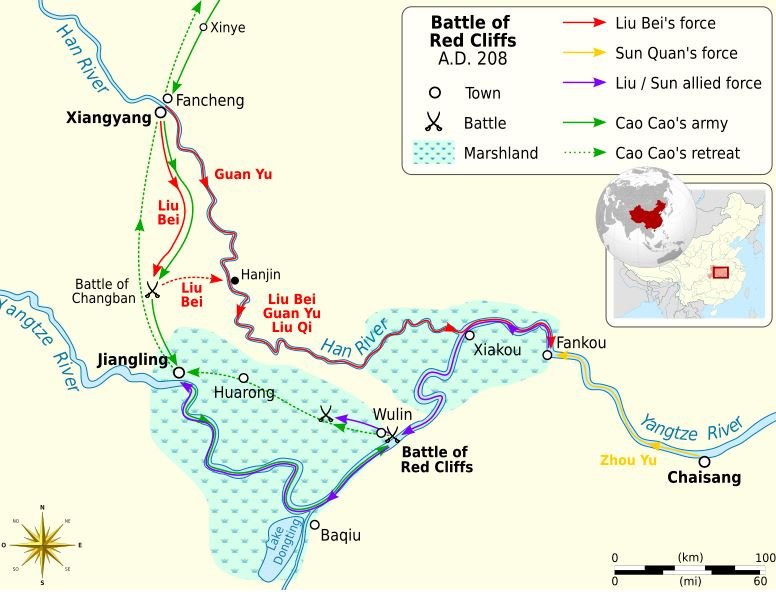
Map highlighting key activities during the Battle of Red Cliffs.
Northern Expeditions
Under Zhuge Liang’s leadership, Shu Han launched several campaigns against Wei. Although they demonstrated strategic brilliance, these campaigns ultimately failed due to logistical constraints and internal dissent.
Conquest of Shu (263 AD)
Wei’s campaign led by Deng Ai resulted in the swift conquest of Shu Han, marking the beginning of the end for the tripartite balance.
Decline and Fall of the Three Kingdoms
The Sima family consolidated power within Wei, culminating in Sima Yan’s usurpation of the throne in 266 AD, establishing the Jin dynasty.
Beset by internal strife and weakened leadership under Sun Hao, Eastern Wu succumbed to Jin forces in 280 AD, completing the reunification of China under the Jin dynasty.
Legacy and Historical Interpretation
The Three Kingdoms era remains a cornerstone of East Asian cultural memory:
Chen Shou’s Records of the Three Kingdoms provided a foundational narrative, later annotated by Pei Songzhi.
Luo Guanzhong’s Romance of the Three Kingdoms dramatized historical events, emphasizing loyalty, strategy, and heroism.
The period is studied for its military strategies, political fragmentation, and resilience in the face of societal collapse, offering insights into governance, warfare, and cultural evolution during times of chaos.
Frequently Asked Questions

Why was the Three Kingdoms era significant in Chinese history?
It was a time of political fragmentation, cultural development, and military innovation. Despite being one of the bloodiest periods, it gave rise to notable advances in technology, literature, and governance.
How did the Three Kingdoms come to an end?
The Jin dynasty overthrew Cao Wei in 266, conquered Shu Han in 263, and ultimately defeated Eastern Wu in 280, reunifying China.
What role did Zhuge Liang play in the Three Kingdoms period?
As Shu Han’s chancellor, Zhuge Liang was a key military strategist and inventor. He led campaigns against Wei and consolidated power in Shu, leaving a legacy as a brilliant tactician.
What are the major literary contributions from this period?
The Records of the Three Kingdoms by Chen Shou became the authoritative historical text. Later, Romance of the Three Kingdoms, a Ming dynasty novel, dramatized the era, cementing its cultural legacy.
How did this period affect China’s population and economy?
Warfare, famine, and disease drastically reduced the population, from nearly 56 million during the Han dynasty to 16 million by 280. The economy relied on manorial systems and alternative currencies like silk and grain.
Timeline of the Three Kingdoms Period

The Three Kingdoms era arose from the ashes of the Eastern Han dynasty. Years of political corruption, natural disasters, and social unrest weakened the Han government. Image: Map of the Three Kingdoms circa 248 A.D.





