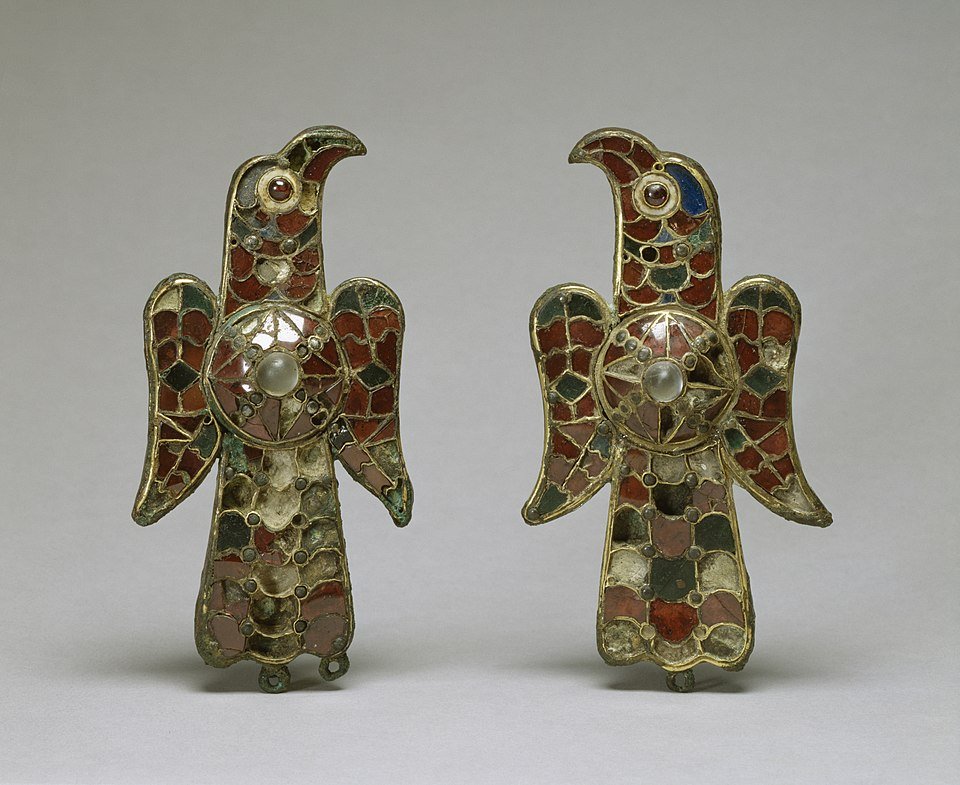
These 6th-century fibulae from Tierra de Barros (Badajoz) feature eagles, a common Gothic symbol in Spain.
Let’s start at the beginning—who exactly were the Visigoths?
The Visigoths were one of the most influential Germanic peoples of Late Antiquity, and their name has echoed across European history books for good reason. The Visigoths were part of a larger group known as the Goths, and they played a massive role in shaping the fate of the Roman Empire and the early medieval West
Interestingly, the term “Visigoth” wasn’t even used by them at first. They simply referred to themselves as “Goths.” The label “Visigoths”—which roughly means “Western Goths”—was coined later by a Roman writer named Cassiodorus to distinguish them from their eastern cousins, the Ostrogoths.
These people weren’t some monolithic tribe; they emerged from a melting pot of groups like the Tervingi and the Vesi, among others, who had been pushed into Roman territory by the advancing Huns around 376 AD.
Did you know…?
The Visigoths spoke a now-extinct eastern Germanic language and, at one point, held sway over a significant chunk of Western Europe, including parts of modern France, Spain, and Portugal.
The Gothic War and the Fall of Rome
One of the Visigoths’ earliest and most significant encounters with the Roman Empire came when they crossed the Danube into Roman territory in 376, asking Emperor Valens for refuge from the Huns. This might have gone well if not for Roman mismanagement and corruption. The refugees were mistreated, starved, and even forced to trade their children for dog meat. Not surprisingly, tensions boiled over into open war.
The climax came in 378 at the Battle of Adrianople, where the Visigoths—led by their chieftain Fritigern—crushed the Roman army and killed Emperor Valens. This was a turning point not just for the Visigoths, but for the entire Roman Empire. Rome had never suffered such a devastating defeat at the hands of so-called “barbarians,” and the battle is often seen as a milestone in the Empire’s decline.
Alaric and the Sack of Rome
After years of uneasy peace and conflict, the Visigoths found themselves under the charismatic leadership of Alaric I.
Alaric was ambitious and, like many of his people, felt that Rome owed them for their service and loyalty as foederati—federated allies who were expected to fight Rome’s wars in exchange for land and pay. But Rome didn’t hold up its end of the bargain. After being repeatedly snubbed and betrayed, Alaric decided enough was enough.
In 410, he led his troops into Rome itself and sacked the city. That’s right—Rome, the Eternal City, had fallen to a barbarian king. Though the city had lost its status as the empire’s capital by then, symbolically, this shook the Roman world to its core. The sack of Rome wasn’t an orgy of destruction but more a strategic looting. Still, it marked the first time in 800 years that Rome had been taken by a foreign enemy.
Settlement in Gaul and Rise of a Kingdom
After Rome, the Visigoths wandered around Italy and southern Gaul for a few years, trying to secure a permanent homeland. In 418, they finally settled in Aquitaine (southwestern France) under the terms of a new agreement with the Romans. They weren’t exactly independent yet, but they were building the foundation of what would soon become their own kingdom.
With their capital in Toulouse, the Visigoths gradually expanded their control across southern Gaul and into Hispania (modern Spain and Portugal). They clashed with other migratory groups like the Vandals and Suebi, carving out an impressive territory. By the mid-5th century, they were arguably the most powerful post-Roman kingdom in Western Europe.
From Toulouse to Toledo
Despite their success in Gaul, the Visigoths would eventually lose that northern territory. In 507, Clovis I of the Franks defeated them at the Battle of Vouillé, killing King Alaric II and taking Aquitaine. This was a major setback, but it didn’t spell the end. Instead, the Visigoths regrouped across the Pyrenees and focused on building a new power base in Hispania.
They moved their capital to Toledo and began a new chapter as rulers of Iberia. Here, the Visigoths created a kingdom that would last for more than two centuries and leave a profound cultural and legal legacy. Unlike other groups that came and went during this chaotic era, the Visigoths left their mark on everything from architecture to law.
Law and Society: The Visigothic Code
One of the Visigoths’ most lasting achievements was their legal code—the Forum Iudiciorum, also known as the Visigothic Code. Finalized in 654 under King Recceswinth, it’s a remarkable document. For starters, it abolished the old system of separate laws for Romans and Goths, unifying the population under one legal framework. That was a big deal. It helped create a shared identity among people who had once seen themselves as fundamentally different.
The code also offered unusually progressive rights to women for the time. For instance, it protected married women’s property rights, a principle that echoed down the centuries in Spanish law. In many ways, the Visigothic Code served as a bridge between Roman law and the medieval legal systems that followed.
Religion: From Arianism to Catholicism
Religion was a complicated affair for the Visigoths. When they first entered the Roman world, they were Christians—but not in the way most Romans were. They followed Arian Christianity, a belief that denied the full divinity of Christ. This put them at odds with the Nicene (or Catholic) majority in their new territories, especially in Hispania.
For decades, the Visigoths maintained their Arian faith, which kept them somewhat isolated from their Roman Catholic subjects. But this changed in 589, when King Reccared I converted to Catholicism. This conversion was a political masterstroke, helping unify the kingdom and earn the support of the local population. However, it also marked the beginning of increasing intolerance, especially toward Jews, who had previously been tolerated under Visigothic rule.
History of the Catholic Church: How and When Did Catholicism Begin?
Culture, Architecture, and Art
While they may not be as famous as the Romans or Greeks when it comes to architecture, the Visigoths did leave behind some impressive structures. They built churches like San Pedro de la Nave and Santa María de Melque in distinct styles that blended Roman traditions with their own innovations. Their architecture leaned heavily on simple, robust forms—cruciform churches, heavy stone, and distinctive capitals.
They were also skilled metalworkers. The Treasure of Guarrazar, a dazzling collection of votive crowns and crosses, shows their artistic flair. These crowns were not worn but rather offered as devotional gifts, often hung above altars. Made of gold and encrusted with jewels, they reflect the wealth and religious piety of the Visigothic elite.
Genetics and Identity
Modern genetic studies have helped fill in some blanks about the Visigoths’ origins. Recent research suggests that while they had a strong Northern and Central European genetic component, they also integrated significantly with local Iberian populations. Some individuals had a near 50-50 mix of Northern and Southern ancestry, pointing to a diverse and evolving identity.
And it’s worth noting—“Visigoth” wasn’t a static identity. It evolved. As they settled into the Roman world and began to see themselves less as outsiders and more as inheritors of the Roman legacy, they started calling themselves Hispani, reflecting their growing fusion with the local population.
Fall of the Kingdom
All good things, as they say, come to an end. In 711, the Visigothic Kingdom met its doom at the hands of a Muslim force composed of Arabs and Berbers. At the Battle of Guadalete, King Roderic and much of the Visigothic elite were killed. The Muslim armies swept through the Iberian Peninsula with remarkable speed, and within a few years, nearly all of it was under Umayyad control.
However, Visigothic culture didn’t disappear overnight. Some nobles fled to the mountains of northern Spain, where they joined local leaders to form the Kingdom of Asturias—the seed from which the Christian Reconquista would eventually grow. Others made their way to Frankish lands and later played roles in Charlemagne’s empire.
Legacy
Despite their kingdom’s fall, the Visigoths’ legacy endured. They were responsible for the only new cities founded in Western Europe during the early Middle Ages—places like Reccopolis and Victoriacum. Their legal code influenced medieval Iberian law for centuries. And many names of Gothic origin still survive in Spanish and Portuguese today.
In some ways, the Visigoths were a bridge between the ancient and medieval worlds. They preserved aspects of Roman civilization, added their own cultural contributions, and helped shape what would become modern Spain and Portugal. Their story is one of adaptation, survival, and transformation—far from the stereotype of wild barbarians tearing down the gates of civilization.
Conclusion
So there you have it—the Visigoths in all their complexity. They weren’t just raiders or footnotes in the story of Rome’s collapse. They were founders, lawmakers, conquerors, and assimilators. From the banks of the Danube to the hills of Toledo, their journey reshaped the map of Europe and left a mark that still lingers in the languages, laws, and landscapes of the Iberian Peninsula.
Frequently asked questions about the Visigoths
What were the origins of the Visigoths?
The Visigoths emerged from Gothic groups like the Tervingi and Vesi, originally from regions near the Black Sea, likely with Scandinavian roots. They formed a distinct identity within the Roman Empire around the late 4th century.
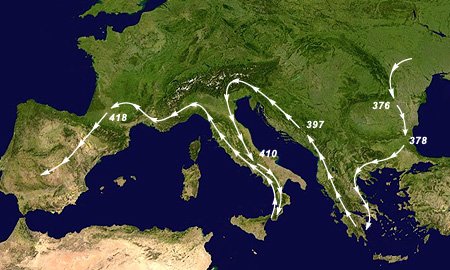
Main migration routes of the Visigothic column.
What role did the Visigoths play in the fall of the Western Roman Empire?
They played a key role by defeating the Romans at the Battle of Adrianople in 378 and sacking Rome in 410 under Alaric I, events that significantly weakened Roman authority and military prestige.
How did the Visigoths establish their own kingdom?
Initially settled as Roman allies in Gaul in 418, they later expanded into Hispania, where they formed an independent kingdom with Toledo as its capital, ruling until the early 8th century.
What was the significance of the Visigothic Code?
The Forum Iudiciorum unified Roman and Gothic law under one system, abolished legal distinctions between populations, and influenced Iberian legal traditions for centuries.
Why did the Visigoths convert from Arianism to Catholicism?
To unify their kingdom and integrate better with the Nicene Christian majority in Hispania, King Reccared I converted to Catholicism in 589, ending religious divisions and boosting royal legitimacy.
What was the impact of the Muslim conquest in 711?
It led to the collapse of the Visigothic kingdom after King Roderic’s defeat at the Battle of Guadalete. Survivors fled north and helped form the Christian Kingdom of Asturias, beginning the Reconquista.
What cultural contributions did the Visigoths make?
They founded new cities, developed a distinct architectural style, and produced treasures like the Guarrazar votive crowns, while also shaping legal and religious institutions in Iberia.
How did Visigothic identity evolve over time?
Initially distinct from the Roman population, the Visigoths gradually assimilated, adopting Latin culture, merging legally and religiously with locals, and eventually identifying as Hispani.





