The Young Turk Revolution of July 1908 dramatically shifted the political landscape of the Ottoman Empire. Sparked by a cadre of reform-minded military officers and intellectuals who came to be known as the Young Turks, this upheaval forced Sultan Abdul Hamid II to restore the long-suspended constitution of 1876 and reestablish the parliament. What followed was a Second Constitutional Era marked by new political opportunities, rising expectations, and tensions that would ultimately reshape the empire’s governing principles. Although the hopes kindled in 1908 were only partially realized, the revolution decisively ended the sultan’s complete dominance and began to replace it with a more participatory political framework.

The Young Turk Revolution aimed to force Sultan Abdul Hamid II to restore the long-suspended constitution of 1876 and reestablish the parliament. Image: Demonstration in the Sultanahmet
Background to the Crisis
By the early twentieth century, the Ottoman Empire faced grave internal and external pressures. The once-powerful state was weakened by territorial losses, financial troubles, and persistent foreign meddling. In its European provinces, called Ottoman Rumeli, various ethnic and religious communities—Bulgarians, Greeks, Serbs, Albanians, and others—contended with each other and with the imperial center. Foreign powers threatened to impose reforms that risked partitioning these lands. Amid such turmoil, many Ottoman officers stationed in these contested regions concluded that fundamental political change was essential to preserve the empire’s unity and sovereignty.
The Hamidian Regime and Its Limitations
Under Abdul Hamid II, who had ascended the throne in 1876 with promises of constitutionalism, the empire soon slipped back into absolutist rule. After a disastrous war with Russia, he suspended the constitution and closed the parliament. For the next three decades, he relied on a tight inner circle, censorship, and informers to maintain control. Though some educational and infrastructural improvements occurred, political participation remained stifled. Increasingly, intellectuals, minorities, rising middle classes, and younger military officers viewed constitutionalism as the only remedy to restore rule of law, limit foreign intrusion, and unify the empire’s diverse populations.

Greek demonstration in Monastir in favour of the constitution
The Emergence of the Young Turks
The Young Turk movement arose as a broad coalition that sought to end Hamidian absolutism. Within it, the Committee of Union and Progress (CUP) stood out as the principal organizational force. Drawing support from exiled intellectuals and officers stationed in the Balkans, the CUP argued that a stable constitutional framework would strengthen the empire. They envisioned equal rights for Muslims and non-Muslims alike, hoping this would weaken separatist sentiments. By granting civic freedoms, they aimed to diminish the pretexts foreign powers used to justify intervention. Although not purely liberal, the CUP’s priority was clear: dismantle the sultan’s arbitrary rule.
Converging Influences and Pressures
By the turn of the century, the Ottoman Empire’s fragile condition intensified the call for reform. Economic hardships, rising foreign debt, and overdue military salaries eroded loyalty among officers. Meanwhile, constitutional revolutions in Russia (1905) and Persia (1906) demonstrated that even entrenched autocrats could be restrained. In Macedonia, the looming threat of foreign-imposed reforms added urgency. Concluding that only a reintroduction of the constitution would prevent further territorial erosion, the CUP and other reformers prepared for decisive action.

Emblem of the Committee of Union and Progress
The Spark in 1908
The revolution began in earnest in July 1908, when Ahmed Niyazi, a CUP-affiliated officer, deserted his post and took to the Albanian highlands. Joined by figures like İsmail Enver and Eyub Sabri, he capitalized on connections within the Salonica-based Third Army. They forged alliances with Albanian leaders, enlisted local support, and demanded the restoration of the 1876 constitution. Theirs was not a separatist rebellion but a carefully planned effort to compel the sultan to accept constitutional governance. They combined propaganda with strategic alliances, presenting themselves as saviors of the empire rather than its destroyers.

Ahmed Niyazi’s desertion to the Albanian highlands launched the revolution, as he and allies like Enver leveraged Salonica’s Third Army connections. Image: Enver Bey and Niyazi Bey from a postcard in 1908.
Mounting Pressure and the Sultan’s Concession
The CUP’s campaign included targeted assassinations of officials loyal to the sultan. Attempts to quell the uprising failed as dispatched pashas were outmaneuvered or convinced to join the cause. Revolutionary fervor spread rapidly, prompting fears in Istanbul that an armed march on the capital was imminent. Sensing the peril to his throne and eager to avoid civil war, Abdul Hamid II capitulated. On July 24, 1908, he reinstated the constitution and called for parliamentary elections. This marked a triumphant victory for the Young Turks and a milestone in diminishing autocratic authority.
Euphoria and High Hopes
The empire erupted in celebration. People from all walks of life paraded under the banners of liberty and equality. Former enemies in the countryside turned in their weapons. Newspapers flourished, and political clubs sprang into being. Many believed that the restored constitution would deliver justice, curb foreign interventions, and unite Ottoman subjects under a shared civic identity. These optimistic days suggested that a revived Ottomanism, transcending ethnic and religious divisions, might become reality.
Immediate Challenges and Territorial Losses
Such hopes soon faced a harsh international reality. Bulgaria declared independence, and Austria-Hungary annexed Bosnia and Herzegovina soon after the revolution. These actions revealed that constitutionalism alone could not prevent further territorial losses. Nevertheless, the internal balance of the empire had shifted irrevocably. The sultan was now a constitutional monarch rather than an autocrat, and the government, press, and parliament gained room to operate. The political sphere became more vibrant, though not necessarily more stable.
The 31 March Incident and Its Aftermath
In April 1909, a counterrevolution known as the 31 March Incident tested the new order. Conservative forces, disillusioned soldiers, and religious students demanded a return to old structures. They argued for reinstating Islamic law and reasserting the sultan’s authority. The CUP responded decisively. Troops from Macedonia crushed the uprising, reaffirming constitutionalism’s triumph. Abdul Hamid II was deposed, and Mehmed V took the throne, his power firmly constrained by the constitution. This second confrontation solidified the revolution’s initial gains and ended any lingering dreams of Hamidian absolutism.
Rising CUP Dominance and Disillusionment
Despite early pluralism, the new constitutional era was soon overshadowed by CUP dominance. Multiple parties formed, but the CUP gradually outmaneuvered its rivals. Promises of decentralization and liberty clashed with the CUP’s drive to centralize authority. Non-Turkish communities became frustrated when meaningful autonomy failed to materialize. By 1913, the CUP’s internal coups and political manipulations left it as the paramount force, governing in ways reminiscent of the authoritarianism it had vowed to dismantle. Enthusiasm waned, replaced by disillusionment and the realization that the revolution had not produced the genuine egalitarian order many had imagined.
Shifting Political Culture and Enduring Significance
Yet even as the CUP tightened its grip, the memory of 1908 persisted as a beacon of possibility. It had ended the sultan’s unilateral rule and normalized the idea of a parliament, even if imperfectly. Intellectuals, journalists, and activists continued to push boundaries. Though the CUP’s later policies tarnished the promise of 1908, that initial moment of liberation influenced future generations of reformers. The revolution revealed both the potential and the complexity of introducing constitutional governance into a deeply divided and beleaguered empire.
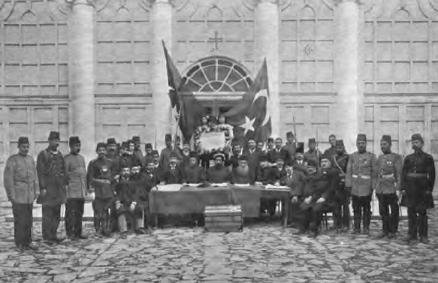
The events of July 1908 permanently altered the Ottoman political landscape. They established that sultans could be forced to share power, that constitutions could guide governance, and that citizens could imagine a more inclusive state. Image: Young Turk Revolution Declaration – Armenian, Greek Orthodox & Muslim religious leaders
Influence Beyond the Empire
The Young Turk Revolution’s echoes were felt beyond Ottoman borders. Reform-minded groups elsewhere drew inspiration, seeing that entrenched autocracy could be challenged. While the Ottoman example did not produce a flawless democracy, it demonstrated that old orders could be disrupted, encouraging others to imagine their own constitutional transformations.
A Complex Legacy
Ultimately, the Young Turk Revolution was both a watershed and a cautionary tale. It ended an era of absolute monarchy, opened political spaces, and briefly united diverse populations in hope. Yet it could not mend all divisions, halt foreign encroachment, or prevent the rise of new authoritarian currents under the CUP. Nevertheless, its legacy endures in Ottoman and Middle Eastern historiography as a key turning point. It illuminated the strengths and limitations of constitutionalism in a late imperial setting, leaving behind a legacy of contested reforms and unrealized ideals.





