The Young Turks: History and Major Facts
The Young Turks were a diverse political movement in the late Ottoman Empire that opposed the absolutist regime of Sultan Abdul Hamid II (r. 1876–1909). They played a pivotal role in shaping the political trajectory of the empire during a critical period of decline and transformation. Their activities culminated in the restoration of the constitution in 1908 and the establishment of the Second Constitutional Era, marking the onset of multi-party democracy in the Ottoman state.
Origins of the Movement
The Young Turks were inspired by earlier reformist movements, such as the Young Ottomans and international examples like Young Italy, which advocated for political and social change. They emerged as an underground network of reform-minded students, military officers, and intellectuals.
The constitution introduced during the reign of Abdul Hamid II in 1876 promised constitutional governance and parliamentary representation. However, Abdul Hamid dissolved parliament in 1878, establishing an era of absolute monarchy. This disillusioned reformists, leading to the formation of the Young Turks as a constitutionalist opposition group.
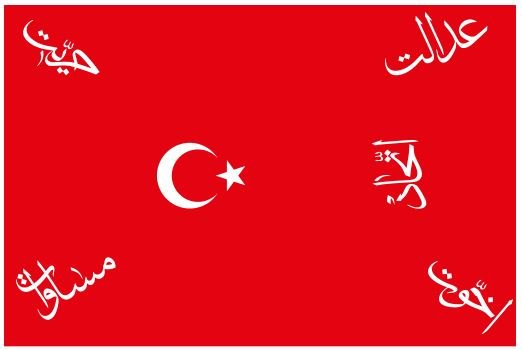
Flag used by the Young Turks
Composition and Ideological Diversity
Despite being labeled the “Young Turks,” the movement encompassed a wide range of ethnicities, including Albanians, Arabs, Armenians, Greeks, Kurds, Circassians, and Jews, reflecting the multicultural nature of the Ottoman Empire.
The movement included democrats, constitutional monarchists, liberals, secularists, and nationalists. While united in their opposition to Abdul Hamid’s rule, these factions often had conflicting visions for the future of the empire.
Early Activities and Opposition
The movement began with secret societies like the Committee of Ottoman Union, which later evolved into the Committee of Union and Progress (CUP). These groups operated clandestinely, publishing newspapers and organizing resistance against the regime.
Many Young Turks operated from European cities like Paris, Geneva, and London, where they collaborated with exiles, academics, and Freemasons to build an international network of opposition.
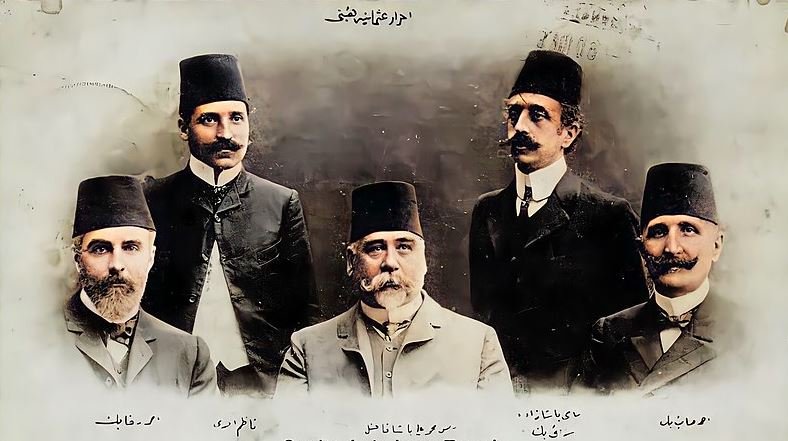
The Committee of Union and Progress (Young Turks) in 1909.
The Young Turk Revolution (1908)
The CUP played a central role in the 1908 revolution, which forced Abdul Hamid II to restore the 1876 constitution. This event marked the beginning of the Second Constitutional Era, a period of political liberalization and multi-party democracy.
Despite initial success, the revolution faced significant challenges, including internal divisions within the Young Turk movement and opposition from conservative factions. The 31 March Incident in 1909 highlighted these tensions, leading to Abdul Hamid’s deposition.

A photo showing the members of the Young Turks.
Consolidation of Power
The CUP, now in power, implemented reforms to modernize and centralize the empire. These included secularizing education and administration and reducing the influence of religious authorities.
The CUP’s emphasis on Turkish nationalism alienated many non-Turkish ethnic groups within the empire, undermining their initial support for the movement.
The Young Turks During World War I
The CUP, dominated by leaders like Enver Pasha and Talat Pasha, aligned the Ottoman Empire with the Central Powers during World War I. This decision had catastrophic consequences, leading to territorial losses and immense human suffering.
The CUP’s policies of centralization and nationalism influenced the early Republic of Turkey. However, their association with genocides and authoritarianism has marred their historical reputation.
Under CUP leadership, the empire orchestrated the Armenian Genocide, along with atrocities against Assyrian and Greek populations. These actions aimed to create a homogenous Turkish state but left a lasting legacy of violence and displacement.
Decline and Legacy
Following the Ottoman defeat in 1918, the CUP leadership fled into exile, and the empire fell under the control of Allied forces and local nationalist leaders.
While the Young Turks modernized aspects of the Ottoman state and championed constitutional governance, their authoritarianism and nationalist policies contributed to the empire’s eventual collapse. The term “Young Turk” has since come to symbolize revolutionary and insurgent movements worldwide.
Etymology and Historical Context
The term “Young Turks” originated from the French phrase Jeunes Turcs, used to describe reformist elements within the Ottoman Empire. Early references to similar groups include the Young Ottomans, who sought liberal reforms under Abdul Hamid II’s predecessors.
Frequently Asked Questions
What was the Young Turks’ main objective?
The Young Turks aimed to end the absolutist rule of Sultan Abdul Hamid II and reinstate the Ottoman constitution of 1876, advocating for constitutional governance and multi-party democracy.
What was the Committee of Union and Progress (CUP)?
The CUP was the most influential organization within the Young Turks movement, evolving from a secret society into a dominant political force. It spearheaded the 1908 Young Turk Revolution and later governed the Ottoman Empire.

The leaders of the Ottoman millets proclaim the Young Turk Revolution in 1908.
How did the Young Turks bring about the Second Constitutional Era?
In the 1908 Young Turk Revolution, CUP-affiliated military officers and activists pressured Sultan Abdul Hamid II to restore the 1876 constitution, marking the start of a multi-party parliamentary system.
What role did ethnic diversity play in the Young Turks movement?
The movement included members from various ethnic and religious backgrounds, such as Turks, Armenians, Kurds, Arabs, Jews, and Greeks, unified by opposition to absolutism but divided on ideological and political goals.

An 1899 portrait of Abdul Hamid II.
What were the ideological divisions within the Young Turks?
The movement encompassed diverse ideologies, including liberalism, nationalism, socialism, and decentralization. These differences often caused internal conflicts, especially between centralists like Ahmed Rıza and decentralists like Prince Sabahaddin.
What were the consequences of the CUP’s rule during World War I?
The CUP’s leadership involved the Ottoman Empire in the war, pursued Turkification policies, and orchestrated genocides against Armenian, Assyrian, and other Christian populations, causing massive loss of life and international condemnation.
What does the term “Young Turk” signify today?
It refers to insurgents or reformists seeking to disrupt or overhaul established systems, reflecting the rebellious and revolutionary ethos of the original movement.





