Treaty of Guadalupe Hidalgo in 1848
The Treaty of Guadalupe Hidalgo, signed on February 2, 1848, marked the formal conclusion of the Mexican-American War (1846–1848). This conflict arose from the United States’ expansionist ideology, known as Manifest Destiny, which held that the U.S. was destined to expand across the North American continent. Tensions escalated following the annexation of Texas by the U.S. in 1845, which Mexico still considered part of its territory despite the 1836 Texas Revolution. Disputes over the southern border of Texas—whether it was the Nueces River or the Rio Grande—further inflamed relations. The discovery of gold in California in 1848 also heightened American interest in expanding westward.
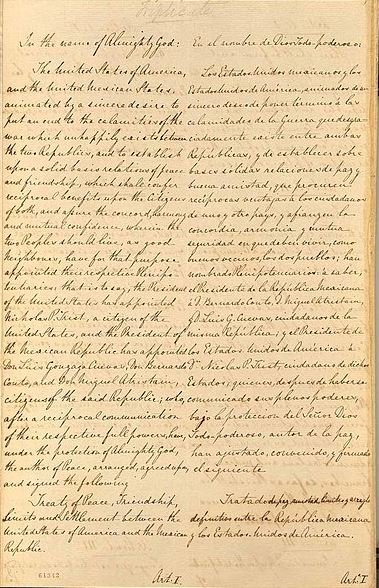
First page of the original Treaty of Guadalupe Hidalgo
Key Events Leading to the Treaty
The war began in earnest in 1846 after President James K. Polk ordered General Zachary Taylor to advance into disputed territories, leading to skirmishes with Mexican forces. The U.S. military successes, including the capture of Monterrey and the decisive Battle of Buena Vista, bolstered American morale. Meanwhile, naval forces under Commodore Matthew Perry gained control of the Pacific coast. The U.S. strategy of dividing Mexican forces and securing key territories proved effective, culminating in the occupation of Mexico City in September 1847.

Following Mexico’s military defeat and the fall of its capital in September 1847, peace negotiations led to the treaty, with U.S. envoy Nicholas Trist overseeing discussions.
With Mexico’s military defeat and economic exhaustion, peace negotiations became inevitable. The U.S. envoy, Nicholas Trist, engaged in talks with Mexican representatives, leading to the signing of the Treaty of Guadalupe Hidalgo in the northern neighborhood of Mexico City.
Terms of the Treaty
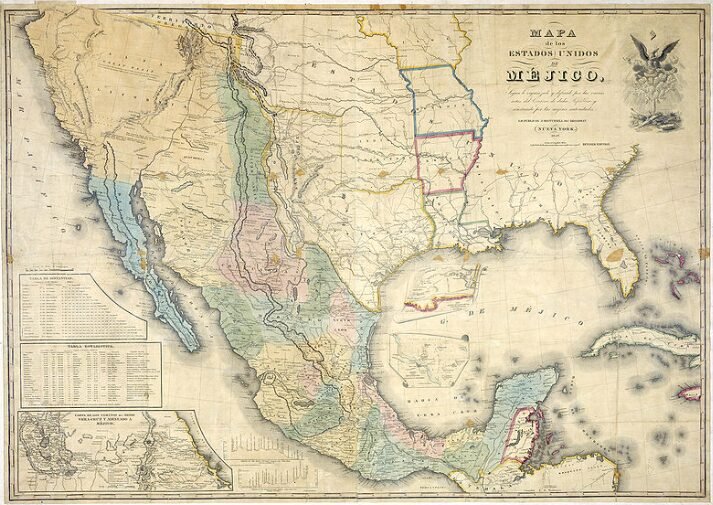
Under the treaty, Mexico ceded 55% of its territory, including present-day California, Nevada, Utah, parts of Colorado, Arizona, New Mexico, and Wyoming, and recognized the Rio Grande as Texas’s southern border. In exchange, the U.S. paid Mexico $15 million and assumed debts owed to American citizens. Image: Map used during the negotiations of the Treaty of Guadalupe Hidalgo in 1848
The Treaty of Guadalupe Hidalgo had several critical provisions:
Territorial Cession
Mexico ceded over 525,000 square miles (1.36 million square kilometers) of land to the United States. This vast territory included present-day Arizona, California, western Colorado, Nevada, New Mexico, Texas, and Utah. The acquisition of this land significantly expanded the United States, completing its continental expansion except for the later Gadsden Purchase in 1853.
Boundary Establishment
The treaty established the Rio Grande and the Gila River as the official boundary between Mexico and the United States, resolving the long-standing dispute over Texas’s southern border.
Financial Compensation
The United States agreed to pay Mexico $15 million as compensation for the ceded territories. Additionally, the U.S. assumed responsibility for settling over $3 million in claims by American citizens against Mexico, addressing financial grievances arising from the war.
Mexican Claims and Rights
The treaty provided that Mexican citizens residing in the newly acquired territories could choose to relocate within Mexico’s new boundaries or remain in the United States, retaining their property rights and, in some cases, being granted U.S. citizenship and full civil rights.
Implementation and Ratification
The Treaty of Guadalupe Hidalgo was ratified by the United States Senate on March 10, 1848, by a vote of 38–14, reflecting significant support despite opposition from certain political factions. Mexico ratified the treaty on May 19, 1848, and the two nations exchanged ratifications on May 30, 1848. The treaty was officially proclaimed on July 4, 1848, coinciding with the United States’ Independence Day, symbolizing a new era of American territorial expansion.
Consequences for Mexico
The treaty had profound and lasting impacts on Mexico:
Territorial Loss
Mexico lost more than half of its pre-war territory, significantly reducing its size and influence. This loss weakened Mexico’s geopolitical standing and economic capacity, as it relinquished resource-rich regions essential for its development.
Political Instability
The cession of vast territories undermined national confidence and contributed to political fragmentation. Mexico struggled to manage its reduced land and population, leading to internal conflicts and power struggles. This instability was a precursor to the Mexican Civil War in 1857, as factions vied for control over the nation’s future.
Economic Impact
The loss of key territories deprived Mexico of valuable resources and economic hubs, exacerbating its financial difficulties. The burden of integrating and governing the remaining regions strained the country’s administrative and economic systems.
Social and Cultural Effects
The treaty altered Mexico’s demographic landscape, with many Mexican citizens finding themselves living within the United States. This shift led to cultural exchanges but also to tensions and discrimination, as Mexican communities navigated their new status and rights within American society.
Consequences for the United States
For the United States, the Treaty of Guadalupe Hidalgo had significant and multifaceted effects:
The acquisition of over 525,000 square miles of land fulfilled the vision of Manifest Destiny, substantially increasing the United States’ size and resource base. This expansion provided vast opportunities for economic growth, settlement, and the development of new states.
The newly acquired territories were rich in resources, including gold, silver, and fertile lands, which spurred economic development and attracted settlers and investors. California’s gold rush, which began shortly after the treaty, exemplified the economic boom resulting from territorial expansion.
The addition of new territories reignited debates over the expansion of slavery in the United States. The question of whether the new states would permit slavery exacerbated sectional tensions between the North and South, contributing to the political struggles that eventually led to the Civil War. The Missouri Compromise of 1820 had temporarily addressed these issues, but the new lands reopened the contentious debate.
The integration of diverse populations, including Mexicans, Native Americans, and immigrants from various backgrounds, created social dynamics that challenged existing social structures. The treaty’s provisions for land rights and citizenship for Mexicans in the U.S. territories also led to ongoing legal and social disputes.
The Treaty of Guadalupe Hidalgo concluded the Mexican-American War (1846–1848).
Long-Term Significance
The Treaty of Guadalupe Hidalgo is a pivotal event in North American history with enduring significance:
The treaty defined the modern boundaries between the United States and Mexico, influencing the geopolitical landscape of North America. The established borders have had lasting implications for international relations, trade, and migration between the two countries.
The incorporation of diverse regions into the United States enriched its cultural fabric, introducing new languages, traditions, and populations. This diversity continues to shape American society, contributing to its multicultural identity.
The treaty set the stage for future territorial acquisitions, most notably the Gadsden Purchase in 1853, which added parts of southern Arizona and New Mexico. These expansions further solidified the United States’ continental presence.
The treaty laid the groundwork for the complex and often contentious relationship between the United States and Mexico. Issues such as border disputes, immigration, and economic ties have their roots in the territorial changes formalized by the treaty.
The treaty influenced American legal and constitutional frameworks, particularly regarding land rights, citizenship, and federal-state relations. The integration of vast new territories required the extension of U.S. laws and governance structures, shaping the nation’s legal landscape.
The treaty’s provisions for Mexican citizens in the ceded territories highlighted issues of civil rights and property ownership, leading to ongoing legal battles and policies addressing the rights of minority populations within the United States.
Conclusion
The Treaty of Guadalupe Hidalgo was a landmark agreement that reshaped the territorial and political landscape of North America. By ending the Mexican-American War, it facilitated the United States’ continental expansion, significantly altering the boundaries between the two nations. The treaty’s provisions resulted in substantial territorial gains for the U.S., economic growth, and the fulfillment of Manifest Destiny, while imposing severe territorial and political losses on Mexico, contributing to its internal instability and eventual civil war.
The treaty’s legacy is evident in the modern borders of the United States and Mexico, the cultural diversity of the expanded U.S. territories, and the enduring political and social issues that emerged from the territorial changes. As a defining moment in both nations’ histories, the Treaty of Guadalupe Hidalgo symbolizes both the achievements and the challenges of territorial expansion, highlighting the complex interplay of political ambition, military conflict, and diplomatic negotiation in shaping the course of history.
Through its profound impact on territorial boundaries, national identities, and international relations, the Treaty of Guadalupe Hidalgo remains a critical subject of study for understanding the historical dynamics that continue to influence North America today. Its significance extends beyond the immediate aftermath of the war, affecting economic, social, and political developments in the decades that followed and contributing to the foundational narratives of both the United States and Mexico.
Frequently Asked Questions
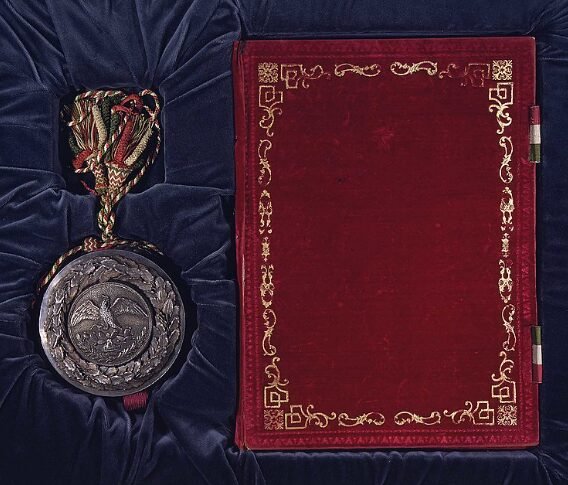
Ratified by both nations in 1848, the Treaty of Guadalupe Hidalgo significantly expanded U.S. territory, later supplemented by the 1853 Gadsden Purchase, adding parts of southern Arizona and New Mexico.
When and where was the Treaty of Guadalupe Hidalgo signed?
It was signed on February 2, 1848, in Villa de Guadalupe Hidalgo, a northern neighborhood of Mexico City.
Which rivers were established as the boundary between the United States and Mexico by the treaty?
The treaty established the Rio Grande and the Gila River as the boundary between the United States and Mexico.
What territories did Mexico cede to the United States under the Treaty of Guadalupe Hidalgo, and for what compensation?
Mexico ceded over 525,000 square miles of territory, including present-day Arizona, California, western Colorado, Nevada, New Mexico, Texas, and Utah, in exchange for $15 million.
What additional financial agreement did the United States make in the treaty?
The United States agreed to settle more than $3 million in claims made by American citizens against Mexico.
How did the Treaty of Guadalupe Hidalgo impact U.S. territorial expansion?
The treaty marked the near-completion of U.S. continental expansion, which was later finalized with the Gadsden Purchase in 1853.
What were the consequences of the treaty for Mexico?
The loss of territory undermined Mexico’s national confidence, fueled political instability and extremism, and contributed to the outbreak of civil war in 1857.
How did the treaty influence internal politics in the United States?
The acquisition of vast new lands reignited tensions over the expansion of slavery, leading to the Compromise of 1850 and the Kansas-Nebraska Act of 1854, which further polarized the nation and contributed to the Civil War.