What was the Pacte de Famine?
The Pacte de Famine (Famine Pact) was an 18th-century conspiracy theory in pre-revolutionary France that alleged intentional manipulation of grain supplies by elites to exploit the common people. The theory emerged during a time of significant social and economic upheaval, rooted in widespread mistrust of the government and suspicion of profiteering by powerful interest groups. The idea gained traction during the 1760s and 1770s, when food shortages and rising prices created an environment of anxiety and unrest.
Between 1715 and 1789, France’s population surged from 22 million to 28 million. This demographic growth strained food production, leading to frequent shortages and widespread hunger. Many citizens fell ill due to malnutrition or blamed “bad grain” for their health issues. This context of scarcity and suffering fostered the belief that grain shortages were artificially engineered by those in power for personal gain.
Role of Turgot and His Reforms
In 1774, after the death of Louis XV, Louis XVI ascended the throne and sought to restore order in a country rife with discontent. One of his first major appointments was Jacques Turgot as Finance Minister. Turgot, a follower of the Physiocrats, sought to implement free-market reforms to address the economic challenges facing France. The Physiocrats believed that economic prosperity depended on agricultural productivity and advocated for minimal government interference in commerce. Turgot championed these principles, famously promoting laissez-faire economics, encapsulated in the phrase “leave it alone, let it pass.”
Turgot had already experimented with reform as the Intendant of Limoges from 1761 to 1774, where he implemented free-market policies on a local scale. As Finance Minister, he sought to replicate these reforms nationwide, focusing on free trade in grain, industrial growth, and the abolition of feudal privileges. His overarching goal was to modernize France’s agricultural system and address its chronic economic inefficiencies.

Image: Louis XV
Grain Reforms and Guild Dissolution
Turgot’s policies included significant changes to France’s grain trade. He abolished guilds, organizations that controlled urban production, and deregulated the grain market, transitioning to a free-trade system. This move, intended to increase efficiency and lower prices, removed police oversight of grain distribution. However, it disrupted traditional structures, sparking widespread discontent.
Guild members argued that deregulation undermined their sense of identity and stability, while the police, who had previously regulated grain and other societal systems, felt their authority eroded. To reassert control, police created bureaucratic obstacles for business owners, such as requiring “moral and solvent” status to obtain licenses. These measures stifled commerce and intensified public frustration.
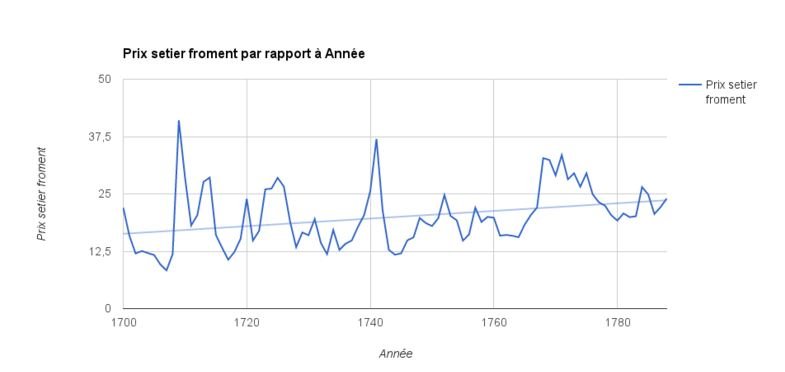
Image: The cost in livres of a setier (approximately 117 kg) of wheat in Paris from 1700 to 1788.
The Flour War of 1775
The backlash to Turgot’s grain reforms culminated in the Flour War of 1775, a series of riots fueled by grain shortages and high prices. Reports of poor harvests exacerbated the crisis, but many citizens suspected profiteering and manipulation rather than natural causes. The poor, government officials, and even the police believed that the disruptions were orchestrated to benefit wealthy interest groups. This distrust intensified the Pacte de Famine conspiracy, with people convinced that elites sought to profit from their hunger.
In response, rioters seized grain shipments and sold the goods at what they deemed a “just price,” a practice known as “taxation populaire” (popular taxation). These acts of defiance allowed citizens to reclaim some power, reflecting their deep resentment of perceived exploitation.
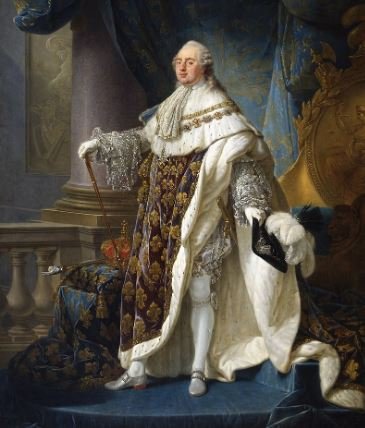
King Louis XVI
Propaganda and Turgot’s Doubts
The grain shortage and ensuing conspiracy theories spread rapidly through propaganda, further destabilizing the social order. Even Turgot began to question the authenticity of the shortages, suspecting political rivals of bribery and agitation to undermine his reforms. This atmosphere of mistrust and disorder made it increasingly difficult for Turgot to maintain his policies or authority.
The End of Turgot’s Reforms
The social and economic chaos prompted by Turgot’s policies led to his dismissal in 1776, ending his tenure as Finance Minister. The police resumed control of the grain trade, and guilds were reinstated in a modified form to reflect the changing social dynamics. While Turgot’s ambitious reforms failed to achieve their intended goals, they highlighted the structural challenges and resistance to change in pre-revolutionary France.

Aftermath and Legacy
Despite the turmoil, France eventually overcame the food shortages of the 18th century. The period following the Revolution of 1789 ushered in industrialization and modernized agricultural techniques, increasing productivity and improving living conditions for many. However, the Pacte de Famine conspiracy left a lasting legacy, reflecting the deep societal mistrust of government and elites. It also underscored the challenges of reforming entrenched systems in a society rife with inequality and resistance to change.
Turgot’s efforts, though short-lived, symbolized the Enlightenment’s influence on governance and economics. His commitment to free-market principles and systemic reform was ahead of its time, laying groundwork for later economic and social transformations. The resistance he faced reveals the complexity of balancing progressive ideas with the realities of deeply stratified societies.
In hindsight, the Pacte de Famine and the Flour War illustrate the fragility of pre-revolutionary France, where widespread poverty, population growth, and economic mismanagement created a powder keg of discontent. These events foreshadowed the larger upheavals of the French Revolution, as citizens increasingly demanded accountability and fairness from their leaders.