Týr in Norse Mythology – Origin Story & Death
Týr is a prominent deity in Norse mythology, known for his associations with war, justice, and law. His origins and family background, however, are somewhat obscure compared to other gods in the Norse pantheon. He is often depicted as a one-handed god, a characteristic linked to a significant mythological event.
The following explains the origin story and the meaning of Tyr, the fierce Norse god of War:
Who was Tyr? – Family Background
Týr’s family background is not extensively detailed in the surviving Norse texts, but we do know the following:
- Father: Týr’s father is Hymir, who is often described as a giant. In some myths, Hymir is a sea giant or a giant of the sky. His role in Norse mythology is relatively minor, and he is not as central as other giants or gods.
- Mother: Týr’s mother is not named in the Norse sagas, and her identity remains unknown. This lack of information about his mother is not unusual in Norse mythology, where the focus often shifts more to the deeds and attributes of the gods rather than their familial relationships.
Týr’s Role and Attributes
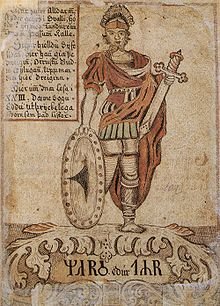
Týr is a significant figure in Norse mythology, known for his role as a god of war and justice. His story, particularly his sacrifice of his hand to bind Fenrir, highlights his dedication to maintaining law and order, making him a symbol of personal sacrifice for the greater good. Image: Týr equated with Mars in an 18th-century manuscript (ÍB 299 4to)
Týr is most famously known for his role in the myth of Fenrir, the monstrous wolf. His attributes and role in Norse mythology extend beyond this single event, reflecting his broader significance:
God of War and Justice
Týr is associated with war and justice, distinct from other warrior gods like Odin and Thor. While Odin is often linked with death and the afterlife and Thor with thunder and protection, Týr represents the legal and moral aspects of warfare. His role includes upholding oaths and maintaining legal order, making him a deity of both combat and law.
The One-Handed God
One of the most distinctive features of Týr is his missing hand. This physical characteristic stems from the myth of Fenrir, where Týr sacrifices his hand to bind the wolf. This sacrifice is symbolic of his commitment to justice and order, highlighting his willingness to make personal sacrifices for the greater good.
The Myth of Fenrir
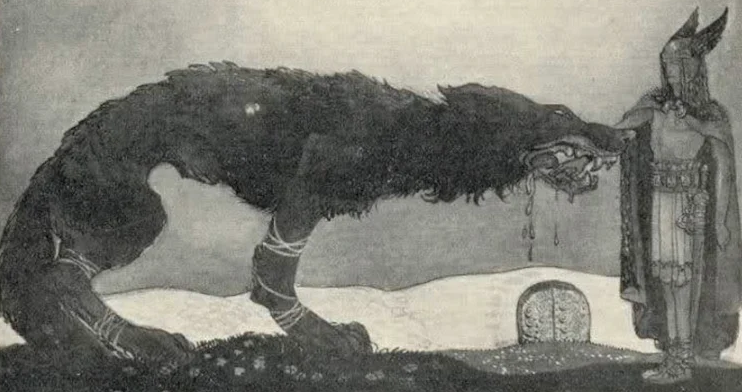
The Aesir used Gleipnir to bind the giant wolf Fenrir, who by the way is one of three monstrous children of Loki, Norse trickster god. Image: Fenrir biting off the hand of Tyr, god of war
The myth of Fenrir is central to understanding Týr’s role in Norse mythology. Fenrir is a monstrous wolf, one of the children of the trickster god Loki. The gods foresaw that Fenrir would play a significant role in the destruction of the world during Ragnarök, the prophesied end of the gods. To prevent this, they decided to imprison Fenrir.
Binding Fenrir
The gods attempted to bind Fenrir using various chains, but the wolf broke free each time. Eventually, they sought the help of the dwarves, who crafted a magical chain called Gleipnir. Gleipnir was made from six impossible things: the sound of a cat’s footfall, the beard of a woman, the roots of a mountain, the sinews of a bear, the breath of a fish, and the spittle of a bird. Despite its delicate appearance, Gleipnir was incredibly strong.
Týr’s Sacrifice
To convince Fenrir to allow himself to be bound by Gleipnir, the gods promised not to harm him. Fenrir agreed to be bound if one of the gods would place a hand in his mouth as a pledge of good faith. Týr, knowing the risks, volunteered. When Fenrir realized he had been tricked and could not break free, he bit off Týr’s hand. This act of sacrifice cemented Týr’s role as a god of justice, demonstrating his willingness to endure personal loss for the sake of maintaining order.
The Consequences
Fenrir remained bound until Ragnarök, where he would eventually break free and participate in the final battle against the gods. Týr’s sacrifice is remembered as a symbol of his commitment to justice and his readiness to face personal loss for the greater good.
Týr’s Death
Týr’s ultimate fate in Norse mythology is not as clearly outlined as that of other gods, but there are implications related to Ragnarök, the end-of-the-world scenario in Norse myth:
Ragnarök
Ragnarök is the prophesied end of the world, a series of events that includes a great battle, natural disasters, and the death of many gods. During Ragnarök, Fenrir is foretold to break free and engage in battle against the gods. Týr, having lost his hand in the earlier binding of Fenrir, is expected to face the wolf again during this final confrontation.
Týr’s Fate
In the context of Ragnarök, Týr’s fate is implied but not explicitly detailed in the sources. However, it is believed that Týr would meet his end during this final battle. His role as a god of justice and law would be tested to the utmost, and it is likely that he would face Fenrir again, possibly leading to his death.

Fenrir ripping off the hands of the Norse god Týr
Legacy and Worship
Despite the ambiguity surrounding his death, Týr’s legacy as a god of war, justice, and sacrifice has endured. In historical Norse culture, Týr was honored and worshipped as a deity who upheld law and order, embodying the values of honor and sacrifice. His one-handedness became a symbol of his commitment to these values.
In modern times, Týr’s legacy continues to be recognized in various ways. He is remembered for his role in the myth of Fenrir and as a symbol of personal sacrifice for the greater good. His story is a reminder of the complex nature of justice and the importance of upholding moral and legal order, even in the face of great personal cost.
Questions and Answers

Tyr is known for his role in binding the wolf Fenrir and is one of the Aesir gods. His lineage is somewhat obscure in the mythological texts, with more focus on his deeds and characteristics rather than detailed family relations. Tyr – Norse god of war, justice and truth
What is Týr primarily associated with in Norse mythology?
Týr is primarily associated with war, justice, and law in Norse mythology.
What is Tyr’s family tree like?
Tyr’s family tree includes:
- Father: Hymir – A giant, sometimes depicted as a sea giant or a giant of the sky.
- Mother: Unknown – Tyr’s mother is not commonly mentioned in Norse sources.
What is Týr’s most significant mythological contribution?
Týr’s most significant mythological contribution is his role in the binding of Fenrir, where he sacrifices his hand to uphold justice and order.

The book Gylfaginning in the Prose Edda describes Týr as the bravest and most noble of the Norse gods. Image: Týr sacrifices his arm to Fenrir in an illustration by John Bauer, 1911
What does Týr’s sacrifice symbolize?
Týr’s sacrifice symbolizes his commitment to justice, law, and the greater good, representing personal sacrifice for the sake of maintaining moral and legal order.
Is Týr’s ultimate fate during Ragnarök explicitly detailed in Norse mythology?
No, Týr’s ultimate fate during Ragnarök is not explicitly detailed in Norse mythology.
How is Týr remembered in Norse mythology?
Týr is remembered as a god of law, justice, and sacrifice, symbolizing personal sacrifice for the greater good and the upholding of moral and legal order.
What role does Týr’s one-handedness play in his mythological story?
Týr’s one-handedness is a result of his sacrifice during the binding of Fenrir, which underscores his dedication to justice and his willingness to endure personal loss to maintain order.
How does Týr’s legacy continue to be relevant in the context of Norse mythology?
Týr’s legacy continues to be relevant as a symbol of honor, sacrifice, and the importance of upholding justice and legal order, even at personal cos

Fenrir bites off the hand of a sword-wielding Týr in an illustration on an 18th-century Icelandic manuscript