Who are the Children of Typhon?
In Greek mythology, Typhon is one of the most fearsome and formidable figures. He is often described as a monstrous giant with serpentine features, a terrifying force of chaos and destruction.
Typhon’s union with Echidna, another fearsome creature known as the “Mother of Monsters,” produced some of the most dangerous and powerful beings in Greek mythology. These offspring, known as the “Children of Typhon,” played significant roles in various myths, often as antagonists to the Olympian gods and heroes.

Typhon is the terrifying monster created by the primordial Earth goddess Gaia to destroy the Olympians. Image: Typhon – the fire-breathing, 100-snake headed creature in Greek mythology.
Typhon and Echidna: The Parentage of Monsters
Before diving into the individual children, it is important to understand the nature of their parents, Typhon and Echidna:
Typhon in Greek mythology
According to Hesiod’s “Theogony,” Typhon was the last son of Gaia (Earth) and Tartarus. He was born after the Titanomachy, the great war between the Olympian gods and the Titans. Typhon was a monstrous figure, often depicted with one hundred dragon heads and eyes that breathed fire. His lower body was said to be made of massive, coiled serpents. Typhon was a personification of natural disasters, particularly volcanic eruptions and storms. He challenged Zeus for control of the cosmos but was ultimately defeated and buried beneath Mount Etna.
Echidna in Greek mythology
Echidna, known as the “Mother of Monsters,” was half-woman and half-serpent. She was the daughter of the sea gods Phorcys and Ceto, though some accounts also describe her as the daughter of Tartarus and Gaia, making her a sibling of Typhon. Echidna was often depicted as a beautiful woman from the waist up, with the lower body of a serpent. She lived in a remote cave and gave birth to many of the most fearsome creatures in Greek mythology.

Children of Typhon
The union of Typhon and Echidna produced numerous offspring, many of whom became central figures in the myths of ancient Greece.
Cerberus

Cerberus is the multi-headed hound that stands guard at the gates of Underworld (i.e. Hades). Image: Cerberus, with the gluttons in Dante’s Third Circle of Hell. English poet and painter William Blake.
Cerberus is perhaps the most famous of Typhon and Echidna’s offspring. Known as the guardian of the Underworld, Cerberus was a monstrous three-headed dog (though some accounts attribute him with up to fifty heads) who prevented the dead from leaving the realm of Hades.
- Role in Mythology: Cerberus appears in several myths, most notably in the Twelve Labors of Heracles. As part of his final labor, Heracles was tasked with capturing Cerberus and bringing him to the surface world without using weapons. Heracles succeeded by subduing the beast with his immense strength and, after presenting him to King Eurystheus, returned him safely to the Underworld.
- Symbolism: Cerberus symbolizes the impassable boundary between the living and the dead, serving as a reminder that death is an irreversible state. His multiple heads and serpentine features represent his association with the underworld’s dangers and mysteries.

Cerberus served as the watchdog of Hades, preventing the dead from leaving the Underworld and the living from entering without permission. Hercules and Cerberus. Oil on canvas, by Peter Paul Rubens 1636, Prado Museum.
The Lernaean Hydra

The Hydra also had poisonous breath and blood so venomous that even its scent was deadly. Painting: French artist Gustave Moreau’s 19th-century depiction of the Hydra, influenced by the Beast from the Book of Revelation
The Hydra is another infamous child of Typhon and Echidna. This multi-headed serpent-like creature lived in the swamps of Lerna and was known for its deadly breath and poisonous blood. The most distinctive feature of the Hydra was its regenerative ability: when one of its heads was cut off, two more would grow in its place.
- Role in Mythology: The Hydra is best known from the myth of Heracles’ Twelve Labors. Slaying the Lernaean Hydra was Heracles’ second labor. With the help of his nephew Iolaus, Heracles managed to overcome the Hydra by cauterizing the stumps of the severed heads with a burning torch to prevent them from regenerating. The last head, which was immortal, was buried under a massive rock.
- Symbolism: The Hydra represents the ever-multiplying dangers and challenges that one must face in life. Its regenerative power symbolizes the futility of dealing with problems in a superficial manner, as they can return stronger if not addressed at the root.
The Chimera

The Chimera was said to roam the region of Lycia, laying waste to the land with its fiery breath. It was eventually slain by the hero Bellerophon, who rode the winged horse Pegasus. Image: The Chimera on a red-figure Apulian plate, c. 350–340 BC
The Chimera is a fire-breathing monster that was a hybrid of different animals: typically, it is described as having the body and head of a lion, a goat’s head emerging from its back, and a serpent as its tail.
- Role in Mythology: The Chimera terrorized the region of Lycia until it was slain by the hero Bellerophon. Bellerophon, riding the winged horse Pegasus, managed to kill the Chimera by driving a lead-tipped spear into its fiery throat, causing it to melt the lead and suffocate.
- Symbolism: The Chimera is often seen as a symbol of impossible or illogical combinations, representing a monstrous form of chaos. In a broader sense, the term “chimera” has come to refer to any fantastical creation or illusion, something that is unreal or a product of wild imagination.

The Chimera symbolizes the monstrous and the unnatural, often representing impossible or fantastical combinations. Image: Bellerophon riding Pegasus and slaying the Chimera, central medallion of a Roman mosaic from Autun, Musée Rolin, 2nd to 3rd century AD
The Sphinx
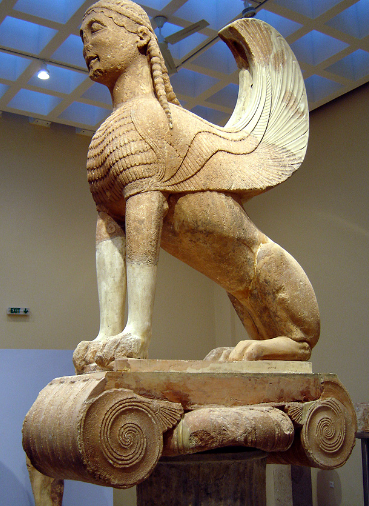
The Sphinx represents the enigma and the power of knowledge. Her riddles symbolize the challenges of life that require wisdom and insight to overcome.
The Sphinx, another child of Typhon and Echidna, is a creature with the body of a lion, the wings of an eagle, and the head of a woman. She is most famous for her role in the myth of Oedipus.
- Role in Mythology: The Sphinx guarded the city of Thebes and posed a riddle to all who wished to enter. The riddle was: “What walks on four legs in the morning, two legs at noon, and three legs in the evening?” Those who could not answer correctly were killed by the Sphinx. Oedipus solved the riddle by answering “Man,” referring to the stages of a human’s life. Upon hearing the correct answer, the Sphinx threw herself from a cliff and died.
- Symbolism: The Sphinx represents the idea of mystery, knowledge, and the consequences of failing to understand or solve life’s riddles. She is often associated with the destructive power of unsolved mysteries and the importance of wisdom.
The Nemean Lion

In some accounts Selene and Zeus are the parents of the Nemean lion, who was then raised by Hera. | Image: Hercules’ fight with the Nemean lion, Pieter Paul Rubens.
The Nemean Lion was a gigantic, fearsome beast with impenetrable skin, making it immune to any mortal weapon. This lion roamed the area around Nemea, terrorizing the inhabitants.
- Role in Mythology: The Nemean Lion is best known from the first of Heracles’ Twelve Labors. Heracles was tasked with killing the lion and bringing back its skin. After realizing that no weapon could pierce the lion’s hide, Heracles strangled it with his immense strength. He then used the lion’s own claws to skin it and wore the hide as armor, which became one of his most iconic attributes.
- Symbolism: The Nemean Lion represents an unconquerable challenge, something that requires more than brute strength to overcome. Its impenetrable skin symbolizes invulnerability and the need for cleverness or a change in approach to solve difficult problems.

The Nemean Lion terrorized the region of Nemea, killing anyone who dared approach it. Image: An artwork depicting Heracles’ battle with the Nemean lion
Orthrus
Orthrus was a two-headed dog and the brother of Cerberus. He was the guardian of the giant Geryon’s cattle.
- Role in Mythology: Orthrus appears in the myth of Heracles’ Tenth Labor, which involved stealing the cattle of Geryon. Heracles killed Orthrus with his club as part of his quest.
- Symbolism: Orthrus, like Cerberus, represents the dangers of the threshold, a guardian that must be overcome to proceed on a heroic journey. The dual heads could symbolize the need to face challenges that come from multiple directions or the necessity of vigilance.
The Caucasian Eagle
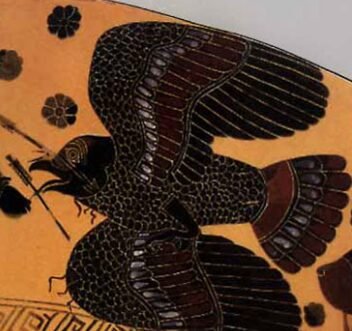
The Caucasian Eagle’s role was to eat Prometheus’ liver every day as it regenerated overnight, subjecting him to endless torment.
The Caucasian Eagle (Aetos Kaukasios) was a gigantic bird sent by Zeus to torment the Titan Prometheus. The eagle’s role was to eat Prometheus’ liver every day, which would regenerate overnight, leading to endless suffering.
- Role in Mythology: The Caucasian Eagle is part of the myth of Prometheus, who was punished by Zeus for stealing fire from the gods and giving it to humanity. The eagle was eventually slain by Heracles as part of his labors.
- Symbolism: The Caucasian Eagle represents divine retribution and the inescapable nature of punishment. It is a symbol of eternal torment, as it perpetually renews the suffering of Prometheus.

The Children of Typhon and Echidna are some of the most memorable figures in Greek mythology, each representing different aspects of the monstrous, the chaotic, and the challenges that heroes must overcome. Image: A 17th century panting by Italian artist Salvator Rosa titled “The Torture of Prometheus”.
The Colchian Dragon

The Colchian Dragon was never defeated in battle, but was instead lulled to sleep by the sorceress Medea, allowing Jason to steal the fleece.
The Colchian Dragon was an enormous serpent that guarded the Golden Fleece in the land of Colchis. This dragon was never defeated in combat but was instead lulled to sleep by the sorceress Medea, who aided Jason and the Argonauts in their quest to steal the fleece.
- Role in Mythology: The Colchian Dragon appears in the story of Jason and the Argonauts. The dragon was the final obstacle in their quest to obtain the Golden Fleece, a symbol of authority and kingship. Medea, using her magic, put the dragon to sleep, allowing Jason to take the fleece.
- Symbolism: The Colchian Dragon represents insurmountable obstacles and the necessity of cunning or external help to overcome them. It also symbolizes the concept of guardianship over something precious or powerful.
The Gorgons (Medusa, Stheno, and Euryale)

Gorgons in Greek mythology
Although the Gorgons are more commonly known as the daughters of Phorcys and Ceto, some later traditions link Medusa, the most famous Gorgon, to Typhon and Echidna. Medusa was a monstrous figure with snakes for hair and a gaze that could turn anyone who looked at her into stone.
- Role in Mythology: Medusa is best known from the myth of Perseus, who was tasked with beheading her. Using a mirrored shield given by Athena, Perseus avoided her deadly gaze and successfully decapitated her. From her severed neck sprang Pegasus, the winged horse, and Chrysaor, a giant.
- Symbolism: Medusa represents the destructive power of rage and the consequences of violating the natural order (as she was originally a beautiful maiden transformed into a monster by Athena). Her petrifying gaze symbolizes the power of an irreversible curse or the inescapability of certain fates.

Medusa (1597) by Italian painter Caravaggio. The oil on canvas mounted on wood shows the exact moment where Medusa’s head was cut off by Greek hero Perseus. The painting is now located in the Uffizi Museum in Florence, Italy.
The Harpies
In some accounts, the Harpies—winged spirits known for stealing food and tormenting mortals—are considered the offspring of Typhon and Echidna. They were often depicted as beautiful women with the bodies of birds, known for their swiftness and ability to snatch people or things away.
- Role in Mythology: The Harpies appear in several myths, including the story of Jason and the Argonauts, where they torment the blind prophet Phineus by stealing his food. They are also mentioned in Virgil’s “Aeneid,” where they prophesy future hardships for Aeneas and his men.
- Symbolism: The Harpies symbolize the destructive forces of wind and storm, as well as the idea of punishment or retribution from the gods. They also represent the concept of loss or something that is taken away suddenly and violently.
The Graeae
The Graeae, also known as the Grey Sisters, are sometimes considered children of Typhon and Echidna, though they are more commonly listed as daughters of Phorcys and Ceto. These sisters shared one eye and one tooth among them and were often depicted as old, withered crones.
- Role in Mythology: The Graeae are best known for their role in the myth of Perseus. They were forced by Perseus to reveal the location of the Gorgons by taking their shared eye and tooth until they complied.
- Symbolism: The Graeae represent the wisdom of age and the power of knowledge that is shared rather than individual. Their singular eye and tooth symbolize the idea of incomplete power or the need for cooperation to achieve a goal.
The Echidna of Scythia
In some myths, a different version of Echidna is mentioned as the “Echidna of Scythia,” who is a variant of the original Echidna but is described as being half-woman, half-serpent, and dwelling in a cave. This Echidna is said to have had children with Zeus, giving birth to several monstrous offspring that terrorized the region.
- Role in Mythology: The Echidna of Scythia appears in myths related to the Scythian people, where she gives birth to powerful beings that establish royal lineages or become powerful leaders.
- Symbolism: This version of Echidna symbolizes the link between the divine and the monstrous, as well as the idea of fertility and the creation of powerful, hybrid beings that influence the world.
The Dragon of Thebes
The Dragon of Thebes, another offspring of Typhon, guarded the sacred spring of Ares. It was defeated by Cadmus, the founder of Thebes, who planted its teeth in the ground, giving rise to the Spartoi, a group of fierce warriors.
- Role in Mythology: The Dragon of Thebes is central to the foundation myth of Thebes. Cadmus’ victory over the dragon and the subsequent creation of the Spartoi symbolize the establishment of order and civilization from chaos.
- Symbolism: The Dragon of Thebes represents primal chaos and the wild forces that must be subdued to establish civilization. The Spartoi, born from its teeth, symbolize the idea that order can arise from chaos, but often through conflict and struggle.
Questions and Answers
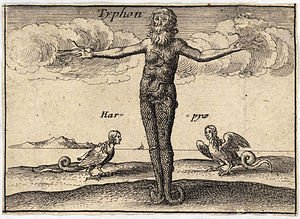
Through the stories of Typhon’s children, the ancient Greeks explored the boundaries of the natural and the supernatural. Typhon was Gaia and Tartarus’ last ditch effort to repel Zeus and the Olympians from taking over cosmos. | Depiction by Wenceslas Hollar
Who was Typhon in Greek mythology?
Typhon was the last son of Gaia, fathered by Tartarus, and known as the “Father of All Monsters.” He had a hundred dragon heads and was the most deadly monster in Greek mythology.
Who was Echidna, and what was her significance in Greek mythology?
Echidna was the wife of Typhon, known as the “Mother of All Monsters.” She was half woman, half snake, and, along with Typhon, raised many of the most fearsome monsters in Greek mythology.
What type of creature was Orthrus, and where did it live?
Orthrus was a fearsome two-headed hound that lived with giants.
What was the Sphinx known for in Greek mythology?
The Sphinx was a half-human, half-lion creature who killed anyone who could not answer her riddles. She drowned herself in a fit of rage when Oedipus answered her riddle correctly.
What was unique about the Nemean Lion, and what did it eventually become?
The Nemean Lion was a gigantic lion with impenetrable skin. After its death, it became the star constellation Leo.

Considered one of the fiercest offspring of Typhon, the Nemean Lion embody the fears and dangers of the ancient world, serving as both literal and symbolic obstacles in the stories of gods and heroes. Image: Hercules fighting the Nemean Lion
What role did Cerberus play in Greek mythology?
Cerberus was a three-headed dog that guarded the entrance to Hades, preventing the dead from leaving and the living from entering without permission.
What made the Lernaean Hydra difficult to defeat?
The Lernaean Hydra was a serpent-like water monster with multiple heads that multiplied if they were cut off, making it nearly impossible to defeat.
What was the role of the Caucasian Eagle in Greek mythology?
The Caucasian Eagle was a giant eagle that ate the liver of Prometheus every day as punishment for giving fire to humanity.
What are the major characteristics of the Chimera?
The Chimera was a monstrous fire-breathing hybrid creature with the body of a lion, the head of a goat, and a tail with a snake’s head.





