
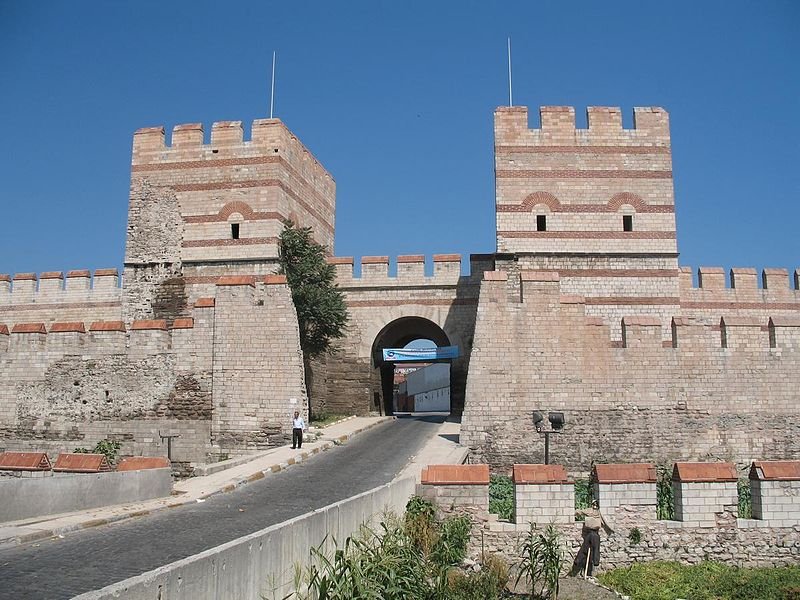
A restored section of the Walls of Constantinople.
The Walls of Constantinople are among the most remarkable fortification systems in history. Constructed initially under Constantine the Great, these walls protected the city for over a millennium. Constantly expanded and reinforced, they resisted numerous sieges, proving to be one of the most formidable defenses in military history. Despite the advent of gunpowder siege cannons, which contributed to the city’s fall to the Ottomans in 1453, the walls remained a remarkable engineering feat. Many sections still stand today, preserved through ongoing restoration efforts.
The Early Walls of Byzantium
Before its transformation into Constantinople, Byzantium was a small Greek colony fortified by a rudimentary wall system. According to tradition, the city was founded by Megarian Greeks led by Byzas around 658 BC. Over the centuries, the city endured several sieges, including an attack by Philip II of Macedon in the 4th century BC, which necessitated repairs and reinforcements to the defensive structures. Following the conquest by Septimius Severus in 196 AD, Byzantium suffered significant destruction but was later rebuilt, including the construction of new walls west of the original fortifications.
Constantinian Walls
With the foundation of Constantinople as the new Roman capital in 330 AD, Constantine the Great expanded the city’s fortifications. The new walls were built approximately 2.7 km west of the Severan Wall. Constructed as a single-wall fortification, these defenses proved effective in protecting the city, though they were eventually replaced by a more formidable system. By the early 5th century, the city had outgrown these walls, prompting the construction of the renowned Theodosian Walls.

The Theodosian Walls
Commissioned during the reign of Theodosius II (r. 402–450), the Theodosian Walls were a double-layered fortification system featuring an inner wall, an outer wall, and a broad moat. This complex defensive structure stretched about 5.6 km across the landward side of the city, approximately 2 km west of the Constantinian Wall. Despite severe damage from earthquakes, particularly in 447 AD, emergency repairs restored their strength, allowing the city to repel various sieges from Attila the Hun, the Arabs, Bulgars, and the Rus’.
The Theodosian Walls were built to protect Constantinople as the city expanded beyond Constantine’s original fortifications, making it one of the most formidable cities in medieval history.
Structure and Design
The Theodosian Walls consisted of three primary components:
- The Inner Wall: Standing approximately 12 meters high and 5 meters thick, reinforced by 96 towers.
- The Outer Wall: 8.5 meters high, positioned about 15 meters in front of the inner wall, also featuring towers.
- The Moat: 20 meters wide and up to 10 meters deep, sometimes flooded to further impede attackers.
This multi-layered design made the walls nearly impregnable for medieval armies, requiring sustained and well-equipped sieges for any hope of success.
The Theodosian Walls consisted of a double-wall system with an inner wall, an outer wall, and a deep moat, making them one of the most complex and effective fortification systems of antiquity.
The Golden Gate and Other Gates
One of the most significant entry points into the city was the Golden Gate, a massive ceremonial gateway constructed of marble. Used for imperial triumphal entries, it symbolized the city’s grandeur. Other notable gates included:
- Gate of St. Romanus: The site of the fiercest fighting during the 1453 siege.
- Xylokerkos Gate: Walled up for centuries, reopened only in the late Ottoman period.
- Pege Gate: Used during the Byzantine recapture of Constantinople in 1261.
The Xylokerkos Gate, also known as the Gate of Belgrade.
Later Additions and Modifications
Several Byzantine emperors reinforced and expanded the walls. The Komnenian-era modifications, such as the Wall of Manuel Komnenos, strengthened the Blachernae sector. The Walls of Blachernae, added in the 12th century, provided additional security for the imperial palace. Despite continuous efforts to maintain them, the walls saw increasing neglect during the late Byzantine period due to economic constraints.
The Fall of Constantinople and the Ottoman Period
The walls resisted numerous sieges over the centuries, but the development of gunpowder artillery ultimately sealed their fate. During the siege of 1453, Sultan Mehmed II deployed massive cannons, including the giant bombard designed by Orban, which eventually breached the walls at the Gate of St. Romanus. After the conquest, the Ottomans largely maintained the walls, using them for defense and city control. The Yedikule Fortress, built soon after the conquest, incorporated sections of the Golden Gate into its structure.
The Walls of Constantinople (Turkish: Konstantinopolis Surları; Greek: Τεῐχη της Κωνσταντινουπόλεως) influence on military architecture is profound, inspiring defensive structures in medieval Europe and beyond.
Preservation and Restoration
During the 19th century, sections of the walls were dismantled as Istanbul expanded beyond its medieval boundaries. In the 1980s, extensive restoration projects began, some controversial due to the use of inappropriate materials. Despite these challenges, the walls remain a significant historical and architectural landmark, recognized by UNESCO and conservation organizations.
Frequently Asked Questions
How effective were the Walls of Constantinople?
The walls repelled numerous attacks from the Avars, Arabs, Bulgars, Rus’, and other invaders for nearly a thousand years, making Constantinople one of the most resilient cities in history.
When did the walls finally fail?
The walls were breached by the Ottomans in 1453, aided by massive cannon bombardments, marking the fall of Constantinople and the end of the Byzantine Empire.
What role did the Golden Gate play?
The Golden Gate was a ceremonial entrance used for imperial triumphs and was part of the strongest section of the fortifications.
What happened to the walls after the Ottoman conquest?
The Ottomans maintained the walls for centuries, but parts were dismantled in the 19th century as the city expanded beyond its medieval boundaries.
Are the Walls of Constantinople still standing today?
Yes, significant portions remain, particularly the Theodosian Walls, and restoration efforts have been ongoing since the 1980s.
What was the function of the Sea Walls and Golden Horn Walls?
The Sea Walls protected the city from naval attacks, while the Golden Horn Walls secured the city’s vital northern harbor, aided by a large chain blocking enemy ships.
What other fortifications protected Constantinople?
The Anastasian Wall, located further west, acted as an outer defense, while fortresses like Anadoluhisarı and Rumelihisarı controlled access to the Bosphorus.





