What triggered the Kaidu–Kublai war?
The Kaidu-Kublai war (1268–1301) was pivotal in permanently dividing the Mongol Empire into four independent khanates: the Golden Horde, Chagatai Khanate, Ilkhanate, and Yuan dynasty. This conflict followed the earlier Toluid Civil War (1260–1264) and underscored the growing rivalry among Mongol leaders, ending the dream of a unified Mongol Empire.
Kaidu’s Rise and Initial Conflicts
After the Toluid Civil War, Kublai Khan emerged victorious but faced opposition from Kaidu, who refused to submit to Kublai’s authority as the Great Khan. In 1266, Kublai attempted to consolidate power by appointing Baraq as the ruler of the Chagatai Khanate, but Baraq, supported by Kaidu, rejected Kublai’s authority.

An illustration depicting Kaidu (center).
Kaidu, a grandson of Ögedei Khan, was a central figure in the disintegration of the Mongol Empire.
Kaidu and Baraq initially clashed, but Kaidu eventually consolidated control over Bukhara and gained Baraq’s allegiance. The two leaders allied against the Ilkhanate and Yuan dynasty, culminating in Baraq’s defeat at the Battle of Herat in 1270. After Baraq’s death, Kaidu emerged as the dominant figure in Central Asia, securing the loyalty of the Chagatayid princes, albeit with significant resistance.

Kaidu’s Challenges in the Chagatai Khanate
Although Kaidu became the de facto ruler of the Chagatai Khanate, his authority faced persistent challenges. Chagatai princes and local leaders, such as Negübei, repeatedly rebelled against his rule. Kaidu’s control only stabilized after 1282 when he appointed Duwa as the khan of the Chagatai Khanate. Duwa became a loyal ally, serving as Kaidu’s second-in-command.
The Golden Horde also allied with Kaidu during this period, strengthening his position. However, the death of Mengu-Timur, the khan of the Golden Horde, in 1284 led to fractures within their alliance, as some Golden Horde leaders sought peace with Kublai Khan.
Kaidu’s Campaigns Against the Yuan Dynasty
Kaidu launched repeated invasions of Yuan-controlled territories, starting with an attack on Ürümqi in 1275. Despite capturing Almaliq and disrupting Yuan-controlled regions, Kublai Khan countered with strategic measures. He fortified key regions in the Tarim Basin, including Beshbalik and Khotan, establishing garrisons, postal stations, and agricultural colonies to support his defenses.
Kaidu’s defiance against Kublai Khan and his successors reshaped the Mongol Empire’s trajectory.
Kublai’s efforts to economically isolate Kaidu were met with mixed success. Although Yuan forces maintained a strong presence, Kaidu’s continuous raids forced the Yuan to withdraw from parts of Central Asia by the late 1280s.
Conflict with Kublai’s Successors
After Kublai Khan’s death in 1294, his successor, Temür Khan, faced increasing aggression from Kaidu and his allies. Duwa, Kaidu’s loyal subordinate, launched surprise attacks on Yuan forces, capturing key figures and disrupting the Yuan’s defenses in Mongolia. Temür responded by reorganizing his military leadership and launching counteroffensives.
The conflict reached its peak in 1300 when Kaidu and Duwa mobilized a large army to attack Karakorum, the former Mongol capital. Although both sides suffered heavy losses, neither could achieve a decisive victory. During a subsequent battle near Karakorum in 1301, Kaidu was mortally wounded and later died, marking the end of his decades-long struggle against the Yuan dynasty.

Impact of the Kaidu-Kublai War
The Kaidu-Kublai war had profound consequences for the Mongol Empire. The prolonged conflict deepened the divisions among the khanates and solidified their independence. Although Temür Khan achieved a nominal peace with the western khanates in 1304, the empire’s unity had irreparably fractured.
Each khanate pursued its own political, cultural, and military goals. The Yuan dynasty focused on consolidating power in China, while the Chagatai Khanate, Ilkhanate, and Golden Horde developed distinct identities. This fragmentation marked the end of the unified Mongol Empire envisioned by Genghis Khan.
Why didn’t the Great Mongol Emperor Genghis Khan invade India?
Timeline of the Kaidu-Kublai war (1268–1301)
1260–1264: The Toluid Civil War sets the stage for future divisions in the Mongol Empire.
1266: Baraq repudiates Kublai Khan’s authority, with Kaidu gaining influence in Central Asia and forming alliances.
1268: Kaidu begins his prolonged war against Kublai Khan to resist Yuan dominance.
1270: Baraq’s defeat at Herat by the Ilkhanate weakens Chagatai authority, and Kaidu consolidates power.
1276–1283: Yuan forces fortify Central Asia, but Kaidu’s raids disrupt Yuan control in the Tarim Basin.
1284: Golden Horde leaders withdraw support from Kaidu, signaling fractures in his alliances.
1294: Kublai Khan dies, and Temür succeeds him as Yuan emperor.
1298–1301: Kaidu intensifies attacks, culminating in his death after a battle near Karakorum.
1304: Peace is established among the khanates, but the empire remains permanently fragmented.
Questions and Answers
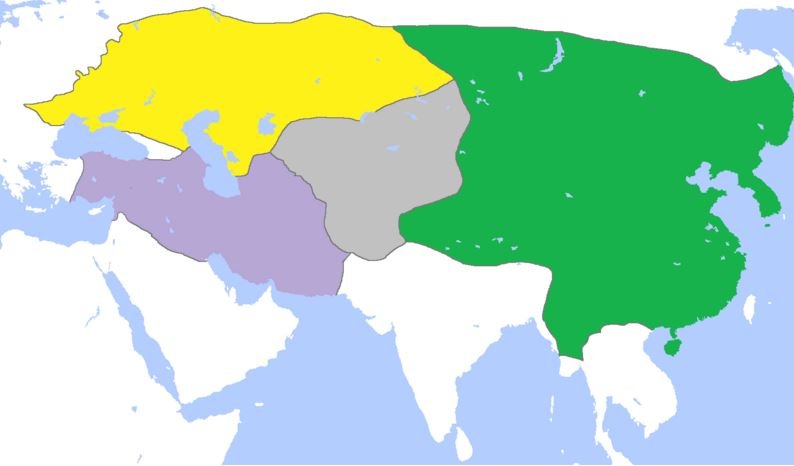
The map of the Mongol Empire, showing the various divisions; Golden Horde (yellow), Chagatai Khanate (gray), Great Yuan Dynasty (green), and Ilkhanate (purple).
Who was Kaidu, and what was his role in the war?
Kaidu was the leader of the House of Ögedei and de facto ruler of the Chagatai Khanate. He opposed Kublai’s Yuan dynasty and aimed to maintain control over Central Asia.
What role did Baraq play in the conflict?
Baraq, initially ruling the Chagatai Khanate, repudiated Kublai’s authority and allied with Kaidu against the Yuan dynasty and the Ilkhanate. However, Baraq’s defeat at Herat in 1270 and subsequent death enabled Kaidu to consolidate power.
How did Kublai respond to Kaidu’s resistance?
Kublai established garrisons, economic sieges, and administrative measures in regions like the Tarim Basin to counter Kaidu’s raids. Despite these efforts, Kaidu consistently resisted and disrupted Yuan control.

What was the significance of Duwa in the war?
Duwa, appointed by Kaidu as Khan of the Chagatai Khanate, became a key ally. He led raids against the Yuan and supported Kaidu’s campaigns but later played a role in peace negotiations after Kaidu’s death.
How did the Golden Horde’s position impact the war?
Initially an ally of Kaidu, the Golden Horde withdrew support after the death of its leader Mengu-Timur. Its leaders later made peace with both the Yuan dynasty and the Ilkhanate, weakening Kaidu’s alliances.
What marked the end of the Kaidu-Kublai war?
The war ended after Kaidu’s death in 1301 following a battle near Karakorum. His death marked the decline of his resistance and eventual peace among the Mongol khanates in 1304.
How did the war affect the Mongol Empire?
The war deepened the fragmentation of the empire, solidifying the division into four separate khanates. Although a nominal peace was established in 1304, the khanates continued to develop independently.





