What was the Great Irish Famine and How many people died as a result of the Irish Catastrophe?

Great Famine in Ireland
The following are some frequently asked questions that shed light on the Irish Potato Famine, aka the Great Famine:
How many people died as a result of the Great Irish Famine?
It has been estimated that between 1845 and 1850, the famine directly or indirectly claimed the lives of a shocking one million people. What that means is that about one-eighth of the island’s population died.
The Irish catastrophe is said to have shrunk Ireland’s population by about a quarter.
Did the British government’s policies exacerbate the suffering?
Yes. Over the years, the British government has been criticized for it laissez-faire approach in handling the Irish Potato famine. Politicians in London discontinued providing vital social and economic support to Ireland at a time when the famine was devastating every nook and cranny of Ireland. It was a simple case of management of a disaster.
The warning signs were on the wall as early as 1846, when almost all of the potatoes failed in Ireland. Soon, other crops like wheat, oats, and barely started suffering as well. Amidst all of that, the British government proceeded to scale back on social support programs on the island. The chief government official in charge of the crisis – Charles Trevelyan – erroneously believed that a non-interventionist policy and the free market would fix the problem. With no government intervention, prices of food skyrocketed on the island, further pushing millions of people into poverty. The few Irish that had money couldn’t even buy food because there was simply no food on the market.
The government’s decision to suspend the soup-kitchen program in late 1847 worsened the catastrophe. Those food programs fed more than two million people a day. Scrapping it off was a bad decision.
Had the Britain provided a swift and reliable response all through the seven years, the number of deaths and the suffering would definitely not have been that severe.

The famine which started as a natural disaster was made far worse by some policies and policies not taken by politicians and policy-makers at Westminster. John Russell succeeded Robert Peel in 1846 as Prime Minister of the United Kingdom. Russell and his Whig Party did not have the political will to adequately tackle the Great Irish Famine
How did the English Protestant landlords make the famine worse?
Much of the lands cultivated by the Irish farmers was owned by the English, who employed middlemen to manage the lands on their behalf in Ireland. Often times, those middlemen abused the tenancy agreement with the Irish Catholic tenants. Irish farmers’ sufferings were compounded because many of them were evicted from the lands as they could not afford the rents. The landlords in England simply failed to intervene, resulting in more pain for the Irish farmers.
And as the English government continued to impose taxes on the landlords to fund relief programs, many landlords tried to avoid paying. They simply evicted the tenants. Tenants that resisted eviction had their houses burnt down.
In the seven years that famine scorched Ireland, over a half a million people were forced out of their homes by English landlords. This explains the level of homelessness that Ireland witnessed during the famine. Certainly, had the British government intervened and stopped those evictions, the situation wouldn’t have gotten that bad.
How did typhus make the famine much worse?
The homeless simply couldn’t catch a break as the winter season that followed was said to be very severe. Throw in diseases like typhus into the mix, and then you have an extremely sickening catastrophe. The disease, which was called “famine fever”, was transmitted via human lice that carried the Rickettsiea prowazekii.
According to the America’s CDC (centers for Disease Control and Prevention), typhus spreads very rapidly in overcrowded places. Since many Irish people were homeless and had resorted to taking shelter in poor and unsanitary makeshift houses, typhus spread like wildfire. The infected suffered symptoms like fever and chills, rapid breathing, headache, nausea, and vomiting, among others.
It remains unclear whether more people died of typhus and other diseases than starvation.
What fungus caused the potato blight?
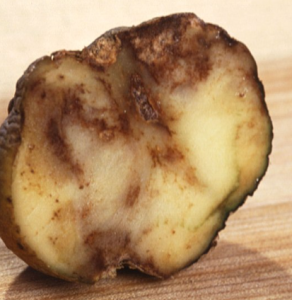
Infected potatoes turned black and became slimy on the inside.
The name of the fungus that devastated Irish farmers’ potatoes was the phytophthora infestans, a lethal plant pathogen. Described as an oomycete, the fungus has some characteristics similar to brown algae. The mode of transmission was primarily via insects, wind and rain. It so happens that 1845 was an ideal period for the fungus to spread rapidly as Ireland had a lot of rain and relatively warm temperature. That year alone, close to half of all potato planted in the country was blighted by the fungus.
A potato that is infected with the phytophthora infestans turns black. The inside of the potato becomes very slimy, producing a foul smell.
As of 2022, no other plant pathogen has wrecked more havoc than the phytophthora.
Where did the Irish potato blight disease come from?
The immediate source of the fungus was traced to the United States. Experts and historians reason that the fungus came aboard ships from the U.S. around 1843. The United States in turn most likely took receipt of the fungus from ships coming from central Mexico.
Why did Ireland continue exporting food and other livestock during the famine?
Farmers of other crops and livestock producers had to sell their produce outside as Irish farmers were simply too poor to afford them. The non-potato farmers sourly needed to the money in order to pay their rent. The actions of those farmers were seen as evil by the poor, starving potato farmers.
Did the British government’s work projects have any effect?
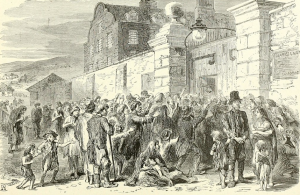
Workhouses were crowded and riddled with typhus and other diseases.
The British government introduced work projects as a means to boost the purchasing power of the Irishman. Many Irish farmers had been rendered unemployed as result of the potato blight. So the British government hoped that creation of jobs on the island would jumpstart the ailing economy.
What the economists and politicians in Westminster did not know is that the issue was not an economic problem. It was a humanitarian crisis that could not be fixed with money.
The people were starving, and what they needed was food. And granted the starving and weak unemployed farmers were able to earn some money from those work projects, the question that begs to be answered is: of what use was the money in a country that had no food? Furthermore, the wages the workers received could not keep up with the soaring food prices at the time.
How many people emigrated from Ireland during the Great Famine?
It’s been estimated that more than a million Irish fled the island, with many of them settling in the United States, Australia, Canada, and England. There were even cases of some generous landlords footing the bill their Irish tenants traveling to United States. This was another very crafty way the English landlords avoided paying taxes on their lands.
The sad thing is that several thousands of the people that fled did not make it to those countries. Since the ships were cramped up, many people, who by the way were malnourished and starving, died on the voyages. Those ships were basically thriving grounds for the spread of typhus. This was because of the overcrowded and unsanitary conditions of the ships.
As Irish immigrants began to overwhelm the system, countries like Canada introduced an immigration policy that sourly affected the poor Irish. Only relatively rich landowners and the top middle-class could afford to immigrate to Canada.
Again had the British government stepped in and made it easy for people wanting to flee the island, the very poor folks wouldn’t have suffered further.
How much did Queen Victoria donate to Ireland during the famine?
There have been criticisms thrown the way of Queen Victoria, the then-monarch of England, with some calling her the “Famine Queen”. The monarch may have failed to act swiftly policy wise; however, she did try to save face by donating about £2,000 (which is about £62,000 in today’s pounds) to the starving population of Ireland. It has been erroneously stated that she only donated £5 to Ireland.
How did the Great Famine fuel calls for Irish independence later?
Having been ravaged by the potato blight for seven years, many of the people who survived came to have doubts about the benefits of being in ruled by politicians in London.
There were some Irish nationalist that erroneously described the catastrophe as an artificial famine caused by England. For many centuries, the Catholic-majority Ireland were displeased by British policy-makers taking them for granted and treating them as second-class citizens. Perhaps it was out of such prejudices that the British government failed to do nothing about the Irish catastrophe.
In the time of their suffering, England did not have the political will to provide the needed support to Ireland. And so Irish independence sentiment was aroused in the decades that followed. After four-fifths of Ireland gave a thumb up to formation of the Irish Free State, Irish nationalists went on to form what is now Northern Ireland in the 1920s.
Other Interesting Facts about the Irish Famine

Westminster simply did not consider the sufferings of the Irish as matter of national emergency. Image: Skibbereen engraving by Irish artist James Mahony, 1847
- In the Irish language, the potato famine is termed as “An Gorta Mor”, which means “the Great Hunger”.
- One of the reasons for there being a sizable Irish diaspora in the western hemisphere is because of the millions of Irish men, women and children that fled the island during the famine. In the United States, many of those refugees settled in places like New York City and Boston.
- The Scottish football club Celtic was founded by Irish immigrants that had fled Ireland during the Great Famine. To this day, the football club pays homage to the effort of those immigrants in laying the pillars of the club.
- The Irish Potato Famine, also known as the Great Famine, was a period between 1845 and 1852 which saw the deaths of more than a million people as a result of the potato blight that tore through Ireland.





