Anna May Wong – History, Facts & Accomplishments
She used to daydream about becoming a famous Hollywood actress like her heroes Mary Pickford and Pearl White when she was younger. Years later, with more than 60 films to her name, the dream did become a reality. Additionally, she was regarded as Hollywood’s first Chinese-American movie star. With jobs in silent cinema, television, and the theater, she was cast in one of the earliest Technicolor pictures. Now, because of her widespread recognition, entertainers all over the world continue to be influenced by her legacy. Let’s explore the life of iconic actress Anna May Wong.

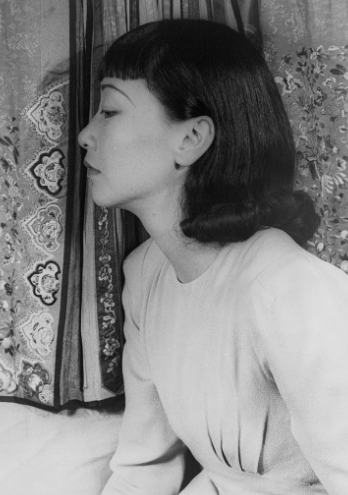
Portrait of Anna May Wong by American artistic photographer Carl Van Vechten, 1935
Early Life
Anna May Wong was born in Los Angeles’ Chinatown on January 3, 1905. She was the second of eight children, and her given name, Wong Liu Tsong, means “Frosted Yellow Willows.” Her parents gave her the English name Anna May. Her ancestors were from Taishan, China, but her grandpa immigrated to the United States in the 1850s.
On North Figueroa Street in Los Angeles, her parents established a laundromat. She was born into a multicultural area, where the kids went to California Street Elementary School. On the other hand, because of their race, she and her older sister were tormented and teased and didn’t feel welcome at school. So her parents relocated them to Chinatown’s Chinese Mission School, where they were accepted.
Anna May Wong’s Dream
Her father was a firm believer in introducing his children to the creative arts, and he frequently took them to traditional Chinese theatrical shows. The local film industry, however, captivated the young actress, who would daydream of being a movie star and decided to become one when she was nine years old. She chose Anna May Wong as her stage name at the age of eleven by merging her English and Chinese names.
When James Wang, a frequent collaborator with the film industry and a local Baptist minister, suggested she be an extra in “The Red Lantern,” an Alla Nazimova silent production, her daydreams seemed to be a reality. She was a hired extra for the film, and in one scene, was instructed to hold a lantern. That became her first recognized position.
While still enrolled in school, she continued to work as an extra in numerous films. She therefore left Los Angeles High School in 1921 to pursue her career as a full-time actor. In the same year, she was cast as Lon Chaney’s wife in the movie “Bits of Life.” She received her first major role at the age of seventeen in “The Toll of the Sea” (1922), the first Technicolor feature film. This film was a silent adaptation of the motion picture “Madame Butterfly.” Her supporting role as a Mongol slave girl and spy opposite Douglas Fairbanks in “The Thief of Bagdad” (1924) catapulted her to stardom.
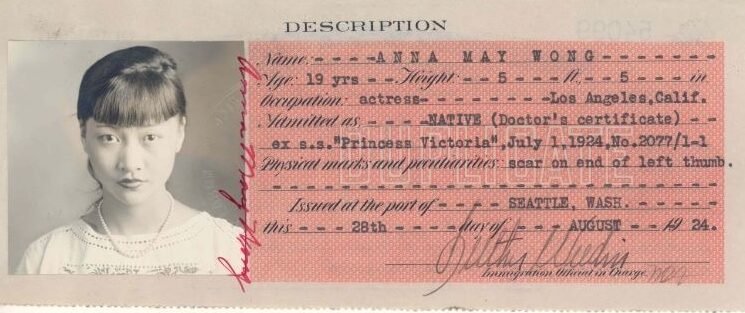
Image: This is a duplicate copy of the Certificate of Identity issued to actress Anna May Wong.
Racism and Whitewashing in Hollywood
Despite her continuous attempts to land leading roles, she was constantly given supporting or stereotypical “Asian” roles. At the time, anti-miscegenation laws in the US prohibited interracial unions and even forbade interracial performers from sharing an on-screen kiss. She was unable to obtain certain starring roles in romantic movies as a result.
To be able to work at her own pace without so many restrictions, she founded her own production company, Anna May Wong Productions, in March 1924 so she could produce her own films depicting her culture. However, the company was forced to close after her business partner was exposed for engaging in unethical behaviors.
Success in Europe
Despite being the star and receiving top billing in the 1931 film “Daughter of the Dragon,” she received only half as much money as Warner Oland, a non-Asian actor who played her father the antagonist Fu Manchu and had significantly less screen time. Feeling constrained and stereotyped in Hollywood and the United States in general, she sought for better working conditions and seemed to have found it in Europe.
After relocating to Europe, she appeared in a number of plays and motion pictures, including “Schmutziges Geld” in 1928, “Piccadilly” in 1929, and “The Flame of Love,” her first talkie, in 1930. She also acted alongside Laurence Olivier in the drama “A Circle of Chalk” and the operetta “Tschun Tschi.”
She felt ready to battle Hollywood’s bigotry after all of the fresh training, reputation, and renown she had received in Europe. During the first part of the 1930s, she traveled back and forth between the US and Europe for film and theatrical work. She appeared in early sound era movies such as “Java Head” (1934), “Daughter of Shanghai” (1937), and in “Shanghai Express” starring alongside Marlene Dietrich.
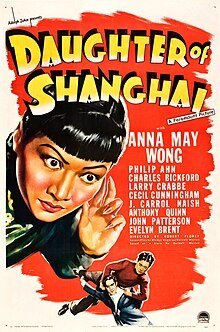
Theatrical release poster of Daughter of Shanghai, a 1937 American crime film directed by Robert Florey. The film starred Anna May Wong alongside Buster Crabbe and Charles Bickford
Even so, Anna was unable to stem the tide on her own. She was still subjected to discrimination and passed over for leading parts. She was rejected for parts in movies where the male lead wasn’t Asian in order to avoid any contentious interracial romances, and one director even referred to her as “too Chinese to portray a Chinese.”
The worst setback of her career came in 1935 when Metro-Goldwyn-Mayer flatly refused to give her the leading role of the Chinese heroine O-Lan in the motion picture adaptation of Pearl S. Buck’s “The Good Earth.” Luise Rainer was instead chosen by MGM to portray the lead in “yellowface.” This film is known today as one of the most infamous instances of casting prejudice in the 1930s.
In another instance, she once rejected a director’s request to adopt Japanese mannerisms when portraying a Chinese character in the movie “Dangerous to Know.”
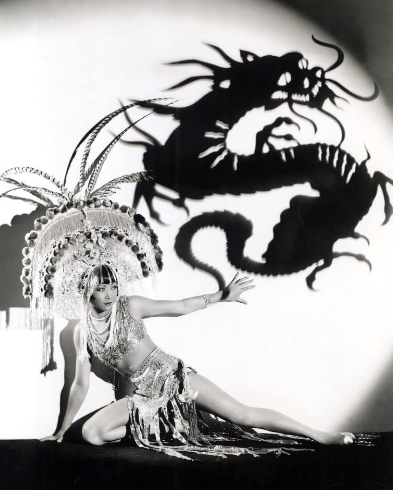
Image: Anna May Wong in Daughter of the Dragon, a 1931 film written and directed by American filmmaker Lloyd Corrigan
Her Love Life
Her romantic relationships were typically with older Caucasian men, but until 1948, California law prohibited Asians and Caucasians from getting married. One of her white partners offered to marry her in Mexico, but when the couple’s intentions were revealed, he backed off, fearing for his Hollywood career. She could have opted for a Chinese partner but because actors were viewed on the same level as prostitutes to put it blantly, she wasn’t the ideal spouse. She also feared that marrying a Chinese man would make her give up her profession and become a dutiful wife because of the cultural norms in her society.
Notable Achievements
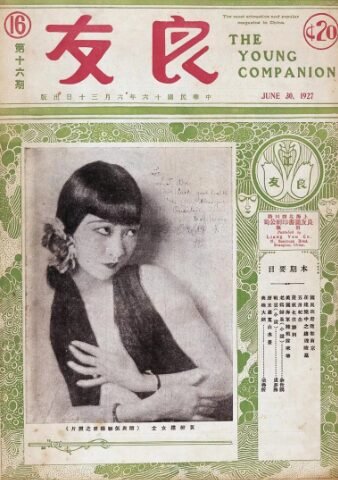
Image: Wong on the cover of the Chinese magazine The Young Companion in June 1927
But the actress’ situation wasn’t entirely hopeless; as the band Queen so well put it, “the show must go on,” and so did her career. She was successful in landing new jobs including “Shanghai Express.” She spent the following year exploring China after producing this movie. With her work on “The Gallery of Madame Liu-Tsong,” which has her real name in the title, she returned to the US in the 1950s and made history by becoming the first Asian American to serve as the showrunner of a US television program.
Being a Hollywood star was never easy, especially for the recognized minority, but Ms. Wong made a point of standing out to establish her status as a celebrity. She worked during a time when East Asian Americans were stereotyped in movies and frequently portrayed by non-East Asian actors who used yellow makeup on their skin and tape on their eyelids to imitate what the industry deemed to be Asian facial features.
She made an effort, nonetheless, to avoid falling into the long-standing stereotype in order to give Asians a voice in the movie industry. She started off appearing in low-budget B movies so she could portray powerful, well-written Chinese characters rather than usual clichés. She used her roles to defy numerous stereotypes as an Asian American woman.
She was a passionate humanitarian and philanthropist who, during World War II, focused more of her energy and resources on supporting China’s fight against Japan and paid less attention to her film career. She even authored a critique of Japan’s invasion of Manchuria in 1931. She also earned money for charities by auctioning off her costumes and contributing the earnings to Chinese relief, as well as by developing a cookbook and selling the proceeds to benefit United China Relief.
She protested against depictions of Chinese characters that were racially insensitive, using her notoriety and power to raise awareness of and condemn these practices in Hollywood. She also helped pave the way for other performers of color to follow by getting them more prominent and leading roles.
She worked her entire life in a field where she was always discriminated against, regardless of where she found herself.
Today, Hollywood still misrepresents films, has stereotypical roles, and discriminates in casting. Nonetheless, Asian actors and other performers of color have far more possibilities today as a result of the tireless efforts of people like Anna who would fight for what is right.
Demise and Acknowledgements
She had been looking forward to making a comeback in the movie “Flower Drum Song” when she passed away from a heart attack in 1961, at the age of 56. Decades after her passing, Asian Fashion Designers and the Asian-American Arts Awards both named yearly awards in her honor. She received a star on the Hollywood Walk of Fame shortly before her death in 1960.
Did you know…?
- In 2019, when Lucy Liu became the second Asian American woman to receive a Hollywood star, she praised her for being a “pioneer while enduring racism, marginalization, and exclusion.”
- Ventris Gibson, the 40th director of the US Mint, revealed in a press release in October 2022 that the iconic actress would be featured on the quarter. Ms. Wong would be the fifth and final woman to appear on the newly released 25 cent American coin. On opposite sides of the quarter are President George Washington and Anna May Wong.
- Her face joining that of other accomplished women like poet Maya Angelou and suffragist Nina Otero-Warren serves as a tribute to her struggle against prejudice in Hollywood.
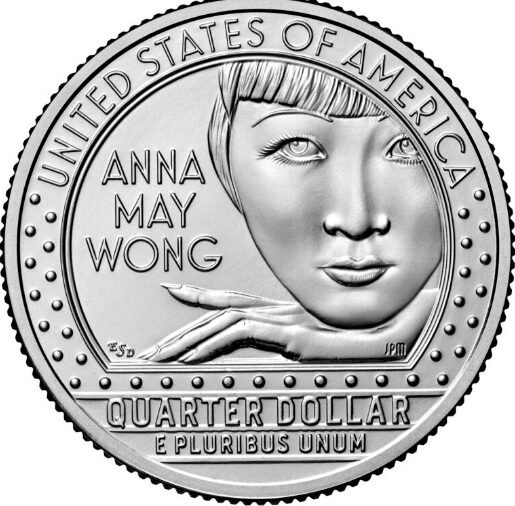
In 2022, Anna May Wong became the first Asian American featured on U.S. coinage through the American Women Quarters series. Image: A US quarter featuring Anna May Wong
Questions and Answers: Anna May Wong’s Life and Career
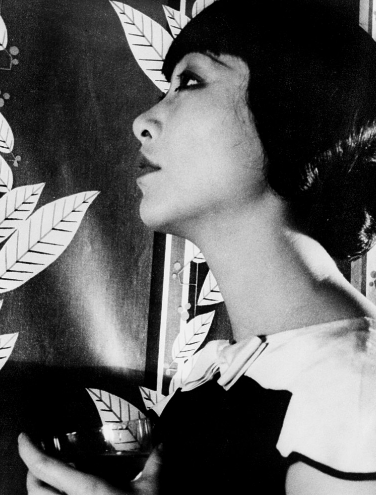
Portrait of Anna May Wong by American artistic photographer Carl Van Vechten, 1932
Who was Anna May Wong?
Anna May Wong, born Wong Liu Tsong on January 3, 1905, in Los Angeles, was the first Chinese American film star in Hollywood and the first Chinese American actress to achieve international fame. She had a significant career that spanned silent films, sound films, television, stage, and radio.
What is Anna May Wong widely recognized for in Hollywood?
Anna May Wong is recognized as the first Chinese American film star in Hollywood and the first Chinese American actress to gain international recognition, breaking barriers in the entertainment industry.
Where was Anna May Wong born and raised?
Anna May Wong was born in Los Angeles, California, and was raised in a vibrant, multicultural environment in early 20th-century Los Angeles.
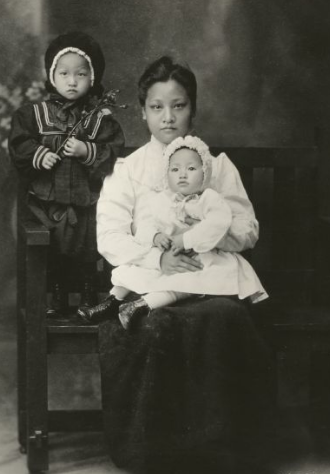
Image: Anna May Wong seated in her mother’s lap, c. 1905
At what age did Anna May Wong decide to become an actress, and what sparked her interest?
Anna May Wong decided to become an actress at the age of 11. She became fascinated with films at a young age, which fueled her ambition to pursue a career in acting.
What was Anna May Wong’s first film role?
Her first role was as an extra in the 1919 film The Red Lantern.
Which films during the silent era brought Anna May Wong significant attention?
Wong gained attention for her performances in The Toll of the Sea (1922), one of the earliest color films, and The Thief of Bagdad (1924), starring Douglas Fairbanks.
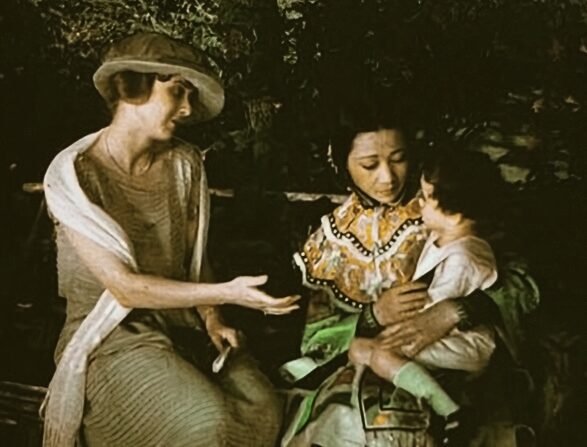
Image: Wong (holding child) with Beatrice Bentley in The Toll of the Sea, a 1922 American silent drama film directed by Chester M. Franklin
How did Anna May Wong influence fashion in the 1920s and 1930s?
Anna May Wong became a fashion icon and international star, known for embracing the flapper style. In 1934, the Mayfair Mannequin Society of New York named her the “world’s best dressed woman,” solidifying her status as a leading fashion figure.
What challenges did Anna May Wong face in Hollywood?
Despite her success, Wong was often relegated to stereotypical supporting roles due to her ethnicity, which frustrated her and led her to seek more fulfilling opportunities in Europe.
Why did Anna May Wong leave Hollywood for Europe in 1928?
Frustrated by the limited and stereotypical roles offered to her in Hollywood, Wong left for Europe in March 1928, where she starred in several acclaimed plays and films, achieving greater artistic freedom.
Which films and roles marked Anna May Wong’s return to the U.S. film industry in the early 1930s?
Upon her return, Wong appeared in Daughter of the Dragon (1931), Shanghai Express (1932) alongside Marlene Dietrich, Java Head (1934), and Daughter of Shanghai (1937).
What was the most significant disappointment of Wong’s career in 1935?
The most significant disappointment of Wong’s career occurred when MGM refused to consider her for the lead role of O-Lan in The Good Earth, opting instead for Luise Rainer, who played the role in yellowface.
How did Anna May Wong reconnect with her heritage after the disappointment in 1935?
After being passed over for The Good Earth, Wong spent a year touring China, exploring her heritage, studying Chinese culture, and documenting her experiences on film.
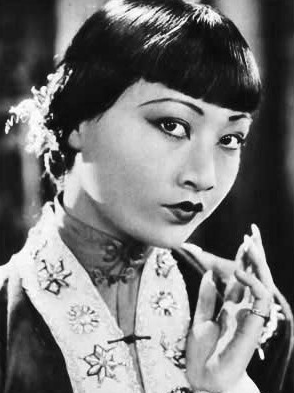
Photograph of Anna May Wong from Stars of the Photoplay, 1930
What role did Anna May Wong play during World War II?
During World War II, Wong shifted her focus from her film career to support the Chinese cause against Japan, dedicating her time and resources to the effort.
What historical achievement did Anna May Wong accomplish in television?
In 1951, Anna May Wong made history as the star of The Gallery of Madame Liu-Tsong, the first U.S. television show to feature an Asian American in the lead role.
What was Anna May Wong planning before her death in 1961?
Anna May Wong was planning to return to the big screen in the film Flower Drum Song before her untimely death from a heart attack on February 3, 1961.
How was Anna May Wong remembered after her death, and how has her legacy been re-evaluated?
For many years, Wong was remembered primarily for the stereotypical roles she often played, such as the “Dragon Lady” and “Butterfly” characters. However, her life and career were re-evaluated around the centennial of her birth, leading to a renewed appreciation of her contributions to film and her pioneering role as a Chinese American actress in Hollywood.