What was the Scilly naval disaster of 1707?
The Scilly naval disaster of 1707 remains one of the most tragic maritime incidents in British history. On the night of October 22, 1707, four Royal Navy warships were lost in treacherous waters off the Isles of Scilly, claiming the lives of between 1,450 and 2,000 sailors. This disaster, occurring during the War of the Spanish Succession, underscored the perils of navigation in the early 18th century and significantly influenced maritime advancements.
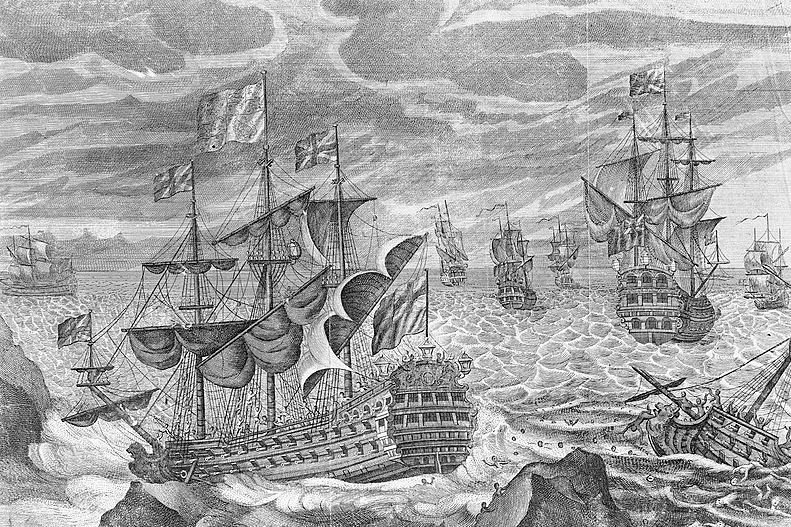
The primary causes of the Scilly naval disaster of 1707 included inaccurate navigational tools, errors in mapping, and adverse weather conditions. Image: An illustration of the Scilly naval incident.
Background and Strategic Context
The incident was rooted in Britain’s military campaign against France during the War of the Spanish Succession. In July 1707, a combined British, Austrian, and Dutch force, under the command of Prince Eugene of Savoy, laid siege to Toulon, a key French naval base.
To support the offensive, Great Britain dispatched a fleet under the leadership of Sir Cloudesley Shovell, the Commander-in-Chief of the British Fleets. The British fleet inflicted considerable damage on the French naval assets but ultimately failed to capture Toulon.
Consequently, Shovell received orders to return to England. In late September 1707, the fleet, consisting of fifteen ships of the line, four fireships, a sloop, and a yacht, set sail from Gibraltar for Portsmouth.
Deteriorating Weather and Navigational Challenges
As the fleet traversed the Atlantic, it encountered severe weather conditions, marked by relentless westerly gales and squalls. The mariners struggled to determine their precise latitude due to the absence of clear skies needed for celestial navigation.
Despite these challenges, on October 21, the fleet managed to obtain a reading at approximately 48° 50′-57′ N, placing them around 200 miles southwest of Scilly. However, from that point onward, they had to rely on dead reckoning, an imprecise method of estimating a ship’s position based on speed, direction, and time elapsed.
Tragic Miscalculation and the Shipwrecks
By the evening of October 22, the fleet believed it was safely navigating through open waters. However, a fatal miscalculation in their estimated position placed them dangerously close to the rocky Isles of Scilly. As darkness fell and visibility remained poor, the ships unknowingly advanced towards disaster. At approximately 8 PM, the flagship HMS Association, commanded by Captain Edmund Loades, struck the Outer Gilstone Rock. Within minutes, the ship sank, claiming the lives of all 800 men on board, including Admiral Shovell. The catastrophic event unfolded rapidly, as more ships followed:
- HMS Eagle, a 70-gun third-rate ship, struck the Crim Rocks and was lost with all hands.
- HMS Romney, a 50-gun fourth-rate vessel, struck Bishop Rock, with only one of its 290 crew members surviving.
- HMS Firebrand, a fireship, managed to escape the initial collision but was eventually wrecked on Menglow Rock, losing 28 of its 40 crew members.
The remaining ships, including HMS Royal Anne, narrowly avoided destruction by taking emergency measures, such as setting topsails to steer clear of the rocky coastlines.
Casualties and Aftermath
The loss of life was immense, making the Scilly disaster one of the deadliest maritime tragedies in British history. Over the following days, wreckage and bodies washed ashore, and local islanders buried the deceased sailors. Shovell’s body, along with those of his stepsons and Captain Loades, was later recovered at Porthellick Cove on St. Mary’s Island. Queen Anne ordered Shovell’s remains to be embalmed and transported to London, where he was interred in Westminster Abbey, commemorated with a grand marble monument by Grinling Gibbons.
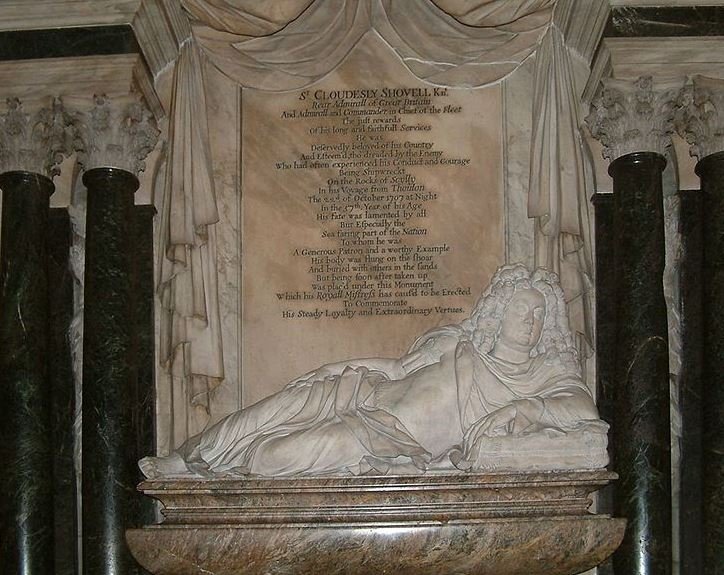
Anglo-Dutch artist, Grinling Gibbons’ monument to Shovell in Westminster Abbey
READ MORE: 10 Longest-Reigning British Monarchs
Legends and Myths Surrounding the Disaster
Over time, several myths emerged surrounding the disaster. One widely circulated story claims that a common sailor aboard HMS Association correctly identified that the fleet was off course but was executed for insubordination when he attempted to warn Admiral Shovell. While this tale has been discredited by historians due to the lack of supporting evidence in contemporary records, it persists as a dramatic cautionary legend about arrogance and authority at sea.
Another enduring legend suggests that Admiral Shovell survived the wreck but was murdered by a Scillonian woman who stole his prized emerald ring. According to this version, she later confessed to the crime on her deathbed, allegedly returning the ring to the Earl of Berkeley. Despite its intrigue, there is no concrete historical proof of this event, making it more folklore than fact.
Navigational Implications and the Longitude Problem
The Scilly disaster highlighted the dire state of maritime navigation in the early 18th century. At the time, longitude determination was a formidable challenge, as there was no reliable method for measuring east-west positioning. While latitude could be determined using the sun and stars, longitude relied on dead reckoning and rough estimates based on ocean depth soundings.
The disaster intensified discussions about improving navigational accuracy. In 1714, the British government passed the Longitude Act, offering a substantial reward to anyone who could devise a method for accurately determining longitude at sea. This incentive ultimately led to the development of the marine chronometer by John Harrison, revolutionizing maritime navigation and making sea travel significantly safer.
Discovery of the Wrecks
For over 250 years, the wrecks of HMS Association and the other lost ships remained hidden beneath the waves. Although salvage attempts were made in search of valuable treasures, the wrecks were not definitively located until the mid-20th century.
In 1967, the Royal Navy minesweeper HMS Puttenham led a diving expedition that successfully identified the remains of HMS Association on Gilstone Ledge. Among the recovered artifacts were cannons, gold and silver coins, and personal belongings of the sailors.
Subsequent discoveries followed in the 1980s, when the wreck of HMS Firebrand was located. Items such as carved wooden decorations, navigational instruments, and a ship’s bell engraved with “1692” provided valuable insights into 17th-century naval warfare and daily life aboard warships.
Due to the historical significance of these wrecks, the British government introduced the Protection of Wrecks Act 1973, aimed at preserving maritime heritage and preventing unauthorized salvage operations.
Commemorations and Cultural Impact
The 300th anniversary of the Scilly disaster was commemorated in 2007 with events organized by English Heritage, the Isles of Scilly Museum, and local authorities. Memorial services were held at Porthellick Cove, and exhibitions displayed recovered artifacts, highlighting the disaster’s lasting impact on maritime history.
The tragedy has also been depicted in literature and media. American author Dava Sobel’s book Longitude (1995) discusses the disaster’s role in spurring navigational advancements.
The 2000 television drama Longitude, based on Sobel’s book, features the disaster prominently, illustrating the perils faced by sailors before the advent of precise navigation. Written and directed by Charles Sturridge, the TV drama stars Jeremy Irons as British lieutenant-commander and horologist Rupert Gould (1890–1948) and Michael Gambon as English clockmaker John Harrison (1693–1776).
Questions and Answers
What caused the Scilly Naval Disaster of 1707?
A combination of inaccurate navigation due to poor latitude and longitude calculations, errors in charts and pilot books, faulty compasses, and bad weather contributed to the fleet’s misjudgment of its position.
Who was Sir Cloudesley Shovell?
Sir Cloudesley Shovell was the Commander-in-Chief of the British Fleets, leading the fleet back from the failed Toulon expedition. He perished when his flagship, HMS Association, struck rocks and sank.

A portrait of Cloudesley Shovell by Swedish painter Michael Dahl.
Which ships were lost in the disaster?
HMS Association, HMS Eagle, HMS Romney, and HMS Firebrand were lost, with Association and Eagle suffering complete crew fatalities.
What myths and legends arose from the disaster?
Stories claim Shovell executed a sailor who correctly warned of the fleet’s position and that he was murdered onshore for his emerald ring. These tales are largely discredited by historians.
How did the disaster impact maritime navigation?
The disaster highlighted the need for accurate navigation and helped spur the 1714 Longitude Act, which eventually led to advancements like the marine chronometer.
When and how were the wrecks discovered?
HMS Association was found in 1967 by Royal Navy divers, followed by Firebrand in 1982. Salvage efforts recovered coins, artifacts, and Shovell’s personal items.





