Who are the faces on the U.S. Dollar Bills?
U.S. dollar bills feature portraits of notable figures in our nation’s history, each selected for their significant contributions to the country. These individuals range from presidents to founding fathers and other key historical figures. As of now, the denominations include $1, $2, $5, $10, $20, $50, and $100 bills, each adorned with a distinct portrait.
$1 Bill: George Washington
The $1 bill features George Washington, the first President of the United States and a key figure in the American Revolutionary War. Washington’s leadership in the Continental Army and his role as the presiding officer of the Constitutional Convention cemented his place in American history. His face has appeared on the $1 bill since 1869, symbolizing the foundation and unity of the United States.

George Washington, as the first President of the United States, exemplifies the Treasury’s criteria of being well-known in history. His face has appeared on the $1 bill since 1869, replacing Salmon P. Chase. Image: Obverse of the One Dollar.
$2 Bill: Thomas Jefferson
The $2 bill bears the portrait of Thomas Jefferson, the third President of the United States and the principal author of the Declaration of Independence. Jefferson was also a Founding Father and served as the nation’s first Secretary of State. The $2 bill, though not as commonly circulated as other denominations, highlights Jefferson’s influence on American political thought and his vision for the country’s future.
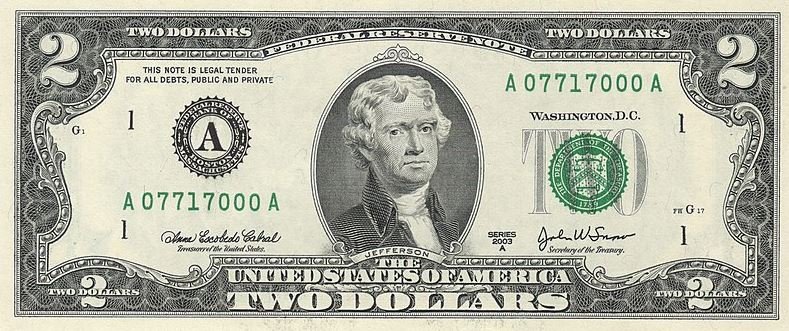
Thomas Jefferson’s face has been on the $2 bill since 1869, replacing Alexander Hamilton, who was originally featured when the bill was first issued in 1862. Image: Obverse of the $2 bill.
$5 Bill: Abraham Lincoln
Abraham Lincoln, the 16th President of the United States, is featured on the $5 bill. Lincoln is best known for leading the nation through the Civil War and his efforts to abolish slavery, culminating in the Emancipation Proclamation. His leadership during one of the most tumultuous periods in American history and his dedication to preserving the Union make him a central figure in U.S. history.
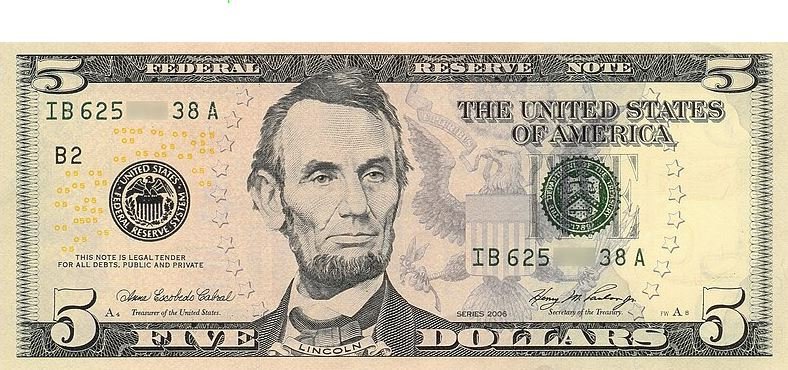
Abraham Lincoln’s face has appeared on the $5 bill since its inception in 1914. The bill, featuring the 16th President of the United States, has undergone several redesigns while maintaining Lincoln’s portrait. Image: Obverse of $5 note.
$10 Bill: Alexander Hamilton
The $10 bill showcases Alexander Hamilton, the first Secretary of the Treasury and one of the Founding Fathers. Hamilton played a crucial role in establishing the U.S. financial system, advocating for a strong central government, and founding the nation’s financial institutions, including the First Bank of the United States. His portrait on the $10 bill reflects his lasting impact on the country’s economic foundations.
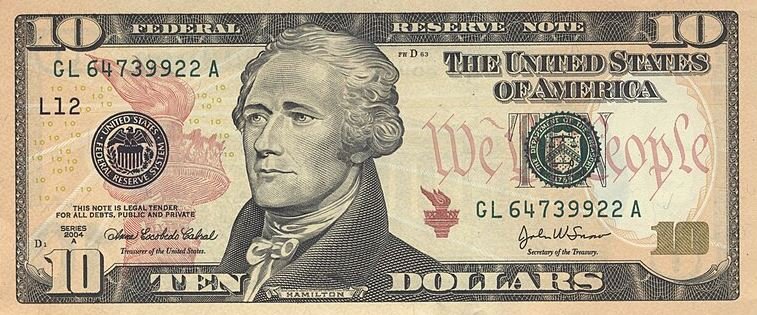
Image: Obverse of the $10 note.
$20 Bill: Andrew Jackson
Andrew Jackson, the seventh President of the United States, appears on the $20 bill. Jackson was a military hero and a populist leader who advocated for the common man. His presidency is noted for the controversial Indian Removal Act, which led to the Trail of Tears, and his opposition to the national bank. Jackson’s legacy is complex, and his appearance on the $20 bill has been a subject of debate.
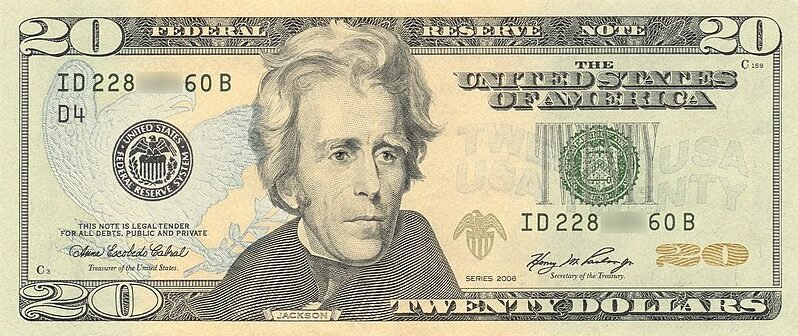
Andrew Jackson’s face has been on the $20 bill since 1929, replacing Grover Cleveland, who appeared on the original 1914 bill. Cleveland was then moved to the $1,000 bill. Image: Obverse of the$20 bill.
$50 Bill: Ulysses S. Grant
Ulysses S. Grant, the 18th President of the United States and a prominent Union general during the Civil War, is featured on the $50 bill. Grant’s leadership was instrumental in securing Union victory, and his presidency focused on Reconstruction and efforts to protect the rights of African Americans. Despite facing scandals during his administration, Grant is remembered for his role in preserving the Union and his military achievements.
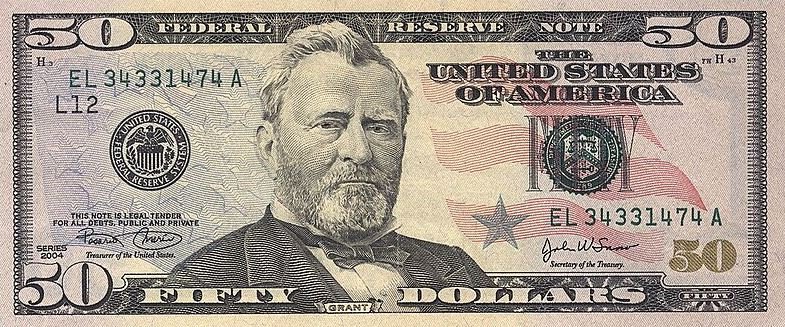
Ulysses S. Grant’s face has appeared on the $50 bill since it was first issued in 1914. The Union general served two terms as president, aiding in post-Civil War recovery. Image: Obverse of the $50 bill.
$100 Bill: Benjamin Franklin
The $100 bill, often referred to as a “Benjamin,” features Benjamin Franklin, a renowned polymath and one of the Founding Fathers. Franklin was never a president, but his contributions to the formation of the United States are immense. He was a diplomat, inventor, scientist, and author, and he played a key role in securing French support during the American Revolution. Franklin’s image on the $100 bill symbolizes his vast influence on American culture and governance.

Benjamin Franklin’s face has been on the $100 bill, the highest denomination in circulation, since it was first issued in 1914. Image: $100 note.
Did you know…?
- Larger denominations out of circulation, such as the $500, $1,000, $5,000, $10,000, and $100,000 bills, also depict men who served as U.S. presidents and Treasury Secretaries. The Treasury stopped printing these larger notes in 1945, and they became rare collectibles after 1969.
- There were false rumors and social media claims suggesting that living former presidents, such as Barack Obama, were being considered for U.S. bills. However, these claims are unfounded.
Plans to have Tubman’s face on a bill
The federal agency responsible for printing U.S. currency plans to introduce gender diversity by featuring a woman on a bill for the first time in over a century. In 2016, the U.S. Department of the Treasury announced plans to move Andrew Jackson to the back of the $20 bill and place Harriet Tubman, a late African American activist and former enslaved woman, on the front. This change was intended to commemorate the 100th anniversary of the 19th Amendment, which granted women the right to vote.
Bills no longer in circulation
President William McKinley’s face appeared on the $500 bill, which is no longer in circulation. Initially issued in 1918 with Chief Justice John Marshall’s face, the $500 bill was discontinued in 1969 due to lack of use, with the last printing in 1945. Despite being out of circulation, some notes are still held by the public. McKinley is notable for being one of the few U.S. presidents who was assassinated, dying after being shot in 1901.
President Grover Cleveland’s face appeared on the $1,000 bill, which was initially issued in 1918 with Alexander Hamilton’s face. The Federal Reserve and Treasury discontinued the bill in 1969, with the last printing in 1945. Despite this, some notes are still held by the public.
President James Madison was featured on the $5,000 bill, a denomination also discontinued in 1969. Similarly, the $10,000 bill, which bore the face of Salmon P. Chase, was first printed in 1918 and discontinued in 1969. Chase was a Treasury secretary under Lincoln and served as a U.S. senator and governor of Ohio. Although he sought the presidency in 1860, he lost to Lincoln, who appointed him as Treasury secretary.
Additionally, there was a $100,000 bill, a gold certificate used only by Federal Reserve Banks and not circulated among the public. These rare bills are highly valued by collectors, sometimes worth over $1 million.
Historical Context and Changes
The selection of these figures for U.S. currency reflects a recognition of their impact on American history and values. The portraits chosen are meant to honor the principles of leadership, innovation, and dedication to the nation’s founding ideals. The designs and individuals featured on U.S. currency have evolved over time, with various redesigns for security and aesthetic reasons.
In recent years, there have been discussions about updating the portraits on U.S. currency to reflect a broader representation of America’s history. For example, there has been a proposal to replace Andrew Jackson on the $20 bill with Harriet Tubman, an abolitionist and conductor of the Underground Railroad. This proposed change seeks to acknowledge the contributions of women and minorities to American history.
Security Features and Design
In addition to their portraits, U.S. dollar bills incorporate various security features to prevent counterfeiting. These features include watermarks, security threads, color-shifting ink, microprinting, and raised printing. The designs of the bills also feature symbols of American culture and history, such as the Great Seal of the United States, famous buildings, and historical events.
Questions and Answers
The faces on U.S. bills in circulation feature five American presidents—George Washington, Thomas Jefferson, Abraham Lincoln, Andrew Jackson, and Ulysses S. Grant—and two founding fathers, Alexander Hamilton and Benjamin Franklin.
Below are some frequently asked questions about the U.S. Bills:
Whose face has been featured on the $10 bill since 1929, and who did they replace?
Alexander Hamilton’s face has been on the $10 bill since 1929, replacing President Andrew Jackson, who initially appeared on the 1914 bill and was later moved to the $20 bill.
The $10 bill, along with larger denominations, was first issued after the Federal Reserve Act of 1913, which established the Federal Reserve and authorized the circulation of Federal Reserve Bank Notes. Later, the Fed’s Board of Governors issued Federal Reserve notes, which became the standard form of paper currency in the United States.
Who decides the faces on our Dollar bills?
The Secretary of the Treasury has the final say over whose faces appear on U.S. bills. While the exact criteria for these decisions are not clearly defined, the Treasury Department states that they consider “persons whose places in history the American people know well.” Most figures on U.S. currency fit this description, though some may seem less familiar.
For example, Salmon P. Chase appears on the now out-of-print $10,000 bill. Chase was significant as the first person responsible for designing the nation’s paper currency and was the father of Kate Chase Sprague, a notable socialite during Lincoln’s presidency who later faced scandal.
What does federal law say about depicting living persons on U.S. currency?
Federal law prohibits the depiction of any living person on U.S. currency. The Treasury Department specifies that “The law prohibits portraits of living persons from appearing on Government Securities.”
What redesign plans did the Treasury announce in 2016?
In 2016, the Treasury announced plans to redesign the $5, $10, and $20 bills to honor the women’s suffrage and civil rights movements. Harriet Tubman was to replace Andrew Jackson on the $20 bill, while Abraham Lincoln and Alexander Hamilton would remain on the $5 and $10 bills, respectively.
The backs of these bills were to feature figures like Marian Anderson, Martin Luther King Jr., Lucretia Mott, Sojourner Truth, Susan B. Anthony, Elizabeth Cady Stanton, and Alice Paul.
Why were the changes to the $20 bill not pursued during the Trump administration?
The Trump administration did not prioritize these changes, with then-Secretary of the Treasury Steven Mnuchin stating in 2017 that there were more pressing issues. He later indicated that the redesigned bill with Tubman’s image would not be ready by 2020 or within the next decade.
Democratic Senator Chuck Schumer requested an investigation into whether White House influence played a role in delaying the redesign of the $20 bill.
In 2021, the Biden administration renewed efforts to place Harriet Tubman on the $20 bill.
What are some examples of the faces on the bills no longer in circulation?
Some examples of faces on U.S. bills that are no longer in circulation include:
- Salmon P. Chase on the $10,000 bill: Chase was the U.S. Treasury Secretary during the Civil War and later served as Chief Justice of the United States.
- Grover Cleveland on the $1,000 bill: Cleveland was the 22nd and 24th President of the United States.
- James Madison on the $5,000 bill: Madison was the 4th President and is known as the “Father of the Constitution.”
- William McKinley on the $500 bill: McKinley was the 25th President of the United States.
The above high-denomination bills were discontinued and officially ceased circulation in 1969.





