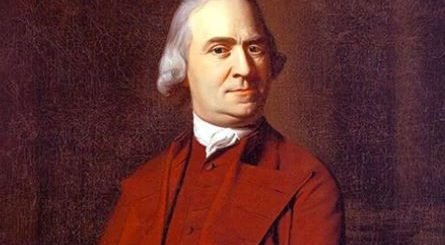
Founding Father Richard Henry Lee
Richard Henry Lee stands among the most resolute figures of the American Revolutionary era. Born on January 20, 1732, in Westmoreland County, Virginia, Lee emerged as a persuasive voice for liberty and a key instigator of independence from British rule. His authorship of the June 1776 Lee Resolution, which directly led to the drafting and adoption of the Declaration of Independence, places him in the pantheon of American Founding Fathers. Over his career, he held influential roles: President of the Continental Congress, signer of the Articles of Confederation, and U.S. Senator from Virginia.
Richard Henry Lee’s legacy is deeply interwoven with the ideological foundations and early governance of the United States.
Early Life and Education: A Privileged Path to Leadership
Richard Henry Lee was born into the prominent Lee family of Virginia, whose roots in colonial leadership were deep and enduring. His father, Colonel Thomas Lee, held a position on the Governor’s Council and briefly served as Virginia’s acting governor. Growing up at Stratford Hall, Lee was educated by private tutors, learning Latin, literature, and classical political theory—an education befitting his future role in the public sphere.
In 1748, Lee traveled to England to attend Queen Elizabeth Grammar School in Wakefield, Yorkshire. His studies immersed him in Enlightenment ideals and sharpened his rhetorical and philosophical skills. The death of both parents in 1750 forced him to return to Virginia in 1753 to help his brothers settle the estate. Though orphaned young, Lee had already developed the intellectual foundation and social connections that would fuel his political ascent.
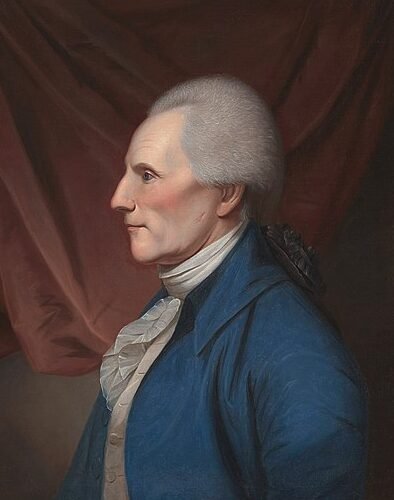
Portrait of Richard Henry Lee
Early Political Career: Opposition to British Authority
By the mid-1750s, Lee had begun to establish his presence in Virginian politics. Appointed justice of the peace in Westmoreland County in 1757, he quickly gained trust among his peers. In 1758, he was elected to the Virginia House of Burgesses, where he developed a lifelong alliance with Patrick Henry and later aligned with the revolutionary sentiments of Samuel Adams.
Lee’s growing disillusionment with British imperial policies led to his participation in organizing Committees of Correspondence, which facilitated communication and coordination among the colonies. His authorship of the 1766 Westmoreland Resolution—an early protest against the British Stamp Act—cemented his reputation as a staunch defender of colonial rights. The document was signed by several prominent landowners, including relatives of George Washington, and marked an early, organized resistance to British interference in colonial affairs.
Advocate for Independence: The Lee Resolution
Lee’s most historic contribution came during his tenure as a delegate to the Second Continental Congress. On June 7, 1776, he introduced a motion that would become a turning point in American history. The Lee Resolution called for complete independence from Great Britain, asserting:
That these united colonies are, and of right ought to be, free and independent States…
Though Lee had to return to Virginia before the official vote, his resolution passed on July 2, 1776, and catalyzed the drafting and adoption of the Declaration of Independence. When he returned to Congress, Lee affixed his signature to the document, solidifying his role in the birth of the nation.
President of the Continental Congress: Governance and Western Expansion
Following the war, Lee served as President of the Continental Congress from November 1784 to November 1785, during a critical transitional period in American governance. Though unpaid, he received reimbursement for household expenses. Lee used his leadership to address post-war challenges, most notably national debt and territorial governance.
He was firmly opposed to federal taxation, believing it threatened state sovereignty. Instead, he advocated for funding the government through the sale of western lands. This vision guided his efforts in supporting the Land Ordinance of 1785, which proposed a standardized method of surveying and distributing land in the Northwest Territory. The final version—passed under his watch—divided land into six-mile-square townships subdivided into 36 lots. Although poorly enforced at the time, this ordinance laid the foundation for future territorial expansion and remains one of the most enduring policies of the Confederation Congress.
Senate Years: Constitutional Skepticism and Retirement
With the ratification of the U.S. Constitution, Lee was elected to the United States Senate, representing Virginia in the First and Second Congresses from 1789 to 1792. During his tenure, he was chosen as President pro tempore in 1792, the Senate’s second-highest ranking official.
Despite his participation in the new federal government, Lee was a known Anti-Federalist. He was wary of centralized power and believed the new Constitution lacked sufficient protections for individual liberties and states’ rights. He strongly supported the addition of a Bill of Rights to address these concerns, aligning him with other skeptical patriots like George Mason and Patrick Henry.
Richard Henry Lee exemplified the courage, intellect, and determination required to sever colonial ties and construct a new nation.
His declining health forced his resignation from the Senate in 1792, ending a public career that had spanned nearly four decades. Lee retired to his home in Virginia, stepping back from national affairs but leaving behind a significant legacy of civic service.
Personal Life and Family Ties
Richard Henry Lee was twice married and fathered thirteen children in total, nine of whom survived infancy. His first marriage, in 1757, was to Anne Aylett, with whom he had six children, including Ludwell Lee. After Anne’s death in 1768, he married Anne (Gaskins) Pinckard in 1769, and they had seven more children.
Lee was part of a political dynasty that profoundly influenced Virginia and national politics. His brother, Francis Lightfoot Lee, was also a signer of both the Declaration of Independence and the Articles of Confederation. Richard honored his sibling by naming one of his sons after him, perpetuating the family’s revolutionary legacy.
Death and Lasting Recognition
Richard Henry Lee died on June 19, 1794, at age 62, at his Virginia estate. His death marked the end of an era of revolutionary leadership but not the conclusion of his influence. Several schools across the United States have been named in his honor, including those in California, Maryland, and Illinois. A Liberty Ship commissioned during World War II bore his name—SS Richard Henry Lee—commemorating his enduring impact on American history.
The Chantilly Archaeological Site, once associated with Lee, was added to the National Register of Historic Places in 1971. Moreover, his role in the independence movement is immortalized in the Broadway musical 1776, where he is depicted as a bold and charismatic figure, emblematic of the revolutionary fervor of the era.
Richard Henry Lee’s work spanned nearly every critical phase of the American founding—from early resistance and revolution to constitutional debate and federal governance. Although he did not enjoy the same level of fame as Jefferson or Washington, Lee’s influence was no less vital.
Political Legacy and Historical Significance
Lee’s legacy is grounded in his consistent advocacy for individual liberty, state sovereignty, and democratic governance. From his early days resisting the Stamp Act to his role in shaping national policy under the Articles of Confederation and the U.S. Constitution, Lee represented a voice of principled independence.
Although he opposed the centralized authority embedded in the new federal system, his contributions were not diminished by his skepticism. Rather, they underscore the ideological diversity of the Founding Fathers—a group bound not by uniformity but by a shared commitment to self-rule and civic virtue.
The Lee Resolution was more than a legislative motion—it was a declaration of political will and moral clarity that helped galvanize a new nation. Richard Henry Lee’s ability to see beyond colonial grievances to the broader promise of self-determination places him among the architects of American liberty.

Frequently Asked Questions
What role did Richard Henry Lee play in the Declaration of Independence?
He introduced the motion for independence and later signed the Declaration.
What was the Westmoreland Resolution?
It was a 1766 protest against the Stamp Act, authored by Lee and signed by Virginia landowners.
What was Lee’s contribution to early colonial coordination?
He helped establish Committees of Correspondence to unify colonial resistance to British rule.
What was his role in the Continental Congress?
He served multiple terms and was its president from 1784 to 1785 under the Articles of Confederation.
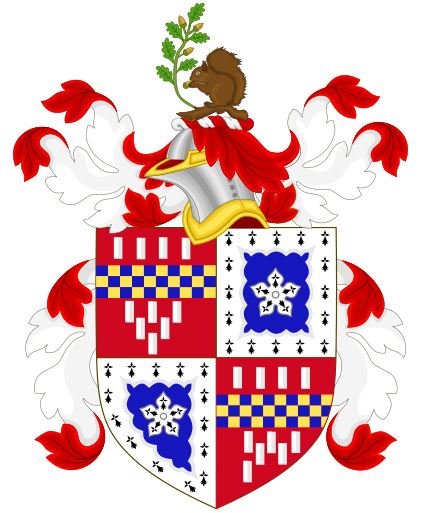
Coat of Arms of the Lee Family.
How did Lee view federal taxation and debt?
He opposed federal taxes and foreign borrowing, favoring land sales to pay off war debts.
What is the Land Ordinance of 1785 and Lee’s connection to it?
Lee supported the ordinance that created a land survey system for the Northwest Territory, though enforcement challenges limited its success.
What was his position in the U.S. Senate?
He served as a senator from Virginia from 1789 to 1792 and became the second president pro tempore.
Why did Lee retire from the Senate?
He resigned in 1792 due to failing health and withdrew from public life.
What is known about his early life and education?
Born in 1732 in Virginia, he studied in England and returned to Virginia to manage family affairs after his parents’ deaths.
What family connections did he have?
He belonged to the influential Lee family of Virginia and had a brother, Francis Lightfoot Lee, who also signed the Declaration.
How is Richard Henry Lee remembered today?
Several schools and a World War II Liberty Ship are named after him; he was also portrayed in the musical 1776.
Most influential intellectuals of the American Revolution Era