Who was Henry Vane the Elder?
Henry Vane the Elder, an influential English statesman and diplomat, played a significant role in the political and diplomatic affairs of early 17th-century England. Born in Hadlow, Kent, into a prominent family, he rose through various governmental roles under the reigns of King James I and King Charles I, ultimately becoming one of the era’s most notable court figures. Vane’s career reflected the tumultuous political landscape of pre-Civil War England and offers insight into the shifting allegiances and tensions that defined this period.
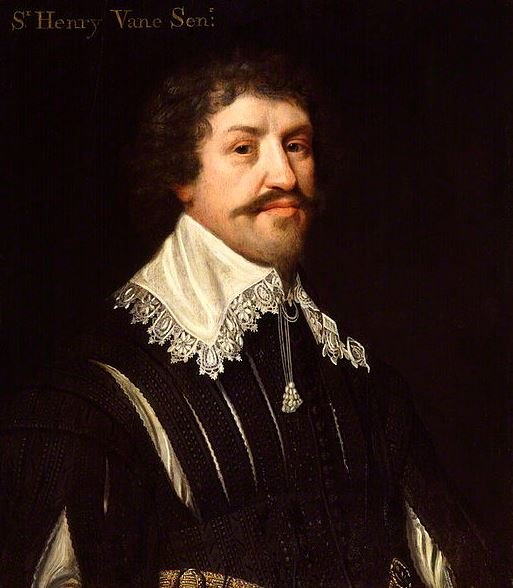
Initially loyal to King Charles I, holding various posts including secretary of state, Henry Vane the Elder later sided with Parliament when the English Civil War began. Image: Portrait of Henry Vane.
Early Life and Education
Henry Vane, sometimes spelled Fane, was born around 1589 to Henry Vane of Hadlow and Margaret Twysden, the daughter of Roger Twysden of East Peckham, Kent. His family’s status and connections positioned him for a prominent public role. Vane pursued education at Brasenose College, Oxford, matriculating in 1604, followed by legal studies at Gray’s Inn in 1606. His elite education and family connections provided him with a foundation for advancement within the English court.
Vane’s first significant step into public service came in 1611 when he was knighted by King James I. Shortly afterward, he married Frances Darcy, the daughter of Thomas Darcy of Tolleshunt D’Arcy, Essex. This marriage linked him to another prominent family and further bolstered his social standing.
Early Court Career and Initial Appointments
In the years following his knighthood, Vane ambitiously sought influential positions at court. He leveraged the friendship of Sir Thomas Overbury to secure a ceremonial role as a “carver” at court, a move that cost him £5,000. This initial role allowed him to gain visibility and cultivate important relationships within the royal household. Soon after, he invested his wife’s dowry of £3,000 in the subpoena office of the Court of Chancery, an office that dealt with various legal orders. His connections, particularly with King James I, eventually granted him reversionary rights to this lucrative post for forty years, a significant financial and professional gain.
In 1617, Vane purchased the role of cofferer to Charles, Prince of Wales, responsible for managing royal finances. He retained this office when Charles ascended to the throne, marking a steady rise in his influence at court. Over the next two decades, Vane would secure key positions, including Comptroller of the Household around 1629 and, eventually, Treasurer of the Household in 1639. Despite setbacks and a sometimes volatile relationship with figures like the Duke of Buckingham, Vane’s skill at court politics allowed him to retain his standing.
Diplomatic Missions and Political Influence
Vane’s political influence extended beyond his domestic roles. In 1629, King Charles I tasked Vane with diplomatic missions to the United Provinces (modern-day Netherlands) to mediate peace negotiations between the Dutch and the Spanish. Although these efforts ultimately failed, Vane’s diplomatic acumen received praise from Charles’s advisors. His next major diplomatic effort involved a mission to Sweden in 1631 to negotiate an alliance with King Gustavus Adolphus. Although the proposed alliance did not materialize, Vane impressed his superiors with his “dexterous” handling of the negotiations, balancing England’s interests with the potential for financial losses.
This period cemented Vane as a favored courtier and as a member of the Privy Council by 1630, a significant step that elevated his role as a royal advisor. He was deeply involved in various commissions and administrative matters, including colonial affairs in the Americas, as a commissioner for colonies. During the 1630s, Vane was a central figure in advising King Charles on Scottish matters, where tensions were building over religious and political disputes.

Image: King Charles I
Secretary of State and the Rise of Tensions with Strafford
In 1640, as tensions mounted in England over Charles I’s policies, Vane’s influence reached new heights when he was unexpectedly appointed Secretary of State. This appointment placed Vane in direct conflict with Thomas Wentworth, the Earl of Strafford, who was already a powerful figure in Charles’s government. Vane’s friendship with the Marquis of Hamilton and his alignment with certain royal advisers alienated Strafford, who perceived Vane as a rival.
One point of contention between Vane and Strafford revolved around Strafford’s selection of the title “Baron Raby,” a title Vane had anticipated for himself, as Raby Castle was an estate linked to his family. This slight deepened their animosity and fed into the larger political tensions of the time. In Parliament, Vane’s role was increasingly complex; as a representative for the constituency of Wilton, he initially attempted to support the king’s efforts to secure funding for his campaign against Scotland. However, the lack of support from Parliament led to its dissolution and further strained Vane’s relationship with Charles.
The Short and Long Parliaments
During the Short Parliament of 1640, Vane faced the daunting task of requesting twelve subsidies from Parliament in exchange for the king’s renunciation of ship money, a controversial tax. This demand was rejected, leading to the dissolution of Parliament, which many blamed on Vane’s failure to gauge Parliament’s opposition accurately. Despite criticism, Vane continued to serve as Secretary of State, though his loyalty to the king was increasingly questioned by peers in Parliament.
The Long Parliament, convened later in 1640, brought renewed scrutiny upon Vane. His testimony became instrumental in the trial of Strafford, where he provided evidence of Strafford’s suggestion to use the Irish army against England, a statement that was pivotal in securing Strafford’s conviction. While some suggested Vane’s evidence was influenced by his personal grudge, others saw it as a reflection of his duty to Parliament. The role of his son, Sir Henry Vane the Younger, in producing notes that supported this accusation added to suspicions of collaboration, though Vane publicly distanced himself from his son’s actions.
Dismissal from Court and Alignment with Parliament
The execution of Strafford marked a turning point for Vane, who realized that his position at court had become untenable. Although he had been appointed as a commissioner of the treasury, Charles dismissed him from all his roles by 1641. Following his dismissal, Vane increasingly aligned himself with the parliamentary opposition, joining the ranks of those who saw the king’s policies as a threat to the country’s stability.
During the early stages of the English Civil War, Vane represented Parliament as the lord lieutenant of Durham, though his authority in the royalist-leaning region was largely nominal. Despite this, Vane became a crucial member of the Committee of Both Kingdoms, overseeing the alliance between Parliament and the Scottish Covenanters. His commitment to Parliament’s cause also positioned him against the monarchy, placing him under scrutiny from royalist factions.
Later Years and Legacy
As the political landscape shifted, Vane’s influence gradually diminished. He retained a seat in the Rump Parliament following Pride’s Purge in 1648, which removed royalist sympathizers, and later represented Kent in the First Protectorate Parliament. His health and political power waned in the 1650s, and he remained on the periphery of political life until his death in 1655. Although rumors circulated that he had died by suicide out of remorse for his role in Strafford’s execution, these claims lack substantiation.
Henry Vane the Elder’s legacy is often overshadowed by that of his son, Sir Henry Vane the Younger, who became a prominent Puritan statesman and advocate for religious tolerance. However, Vane the Elder’s career provides a window into the complexities of royal court life, the volatile nature of 17th-century English politics, and the shifting allegiances during one of England’s most tumultuous periods.
Vane’s Family and Descendants
Vane’s family continued his legacy in various ways. His eldest son, Henry Vane the Younger, emerged as a key figure in Puritan politics, serving as colonial governor of Massachusetts and later as a member of the English Parliament during the Commonwealth period. His other children held notable positions, including his son George, who served as High Sheriff of Durham, and his son Charles, who became a diplomat. Vane’s descendants played a role in British political life, perpetuating the family’s influence across generations.
Summary and Assessment
Sir Henry Vane the Elder’s life and career illustrate the delicate balance required of a courtier navigating the inner circles of power. His efforts to rise within the court were met with both success and opposition, reflecting the court’s factional nature and the intense rivalries that could make or break a career. Although he maintained loyalty to the monarchy for most of his life, his ultimate alignment with Parliament during the Civil War demonstrates his adaptability to shifting political landscapes.
While Vane was not beloved by many of his peers and did not hold substantial influence during the Commonwealth, his legacy endures through the political accomplishments of his descendants and his role in England’s pre-Civil War governance. His career reflects the era’s larger struggles over governance, religious conformity, and the distribution of power, providing insight into the tensions that would culminate in the English Civil War and the subsequent transformation of the English government.
Frequently Asked Questions

Where was Sir Henry Vane the Elder born, and who were his parents?
He was born in Hadlow, Kent, to Henry Vane or Fane and Margaret Twysden, daughter of Roger Twysden of East Peckham, Kent.
What was Vane’s educational background?
Vane attended Brasenose College, Oxford, where he matriculated in 1604, and he joined Gray’s Inn in 1606.
How did Vane establish himself in court?
After being knighted by King James I in 1611, Vane married Frances Darcy and secured a position as a “carver” at court with the help of Sir Thomas Overbury, purchasing the role for £5,000. He then invested in the lucrative subpoena office in the Court of Chancery, gaining favor with the king.
What positions did Vane hold in the royal household?
He served as cofferer to Charles, Prince of Wales, and continued in this role when Charles became king. He later became Comptroller of the Household and, in 1639, was appointed Treasurer of the Household.
What diplomatic missions did Vane undertake?
In 1629, King Charles I sent Vane on diplomatic missions to Holland to mediate peace between the United Provinces and Spain. In 1631, he was sent to Germany to negotiate with Gustavus Adolphus of Sweden, though the alliance was unsuccessful.
What was Vane’s role in Parliament?
He represented Lostwithiel in 1614 and Carlisle from 1621 to 1626. However, he kept a low profile in debates. In 1640, he was elected as MP for Wilton during the Short Parliament, where he was tasked with negotiating subsidies for the king.
How did Vane rise to political prominence?
His court success led to his appointment to the Privy Council in 1630, and he became one of the king’s main advisors on Scottish affairs. In 1640, Charles I appointed him Secretary of State, boosting his influence significantly.
Why did Vane and Lord Strafford become rivals?
The rivalry intensified when Strafford chose “Baron Raby” as his title, associated with Vane’s estate. This act led to heightened tensions and contributed to the political conflict of the era.
What role did Vane play in Strafford’s trial?
Vane’s testimony was instrumental in Strafford’s trial, as he provided evidence that Strafford had suggested using the Irish army against England. This evidence significantly swayed public opinion against Strafford.
What was the outcome of Strafford’s trial for Vane?
Though Vane expected to retain the king’s favor after the trial, he was dismissed from his court posts by 1641, leading him to align with Parliament’s opposition as the English Civil War loomed.
How did Vane contribute during the English Civil War?
Vane served on the Committee of Both Kingdoms, which managed Parliament’s alliance with the Scottish army. His loyalty to Parliament and his son’s influence helped him avoid royalist reprisals.
How was Vane perceived by his peers?
Despite his political skills, Vane was often seen as neither particularly loved nor trusted by his peers, which limited his influence during the Commonwealth period.
When did Vane die, and what rumors surrounded his death?
Vane died around May 1655 at about age 66. Some royalists spread rumors that he had committed suicide out of remorse for Strafford’s execution, but this claim remains unproven.
Who were Vane’s notable descendants?
His eldest son, Sir Henry Vane the Younger, became a prominent Puritan statesman and colonial governor of Massachusetts. His second son, George, was also active in Parliamentary circles, serving as High Sheriff of Durham.





