Who was Qutb ud-Din Aibak?
Qutb ud-Din Aibak (1150 – 14 November 1210) was a central figure in shaping the early history of Muslim rule in India. His life story is an extraordinary tale of a slave who rose to become the founder of the Delhi Sultanate, which established the foundation for centuries of Muslim dominance in northern India.
Aibak’s journey, from a slave in Turkestan to a ruler in Lahore, highlights not only his military prowess but also his diplomatic and administrative skills. His reign was brief but highly impactful, as it marked the transition from the Ghurid Empire’s rule in India to the establishment of an independent Muslim sultanate, setting the stage for his successors to further consolidate and expand their rule.
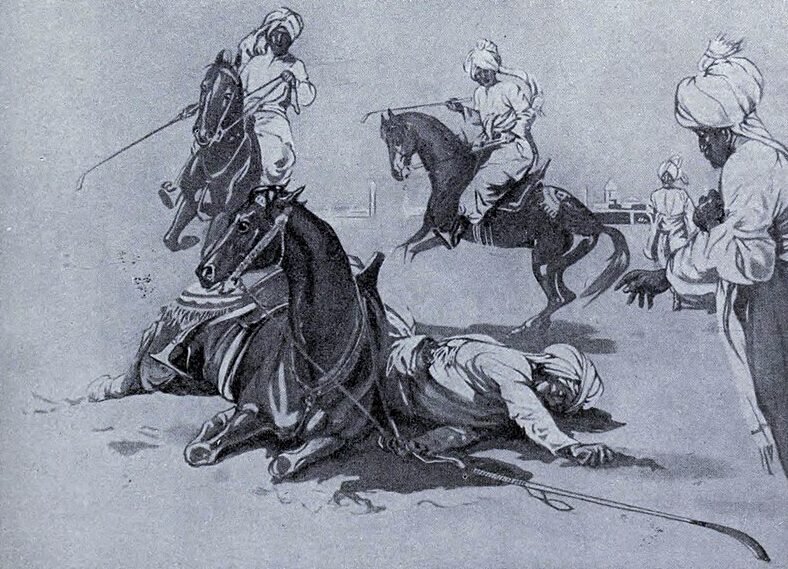
Qutb ud-Din Aibak played a key role in overseeing Ghurid territories in northern India and later laid the foundation for the Delhi Sultanate after declaring his independence in 1206. Image: An illustration of the demise of Qutb ud-Din Aibak.
Early Life
Qutb ud-Din Aibak was born around 1150 in Turkestan, in present-day Central Asia. Like many other young boys from that region during the time, he was sold into slavery at a very young age. His early childhood was marked by a series of changes in his masters. Initially purchased by a Qazi (Islamic judge) in Nishapur, Persia, Aibak was introduced to a variety of skills that would later prove valuable. He was trained in archery, horse-riding, and other physical pursuits while also receiving a basic education. This upbringing, although in bondage, provided him with the foundation that later allowed him to excel in the military.
At some point, Aibak’s master, the Qazi, passed away, and he was resold to a man in Ghazni, who eventually introduced him to Muhammad Ghori, the Ghurid ruler. It was under Ghori’s patronage that Aibak began his rise to prominence.
Rise to Power
Muhammad Ghori, also known as Mu’izz al-Din, was one of the most important rulers of the Ghurid Empire. He recognized Aibak’s military potential and leadership qualities, gradually promoting him through the ranks. Aibak began as an officer in the royal stables but quickly rose to more prominent positions due to his loyalty and capabilities. He played an essential role in the Ghurid campaigns against the Khwarazmians and other adversaries, solidifying his status as a trusted general in Muhammad Ghori’s army.
Aibak’s most significant opportunity came after the Ghurids turned their focus towards expanding their territories into the Indian subcontinent. India, at that time, was composed of several independent kingdoms, with the most significant being the Rajputs and the Chauhans. Ghori aimed to subdue these local powers and extend Ghurid influence.
The Second Battle of Tarain (1192)
Aibak’s military prowess was demonstrated during the Second Battle of Tarain in 1192, one of the most decisive battles in Indian history. The battle took place between the forces of Muhammad Ghori and the Rajput king Prithviraj Chauhan, ruler of Delhi and Ajmer. In the first battle, fought a year earlier, Ghori had been defeated by the Rajputs. However, in the second encounter, Aibak played a crucial role in the Ghurid victory, which resulted in the fall of Prithviraj Chauhan and opened the gates for Muslim expansion in northern India.
This victory not only secured Muhammad Ghori’s position in India but also further established Aibak’s status as one of Ghori’s most reliable generals. After the victory, Ghori entrusted Aibak with the administration of the newly conquered territories in northern India, including Delhi and Ajmer.
Expansion of Ghurid Power in India
With the responsibility of overseeing northern India, Aibak set about consolidating Ghurid rule and extending their influence further into the subcontinent. Over the next several years, Aibak launched a series of campaigns aimed at expanding Ghurid control over regions such as the Chahamana, Gahadavala, Chaulukya, and Chandela kingdoms. These campaigns were marked by both military conquests and strategic raids that weakened the local rulers and brought them under Ghurid suzerainty.
Aibak’s administrative skills were equally important in his success as a ruler. He worked to establish a stable administrative framework in the territories under his control, ensuring that the region could be effectively governed in Ghori’s absence. He also demonstrated diplomatic acumen by making alliances with local chieftains and other power brokers in northern India, thereby securing Ghurid dominance over vast swathes of land.
Foundation of Independent Rule
The turning point in Aibak’s career came in 1206, when his master, Muhammad Ghori, was assassinated. Ghori’s death created a power vacuum, particularly in the Indian territories, as various former generals and subordinates vied for control over the empire’s fragmented lands. One of the most significant rivals Aibak faced was Taj al-Din Yildiz, another former slave-general of Ghori who sought control over the Ghurid territories in north-western India.
Aibak, however, managed to outmaneuver Yildiz and other rivals by consolidating his power base in Lahore. Though he nominally acknowledged the suzerainty of Ghori’s successor, Ghiyasuddin Mahmud, who ruled over the Ghurid heartland in Central Asia, Aibak effectively ruled independently in India. He established Lahore as his capital and maintained control over much of northern India, laying the groundwork for what would later become the Delhi Sultanate.
Aibak’s rule marked a significant transition in Indian history, as it represented the formal establishment of Muslim dominance over northern India. Although the Ghurid Empire had initiated this process, it was Aibak who ensured that these territories remained under Muslim control following Ghori’s death.
Architectural Legacy
One of Aibak’s lasting contributions to Indian history is his architectural patronage. His most famous commission is the Qutb Minar in Delhi, a towering minaret that stands as a symbol of the new Muslim rule in India. The Qutb Minar, named after Aibak, remains one of the most iconic landmarks in India today and is recognized as a UNESCO World Heritage Site. The construction of the minaret began during Aibak’s reign but was completed by his successor, Iltutmish.
Another significant architectural achievement attributed to Aibak is the Adhai Din Ka Jhonpra in Ajmer, a mosque built on the ruins of a former Hindu temple. This structure exemplifies the synthesis of Islamic and Indian architectural styles that became characteristic of many subsequent buildings in the Delhi Sultanate.
Aibak’s architectural patronage not only served to demonstrate the power and prestige of his rule but also laid the foundation for the development of Indo-Islamic architecture, which flourished under his successors.
Death and Succession
Qutb ud-Din Aibak’s reign was relatively short, lasting from 1206 until his death in 1210. His demise was sudden and unexpected, as he died from injuries sustained in a polo match in Lahore. The sport, known as chaugan, was popular among the nobility, and Aibak’s fall from his horse during a match resulted in fatal injuries. His death marked the end of his brief but impactful reign.
Aibak’s sudden death left a power vacuum in his territories. He was succeeded by Aram Shah, whose reign was short-lived and unstable. Aram Shah was unable to command the same respect and authority as Aibak, leading to unrest and challenges to his rule. It was only with the rise of Iltutmish, Aibak’s former slave and son-in-law, that the Delhi Sultanate was solidified as a powerful and enduring political entity.
Iltutmish not only stabilized the sultanate but also expanded its territories and strengthened its administrative and military structures. He is credited with transforming the loosely held Ghurid territories in India into a centralized and powerful sultanate, which lasted for several centuries.
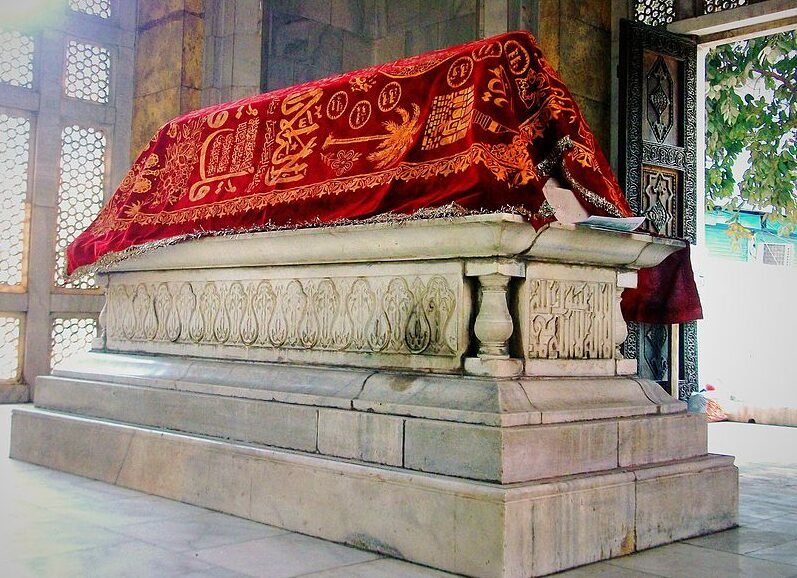
Image: Qutb ud-Din Aibak’s grave in Lahore Pakistan.
Legacy
Qutb ud-Din Aibak’s legacy is profound, despite the brevity of his reign. As the first ruler to establish an independent Muslim state in India, he set the stage for centuries of Muslim rule on the subcontinent. His military conquests, administrative reforms, and architectural contributions laid the foundation for the Delhi Sultanate, which became one of the most powerful and influential empires in Indian history.
Aibak’s rise from a slave to a sultan is also a testament to the fluidity of social and political mobility in the medieval Islamic world. His career exemplifies how slaves could rise to positions of great power and influence, particularly in the military and political spheres.
Moreover, Aibak’s architectural patronage, particularly the Qutb Minar, remains a lasting reminder of his reign. The minaret, one of the tallest in the world, continues to attract visitors from around the globe and serves as a symbol of the enduring legacy of Indo-Islamic culture.
Conclusion
Qutb ud-Din Aibak’s life and reign were marked by significant achievements that shaped the course of Indian history. From his humble beginnings as a slave to his rise as the founder of the Delhi Sultanate, Aibak’s story is one of resilience, ambition, and strategic brilliance. His military successes and administrative reforms helped secure Muslim dominance in northern India, while his architectural contributions left a lasting cultural legacy. Though his reign was short-lived, Aibak’s impact was profound, as he laid the foundation for a powerful empire that would endure for centuries under the Delhi Sultanate.
Questions and Answers

Where was Qutb ud-Din Aibak born, and how did he start his life?
Aibak was born in Turkestan and was sold into slavery as a child. He was initially purchased by a Qazi in Nishapur, Persia, where he was trained in archery and horse-riding. Later, he was sold to Muhammad Ghori in Ghazni.
How did Aibak rise through the ranks in Muhammad Ghori’s court?
Aibak began as an officer in the royal stables and, through his loyalty and capabilities, earned Muhammad Ghori’s favor, eventually rising to become one of his most trusted generals.
What role did Aibak play in the expansion of Ghurid power in India?
After the Ghurid victory in the Second Battle of Tarain in 1192, Aibak was appointed as the governor of Ghori’s Indian territories. He expanded Ghurid control by conquering and raiding regions such as Chahamana, Gahadavala, Chaulukya, and Chandela.
What happened after Muhammad Ghori was assassinated in 1206?
After Ghori’s assassination in 1206, Aibak fought with another general, Taj al-Din Yildiz, for control over the Ghurid territories in north-western India. Aibak eventually retreated to Lahore and declared his independence, laying the foundation for the Delhi Sultanate.
How did Aibak consolidate his rule in India?
Though Aibak nominally acknowledged the suzerainty of Ghori’s successor, Ghiyasuddin Mahmud, he effectively ruled independently in India from Lahore, consolidating his power after winning key military campaigns.
Who succeeded Qutb ud-Din Aibak?
Aibak was first succeeded by Aram Shah and then by his former slave and son-in-law, Iltutmish, who strengthened and expanded the Delhi Sultanate.
What are some notable architectural works commissioned by Aibak?
Aibak is known for commissioning the Qutb Minar in Delhi and the Adhai Din Ka Jhonpra in Ajmer, both of which remain important historical monuments.





