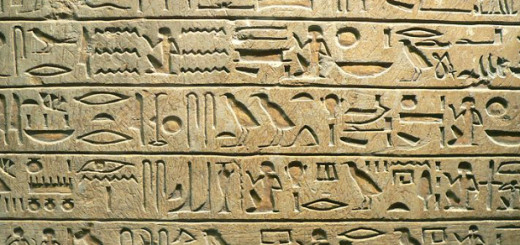
The Great Sphinx and the mystery of the missing nose

Missing nose of the Great Sphinx
The Great Sphinx of Giza is one of the most iconic and enduring symbols of ancient Egypt, standing proudly on the Giza Plateau, adjacent to the pyramids. It has intrigued scholars, historians, and travelers for millennia, not only for its impressive size and enigmatic appearance but also for the many mysteries surrounding its origins, purpose, and construction.
While countless theories have emerged over time, there are still several unanswered questions, making the Sphinx a focal point of both fascination and speculation.
READ MORE: 10 Major Events in the History of Ancient Egypt
In this in-depth exploration, World History Edu delves into the known facts, theories, and mysteries of the Great Sphinx.
Description and Features
The Great Sphinx, carved from a single limestone outcrop, represents a creature with the body of a lion and the head of a human. It measures about 73 meters (240 feet) long and 20 meters (66 feet) high, making it one of the largest sculptures of its kind in the world. The face of the Sphinx is believed to depict a pharaoh, although which one remains a subject of debate.
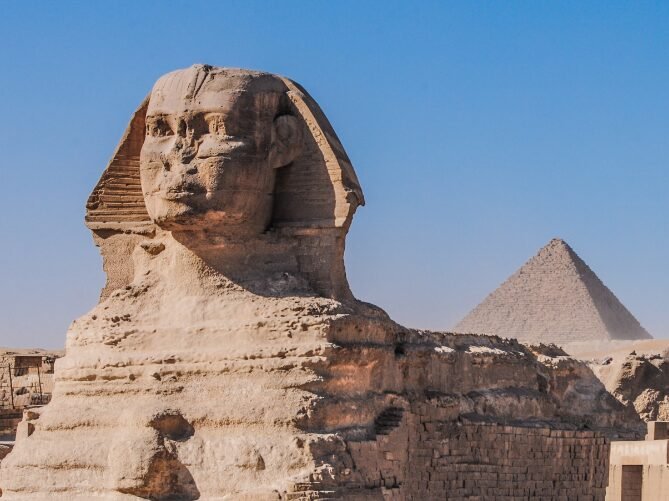
Over time, the Sphinx has suffered significant erosion and damage, particularly to its face. The missing nose is often highlighted in depictions and discussions, and though many have speculated about the reasons for its absence, the most accepted theory is that it was deliberately vandalized, possibly in the later periods of Egypt’s history.
Theories of Construction and Purpose

The Great Sphinx retains its allure due to the many unanswered questions about its origins, purpose, and possible hidden chambers.
Pharaoh Khafre’s Monument
One of the prevailing theories is that the Sphinx was built during the reign of Pharaoh Khafre (also known as Chephren) around 2500 BCE. Khafre was the builder of the second pyramid at Giza, and many Egyptologists believe that the Sphinx was intended to serve as a guardian for his pyramid complex. The reasoning behind this is the close proximity of the Sphinx to Khafre’s pyramid and the similar architectural styles observed in both.
Additionally, a diorite statue of Khafre found near the Sphinx shows a strong resemblance to the face of the statue, lending credence to this theory. According to this view, the Sphinx was part of a larger funerary complex designed to ensure the pharaoh’s safe passage to the afterlife, with the lion’s body symbolizing strength and the human head representing wisdom and leadership.
Older Origin Theory (Pre-Dynastic)
Some researchers and scholars believe that the Sphinx predates Khafre by several thousand years, perhaps going back to the pre-dynastic or early dynastic periods. This theory is often supported by geological studies, which suggest that the weathering patterns on the Sphinx’s body may have been caused by water erosion, indicating that it was built at a time when the region experienced much more rainfall, such as during the end of the last Ice Age, around 10,000 BCE.
Proponents of this theory argue that the Sphinx could have been an important structure for a lost civilization or earlier Egyptians who worshipped different deities. The alignment of the Sphinx with the constellation of Leo around 10,500 BCE has also been cited as evidence for this theory, suggesting that it might have served an astronomical or ceremonial purpose.
Symbol of Ra-Horakhty
Another interpretation connects the Sphinx with the sun god Ra-Horakhty, a composite deity who combined the powers of Horus and Ra, symbolizing the rising sun. In this context, the Sphinx would have acted as a symbol of divine power and protection, ensuring the daily rebirth of the sun. This theory is supported by the later association of the Sphinx with solar cults, particularly during the New Kingdom (around 1500 BCE), when it was referred to as the “Horus of the Horizon” and the “Great Lord of Terror.”

Relief of Horus depicting the falcon-headed god as sphinx.
The Mystery of the Missing Nose
One of the most famous mysteries surrounding the Great Sphinx is the missing nose. Several theories exist regarding its removal. Some accounts suggest that it was destroyed by Napoleon’s soldiers, who allegedly used the Sphinx for target practice, but this theory has been largely debunked by historical evidence, as earlier drawings show the nose missing well before Napoleon’s expedition.
The most plausible theory is that it was deliberately defaced by iconoclasts, possibly during the later periods of Egyptian history, as the Sphinx may have been seen as a symbol of paganism or a rival religious figure to emerging faiths. Egyptian historian al-Maqrizi, writing in the 15th century, attributed the damage to a Sufi Muslim named Muhammad Sa’im al-Dahr, who defaced the Sphinx in the 14th century out of religious zeal, believing it to be an idolatrous relic.
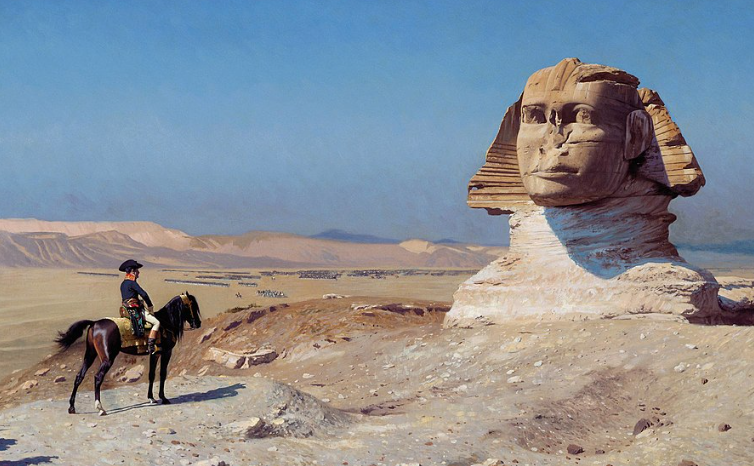
Bonaparte Devant le Sphinx (Bonaparte Before the Sphinx) by French painter Jean-Léon Gérôme.
Hidden Chambers and the Hall of Records
Another source of intrigue is the possibility of hidden chambers beneath the Sphinx. Some researchers have speculated that the Sphinx may guard an ancient repository of knowledge, often referred to as the “Hall of Records.” According to this theory, the Hall contains secret knowledge or historical records from an advanced civilization, possibly Atlantis, or even the original builders of the Sphinx.
In the 1990s, geophysical surveys using ground-penetrating radar revealed anomalies beneath the Sphinx, suggesting the presence of cavities or tunnels. However, no definitive evidence of a hidden chamber or Hall of Records has been found, and mainstream Egyptologists remain skeptical of these claims, attributing the anomalies to natural features or undocumented excavation work.

Image: The Great Sphinx partially excavated, ca. 1878
The Sphinx’s Face and Identity
One of the most debated aspects of the Sphinx is the identity of the person whose face it bears. While the majority of Egyptologists agree that the Sphinx’s face resembles Pharaoh Khafre, some dissenting scholars argue that the proportions of the face do not match known depictions of Khafre, suggesting that it may represent another ruler or even an unknown figure from an earlier period.
One of the most compelling arguments against the Khafre theory is the erosion patterns on the Sphinx’s body, which some researchers believe suggest that the monument was exposed to heavy rainfall, a climate condition that had not existed in Egypt during Khafre’s reign. This has led to the proposal that the Sphinx might have been re-carved from an earlier structure, possibly explaining why its head appears disproportionately small compared to its massive body.
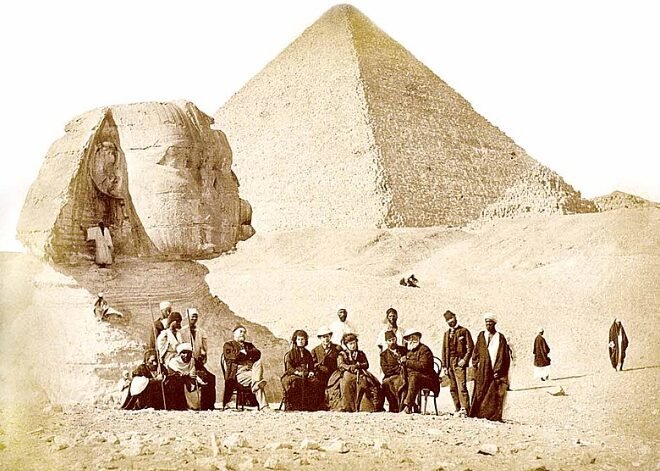
Image: French archaeologist Auguste Mariette (seated, far left) and Emperor Pedro II of Brazil (seated, far right) with others in front of the Sphinx, 1871
Restoration Efforts
Over the centuries, the Sphinx has undergone numerous restoration efforts to protect it from further damage. The earliest known restoration dates back to around 1400 BCE, during the reign of Pharaoh Thutmose IV. According to legend, Thutmose IV had a dream in which the Sphinx spoke to him, promising him the throne of Egypt if he cleared away the sand that had accumulated around it. In gratitude, Thutmose IV not only restored the Sphinx but also placed a large stela (now known as the Dream Stela) between its paws, commemorating the event.

Head of ancient Egyptian King Thutmose IV wearing the blue crown. 18th Dynasty. State Museum of Egyptian Art, Munich, Germany.
In modern times, the Sphinx has been subjected to a variety of preservation techniques, including the use of limestone blocks to shore up its deteriorating body and the application of chemicals to protect it from pollution. However, the harsh desert environment and the passage of time continue to pose significant challenges to the long-term preservation of the monument.
The Sphinx in Popular Culture
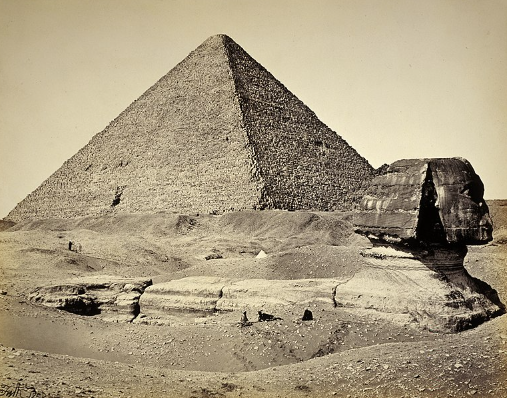
The Great Sphinx of Giza in 1858
The Great Sphinx has captured the imagination of people across cultures and time periods. In ancient Egypt, it was revered as a powerful symbol of kingship and divine protection. During the Greco-Roman period, it was associated with the mythological sphinx, a creature known for posing riddles to those who sought to pass by.
In more recent times, the Sphinx has appeared in countless works of literature, art, and film, often symbolizing mystery, power, and the enigma of ancient Egypt. It has become an enduring symbol of the country’s cultural heritage and one of the most recognizable monuments in the world, drawing millions of tourists each year.
The Sphinx and the constellation Orion
Some researchers argue that the layout of the Sphinx and the pyramids corresponds to the stars of Orion’s belt as they appeared around 10,500 BCE. This theory suggests an astronomical connection between the Giza monuments and the constellation Orion. However, mainstream Egyptologists have criticized this theory due to the lack of archaeological evidence from that period.
Conclusion
The Great Sphinx of Giza remains one of the most enigmatic monuments of the ancient world. While much has been learned about its construction, purpose, and history, many questions still linger. Who built the Sphinx, and when? What was its original purpose? What secrets, if any, lie beneath its massive form?
Despite the passage of time, the Great Sphinx continues to inspire awe and wonder, serving as a reminder of the incredible achievements of ancient civilizations and the mysteries that remain to be uncovered. Whether seen as a guardian of the pyramids, a symbol of divine power, or a relic of a forgotten era, the Sphinx stands as a testament to the enduring allure of ancient Egypt. Its mysteries may never be fully solved, but they ensure that the Sphinx will continue to captivate and challenge us for generations to come.
Questions and Answers on the Great Sphinx of Giza

The Great Sphinx was built just close to the causeway that links Khafre’s Pyramid and Khafre’s valley temple. Thus the pyramid of Khafre is in the background of the Great Sphinx.
Why has the Great Sphinx remained a mysterious monument throughout history?
The Great Sphinx has been buried beneath the desert sand for much of its existence, which has fueled speculation about its origins, purpose, construction methods, and the possibility of hidden chambers. These factors, combined with the lack of conclusive evidence, have made it an enduring source of intrigue. While Egyptologists rely on evidence-based conclusions, many alternative theories have emerged over time.
Where is the Great Sphinx located, and what was its purpose?

The Great Sphinx is located in present-day Giza, Egypt. The city is the third-largest in Egypt by area after Cairo and Alexandria
The Great Sphinx is located on the Giza Plateau, about 10 kilometers west of Cairo, near the pyramids of Khufu, Khafre, and Menkaura. It faces east, towards the rising sun. Its proximity to the pyramids and the ancient city of Memphis suggests it was likely intended as a guardian for the royal tombs. Later Egyptian rulers associated it with the sun god, referring to it as “Horus of the Horizon” (Hor-Em-Akhet).
What are the dimensions of the Sphinx, and how has it been affected over time?
The Great Sphinx measures 73.5 meters in length and up to 20 meters in height. Over the centuries, it has suffered significant damage from weathering, human activity, and pollution. Notably, the nose and the ritual beard are missing, and traces of its original red paint can still be seen. A temple between its paws once contained stelae honoring the sun god.
What is the legend associated with Pharaoh Thutmose IV and the Sphinx?
According to legend, Pharaoh Thutmose IV, while resting in the Sphinx’s shade around 1400 BCE, had a dream in which the Sphinx told him that if he cleared the sand covering it, he would become the ruler of Egypt. After becoming pharaoh, Thutmose fulfilled the Sphinx’s request, and a stela known as the “Dream Stela” was placed between its paws to commemorate the event.
How has the Sphinx been protected from the desert environment over the years?
Pharaoh Thutmose IV is believed to have built a large mudbrick wall around the Sphinx after his dream, to protect it from desert winds and shifting sands. Despite these efforts, the Sphinx has repeatedly been buried and uncovered over the centuries. Restoration efforts in modern times have focused on protecting the monument from environmental damage, including wind erosion and pollution.
What is the debate surrounding the missing nose of the Sphinx?
The missing nose has sparked several theories. Some early accounts suggested that Napoleon’s soldiers shot it off during their campaign in Egypt, but evidence shows the nose was missing long before his arrival. The most plausible explanation is that the nose was deliberately removed in the 8th century CE by a Sufi who viewed the Sphinx as a pagan idol.
Who does the Sphinx represent, and why is this debated?
Most Egyptologists believe the Sphinx was modeled after Pharaoh Khafre (Chephren), who ruled during the Fourth Dynasty around 2540 BCE, and that it was carved during the construction of his nearby pyramid. However, there are no inscriptions directly linking Khafre to the Sphinx, which has led to alternative theories suggesting it may represent Khafre’s brother, Djedefre. This debate remains unresolved.

Image: The Sphinx circa 1880s, by Italian photographer Beniamino Facchinelli
Why is the age of the Sphinx a subject of controversy?
In the 1990s, geologist Robert Schoch proposed that the weathering on the Sphinx was caused by water erosion, suggesting that the monument could be much older—possibly between 7,000 and 10,000 years old. This theory contradicts the traditional dating to around 2540 BCE and has been largely dismissed by Egyptologists, who argue that there is no evidence of such weathering on nearby structures.
Are there any hidden chambers beneath the Great Sphinx?
Legends of secret passageways beneath the Sphinx have persisted for centuries. In the 1990s, seismic technology revealed anomalies beneath the monument, which some interpret as possible chambers. However, no definitive proof has been found, and further excavations have been limited by Egyptian authorities.
What is the current state of the Sphinx, and what efforts are being made to preserve it?
The Great Sphinx continues to suffer from environmental damage caused by wind, humidity, and pollution from nearby Cairo. Ongoing restoration efforts have been in place since the mid-20th century, but early attempts using incompatible materials caused further damage. Today, conservation work focuses on preserving the monument rather than exploring potential hidden secrets beneath it.
Despite ongoing restoration and preservation efforts, the debate over its age and the identity it represents continues to captivate historians, archaeologists, and enthusiasts worldwide. Its enigmatic presence remains a symbol of ancient Egypt’s enduring mystery.
What are the significant achievements of the Ancient Egyptians?