Who was Sir Richard Grenville?
Sir Richard Grenville’s life was marked by ambition, adventure, and a desire to expand England’s influence in the world. From his early days as a soldier fighting in Hungary to his role in colonizing Ireland and the Americas, Grenville was deeply involved in the key political and military events of his time. His final battle at the Azores, where he chose to fight against overwhelming odds, solidified his reputation as a hero of English naval history.
Although Grenville’s colonial ventures were fraught with difficulty and his plans for establishing a permanent colony in the New World ultimately failed, his efforts contributed to the broader history of English exploration and expansion. His military achievements, particularly his last stand aboard the Revenge, ensured that his name would be remembered as one of England’s most courageous and determined naval commanders.
In the article below, World History Edu delves into the life and exploits of Richard Grenville.
Early Life and Background
Sir Richard Grenville, born on 15 June 1542, was the eldest son of Sir Roger Grenville, a naval officer who died when the Mary Rose, his ship, sank in 1545. Grenville’s mother, Thomasine Cole, later remarried Thomas Arundell, a prominent member of the English aristocracy. As a result, Richard Grenville spent much of his childhood at Arundell’s residence, Clifton Arundell House, which exposed him to the culture and politics of the English upper class.
The Grenville family had a long and distinguished history, with strong ties to the West Country, particularly Cornwall and Devon. Grenville inherited his family’s estates at Stowe in Cornwall and Bideford in Devon when he was 21, after the death of his grandfather, Sir Richard Grenville (1495–1550), who had been a Member of Parliament for Cornwall. Grenville’s family estates and connections would play a crucial role in his later career, as both a landowner and military figure.

Sir Richard Grenville (15 June 1542 – 10 September 1591)
Early Career and Military Involvement
Despite his early inheritance of significant lands, Grenville did not limit himself to the life of a gentleman landowner. Instead, he pursued a career as a soldier and adventurer. At the age of 17, he began studying law at the Inner Temple in London, one of the prestigious legal institutions of the time. However, his interests soon shifted toward military service and exploration.
Grenville first gained attention for his role in a deadly duel in London in 1562. Involved in a dispute with Robert Bannister, Grenville ran Bannister through with his sword, leaving him to die. As a result, Grenville and his associates were outlawed for three months before being pardoned for manslaughter. This incident reflected Grenville’s volatile nature and his willingness to engage in violent confrontation, traits that would define much of his later career.
In 1566, Grenville set out on a military expedition to Hungary, where he fought alongside other West Countrymen, such as the Godolphins, Carews, and Killigrews, against the Ottoman Turks. The conflict was part of the larger struggle between the Holy Roman Empire, led by Emperor Maximilian II, and the Ottoman Empire. Grenville’s participation in the Hungarian campaign cemented his reputation as a skilled soldier and military commander, earning him recognition and prestige back in England.
Involvement in Irish Colonization
After returning to England, Grenville became involved in the English colonization of Ireland, particularly in the Munster plantations. During the reign of Queen Elizabeth I, England sought to assert control over Ireland by settling English Protestants on land seized from the native Irish. In 1569, Grenville, along with his cousin Sir Warham St Leger, went to Ireland to secure lands in the Barony of Kerricurrihy, near Cork, as part of the plantation efforts.
Grenville’s tenure in Ireland was marked by conflict with the local Irish nobility. The Desmond Rebellions, led by James Fitzmaurice Fitzgerald, were a series of uprisings by the Irish lords of Munster who opposed English rule. As High Sheriff of Cork, Grenville played a role in quelling the rebellion, although the violence in the region would persist for many years. The rebellion escalated when Fitzmaurice and his allies attacked English outposts, including Tracton, where they massacred nearly the entire garrison. Despite the threats and unrest, Grenville sailed back to England, leaving the rebellion to continue.
Grenville’s efforts in Ireland brought him into close contact with other prominent English figures, including Sir Humphrey Gilbert, Sir Peter Carew, and Sir Walter Raleigh, all of whom were involved in colonization and military ventures. These connections would be important as Grenville transitioned into his more famous role as a leader in England’s attempts to colonize the Americas.
READ MORE: Major Accomplishments of Queen Elizabeth I of England
Grenville’s Role in English Exploration and Roanoke Colony
Grenville’s most notable involvement in English exploration came in 1585, when he was appointed admiral of a fleet tasked with establishing the first English colony in North America. Sponsored by his cousin, Sir Walter Raleigh, Grenville led an expedition of seven ships to Roanoke Island, located off the coast of present-day North Carolina.
The goal of the expedition was to establish a permanent English presence in the New World, which would enable England to challenge Spain’s dominance in the Americas and potentially find a lucrative passage to Asia. Grenville’s fleet arrived at Roanoke in July 1585, but the mission soon faced difficulties. Relations with the local Native American tribes were initially peaceful, but tensions escalated after a silver drinking cup went missing. In retaliation, Grenville ordered the village of Aquascogoc to be burned, an act that soured relations with the indigenous population and complicated the colony’s future prospects.
Despite these setbacks, Grenville returned to England, leaving a small group of settlers behind at Roanoke. Before departing, he captured a Spanish ship, the Santa Maria de Vincente, which he brought back to England as a prize. This act of privateering was typical of Grenville’s career, blending exploration with opportunities for personal profit through raiding enemy ships.
In 1586, Grenville returned to Roanoke only to find that the colonists had been evacuated by Sir Francis Drake. In their place, Grenville left 15 of his own men to maintain an English presence in the area. However, these men were never heard from again, and the mystery of their fate became part of the larger enigma surrounding the “Lost Colony” of Roanoke.
The Colonization of Bideford and Business Ventures
While his role in the Roanoke colony is perhaps the most famous aspect of his career, Grenville also had significant interests in developing the port town of Bideford in Devon. The Grenville family had long been lords of the manor of Bideford, but it was under Richard Grenville’s leadership that the town became a thriving center of trade.
Grenville sought to transform Bideford into a major trading port, particularly for commerce with the newly established American colonies. In 1575, he was granted a new charter for the town, allowing it to hold markets and fairs, and he worked to expand the port facilities. Bideford would later become an important hub for the tobacco trade, linking the West Country with the New World.
Grenville’s efforts to develop Bideford included building ships, expanding the local infrastructure, and encouraging settlement in the area. Although he was never officially the mayor of Bideford, Grenville wielded considerable influence over the town’s affairs as its primary landowner and benefactor.
The Battle Against the Spanish Armada
By the late 1580s, England was facing an existential threat from Spain, its chief rival for dominance in Europe and the New World. In 1588, Spain launched the Armada, a massive fleet intended to invade England and overthrow Queen Elizabeth I. Grenville, like many other English noblemen, played a role in organizing England’s defense.
As Deputy Lieutenant of the West Country, Grenville was responsible for overseeing the defense of Devon and Cornwall. He helped coordinate the construction and repair of coastal fortifications and prepared local militias to defend against a possible Spanish landing. Although the Armada was ultimately defeated by a combination of English naval tactics and unfavorable weather, Grenville’s role in organizing the defense of the West Country contributed to the overall success of the campaign.
READ MORE: Difference between Spanish Armada and English Armada
The Battle of Flores and Grenville’s Death
Richard Grenville’s final and most famous military engagement came in 1591 during the Battle of Flores, which took place in the Azores, a key strategic location in the Atlantic. England had sent a fleet, under the command of Lord Thomas Howard, to intercept Spanish treasure ships returning from the Americas. Grenville was given command of the Revenge, a galleon renowned for its speed and maneuverability.
While stationed near the Azores, Grenville’s fleet was surprised by a much larger Spanish squadron of 53 ships. Howard ordered his ships to retreat, but Grenville refused to abandon his position and instead chose to engage the Spanish fleet with the Revenge. What followed was a legendary battle in which Grenville and his crew fought valiantly against overwhelming odds.
For 12 hours, the Revenge held off the Spanish fleet, inflicting significant damage on several of their ships. Grenville was severely wounded during the battle, but he continued to command his crew, urging them to fight on. According to accounts, Grenville even considered blowing up the ship rather than surrendering, preferring to go down in flames rather than be captured by the Spanish. However, his crew refused to follow this order, and the Revenge was eventually taken by the Spanish.
Grenville died from his wounds several days after the battle, but his courage and tenacity became legendary. The Battle of Flores and Grenville’s last stand were immortalized in Alfred Lord Tennyson’s poem “The Revenge: A Ballad of the Fleet,” which celebrated Grenville’s defiance in the face of impossible odds. His famous refusal to retreat, even when outnumbered 53 to 1, became a symbol of English bravery and determination.

Legacy and Influence
Richard Grenville’s legacy is multifaceted. He was a fierce and ambitious man, known for his military prowess, his contributions to English colonization efforts, and his involvement in local politics and trade. His attempts to establish a lasting English presence in the Americas, while ultimately unsuccessful, laid the groundwork for future English colonization efforts, which would eventually lead to the establishment of permanent colonies like Jamestown in 1607.
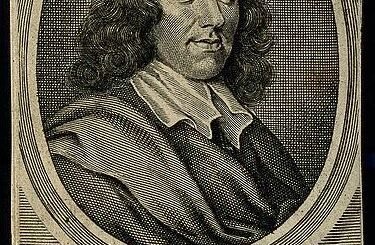
Grenville’s influence extended beyond his military and colonial achievements. His efforts to transform Bideford into a thriving port town had lasting effects on the region’s economy, and his family continued to play a significant role in English politics and military affairs. His grandson, Sir Bevil Grenville, became a prominent Royalist commander during the English Civil War.

Image: Sir Bevil Grenville
In popular culture, Grenville’s final battle aboard the Revenge has been romanticized and commemorated in literature, music, and film. Alfred Lord Tennyson’s poem “The Revenge” is perhaps the most famous retelling of the battle, highlighting Grenville’s bravery and refusal to surrender. Grenville’s legacy also lives on in educational institutions, with several schools and houses named after him in his honor.
Frequently Asked Questions about Sir Richard Grenville
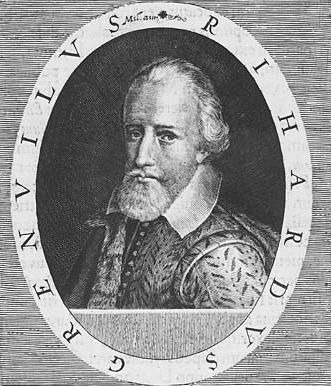
Sir Grenville heroically died in the 1591 Battle of Flores, defending against a larger Spanish fleet.
When and where was Richard Grenville born?
Richard Grenville was born in 1542. He was the eldest son of Sir Roger Grenville, the captain of the Mary Rose when it sank in 1545.
What happened to Grenville’s father, and how did it affect Grenville’s childhood?
Grenville’s father, Sir Roger Grenville, died in 1545 when the Mary Rose sank. Grenville’s mother, Thomasine Cole, remarried Thomas Arundell, and Grenville spent much of his childhood at Arundell’s home.
At the age of 21, Grenville inherited his grandfather’s estates at Stowe in Cornwall and Bideford in Devon.
What significant legal event occurred in Grenville’s early twenties?
In his early twenties, Grenville was involved in a fatal duel in London. He was outlawed for three months for public dueling and manslaughter but was later pardoned.
How did Grenville’s military career begin?
Grenville began his military career by fighting against the Turks in Hungary for the Holy Roman Emperor Maximilian in 1566.
What role did Grenville play in the colonization of Ireland?
Grenville was involved in English colonial ventures in Ireland by 1569, settling lands in Munster. His efforts in the Irish plantations often led to conflicts with local Irish nobility.
How did Grenville contribute to English exploration in the Americas?
Grenville supported Sir Walter Raleigh’s colonial efforts and served as admiral of a fleet that established the first English settlement on Roanoke Island in 1585.
What event during Grenville’s time at Roanoke damaged relations with Native Americans?
Grenville burned the Native American village of Aquascogoc in retaliation for a missing silver cup, which worsened relations between the English and the local tribes.
What were the early European settlements that failed in North America?
What role did Grenville play in defending England during the Spanish Armada?
Grenville played a key role in organizing defenses in Devon and Cornwall against the Spanish Armada in 1588.
What was the significance of Grenville’s battle at the Azores in 1591?
In 1591, Grenville commanded the Revenge in a legendary 12-hour battle against a much larger Spanish fleet near the Azores. Despite being outnumbered 53 to 1, Grenville fought courageously before succumbing to his wounds.
How has Richard Grenville’s final battle been immortalized?
Grenville’s final battle was immortalized in Alfred Lord Tennyson’s poem “The Revenge,” which celebrates his bravery in the face of overwhelming odds.