Who was Theodore Beza, and why is he significant in the context of the Protestant Reformation?
Theodore Beza (1519-1605) was a pivotal figure in the Protestant Reformation, particularly within Calvinism, where he played a crucial role following the death of John Calvin. His life and work spanned most of the sixteenth century, a period of significant religious upheaval and transformation in Europe.
Below, World History Edu presents a detailed exploration of Beza’s history and key facts that highlight his contributions and legacy.

Beza’s contributions to the Protestant movement, particularly within Calvinist circles, marked him as one of the key figures in shaping the theological, cultural, and political contours of Reformed Protestantism. Image: An artwork portraying Beza.
Early Life and Education
Theodore Beza was the youngest son of Pierre de Besze, a royal governor in Burgundy. His upbringing was marked by privilege and rigorous education. From a young age, Beza demonstrated a precocious intellect, prompting his family to ensure he received a thorough education.
He attended the University of Orléans in 1535, where he studied law, reflecting the typical career path expected of someone of his social standing. However, Beza’s intellectual and spiritual journeys were soon to take a significant turn towards theology.

Theodore Beza, known in Latin as Theodorus Beza and in French as Théodore de Bèze or de Besze, was born on June 24, 1519, in the Burgundian town of Vézelay, which at the time was part of the Holy Roman Empire but is now in modern-day France. Image: A portrait of Beza during his mid-twenties.
Conversion and Commitment to Reformation
Beza’s conversion to Protestantism occurred around 1548, amidst the turbulent religious climate that followed Martin Luther’s nailing of the 95 Theses in 1517, which had ignited the Protestant Reformation. The conversion was both a personal epiphany and a professional risk, given the hostility towards Protestantism in many quarters of Europe. Nonetheless, driven by conviction, Beza abandoned his legal career, dedicating himself to the cause of the Reformation. He moved to Geneva, the burgeoning epicenter of Reformed Protestantism under the leadership of John Calvin.
Collaboration with John Calvin
In Geneva, Beza quickly became a close associate and disciple of John Calvin, who had established the city as a model of Protestant reform. Calvin’s Geneva was characterized by strict moral codes and governance by religious principles. Beza’s intellectual capabilities and theological alignment with Calvin made him a key figure in the city. He worked closely with Calvin on various projects, including the translation and annotation of the Bible, which played a crucial role in defining the theological underpinnings of Reformed Protestantism.

In Geneva, Beza quickly became a close associate of John Calvin, contributing to various theological and educational projects, which included work on Bible translations and doctrinal treatises. Image: A painting depicting Calvin.
Leadership in Geneva
Upon Calvin’s death in 1564, Beza succeeded him as the spiritual leader of the Republic of Geneva. This was a period marked by significant challenges, including political tensions with surrounding Catholic states and internal disputes within the Protestant community. Beza’s leadership was instrumental in navigating these challenges. He continued and expanded Calvin’s work, emphasizing doctrinal purity and ecclesiastical discipline. His theological works and sermons helped solidify the Calvinist doctrine, particularly predestination and the sovereignty of God, which became hallmarks of Reformed theology.
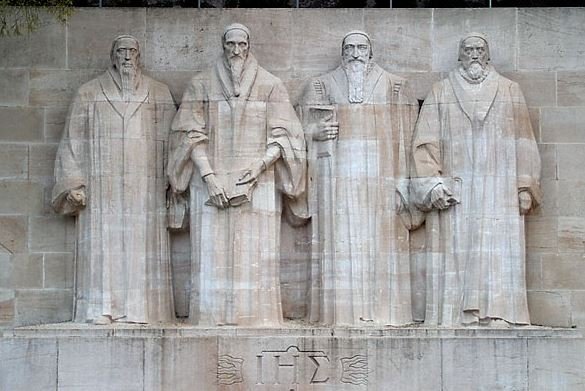
Beza’s life spanned the heart of the Protestant Reformation, a period of profound religious and social upheaval that dramatically reshaped Christianity in Europe. Image: Beza’s statue (second right) on the Reformation Wall together with other theologians (from right), John Knox, John Calvin, and William Farel.
Scholarly Contributions
Theodore Beza was also a prolific scholar. His works include commentaries on the New Testament, theological treatises, and a famous biography of Calvin. His annotations on the Greek New Testament were particularly influential, reflecting his deep linguistic knowledge and commitment to a textually rigorous approach to scripture. These contributions were not merely academic; they served as foundational texts for Calvinist theology and helped spread Reformed ideas throughout Europe and beyond.
Beza’s International Influence
Beyond Geneva, Beza played a significant role in the broader Protestant world. He was a frequent delegate to the religious colloquies and synods that sought to defend and spread Protestant doctrines. His influence extended to France, particularly during the French Wars of Religion, where he supported the Huguenots, French Calvinist Protestants, both morally and theologically.
Legacy
Theodore Beza died on October 13, 1605, but his legacy lived on. He had laid a robust theological foundation that would guide Reformed churches for centuries. His leadership helped Geneva become a refuge for persecuted Protestants from across Europe, earning the city the nickname “Protestant Rome.” Through his scholarly and spiritual labors, Beza was pivotal in cementing the Calvinist tradition within the Protestant Reformation.
Conclusion
Theodore Beza’s life and work were deeply intertwined with the major religious, intellectual, and political currents of his time. As a disciple and successor of John Calvin, his influence on the development of Calvinist theology and the broader Protestant Reformation was profound.
His theological insights, administrative acumen, and scholarly output not only sustained Geneva’s role as a center of Protestant orthodoxy but also contributed to the Reformation’s enduring legacy. Through his efforts, Beza shaped the contours of Reformed Protestantism, impacting countless lives and generations across continents.
Frequently Asked Questions about Theodore Beza
Here are some frequently asked questions about Theodore Beza, which cover various aspects of his life, work, and contributions to the Protestant Reformation:
What was Beza’s relationship with John Calvin?
Beza was both a disciple and close friend of John Calvin. After Calvin’s death in 1564, Beza succeeded him as the leader of the Genevan church, where he continued and expanded upon Calvin’s work, particularly in areas of church governance and doctrinal development.
What were Theodore Beza’s major contributions to the Reformation?
Beza’s contributions were multi-faceted, including his theological writings, biblical commentaries, and leadership in Geneva. He was influential in defining and defending the doctrines of predestination and the sovereignty of God. Additionally, he played a key role in international Reformed movements and supported the Huguenot cause in France.

After Calvin’s death in 1564, Beza succeeded him as the leader of the Genevan church. His leadership was marked by continuity and consolidation of Calvin’s reforms and doctrines, particularly in areas like church governance and scriptural interpretation. Image: A portrait depicting Beza at age 58.
How did Beza impact the field of biblical scholarship?
Beza was a prominent biblical scholar, known especially for his work on the Greek New Testament. His annotations and translations helped shape Protestant biblical interpretation and were influential in the development of subsequent English translations of the Bible.
Did Theodore Beza have any political influence?
Beza had significant political influence, particularly in Geneva and among the Protestant cantons of Switzerland. He also played a role in the wider European context, particularly through his support of the Huguenots in France during the Wars of Religion.
What role did Theodore Beza play in the education system of Geneva?
Theodore Beza was deeply involved in the educational system of Geneva, serving as the rector of the Academy of Geneva, which he helped develop into a major center of Reformed thought and education. This institution trained ministers and scholars who would continue the work of the Reformation across Europe.

Beza was a prolific writer and theologian. His works include significant contributions to biblical scholarship, such as his annotations on the New Testament and a famous biography of John Calvin. Image: Woodcut depicting Beza.
How did Beza’s theological views differ from those of Luther or other Reformers?
While Beza shared many core Protestant beliefs with Luther, such as justification by faith alone, his views on predestination and the absolute sovereignty of God were more closely aligned with Calvin’s teachings. Beza emphasized a more systematic and rigorous approach to these doctrines, which distinguished his Calvinist perspective from Lutheran and other Reformation theologies.
What were some of Beza’s notable works?
Among Beza’s numerous works, his “Icones” (biographical sketches of Reformers), his annotations on the New Testament, and his theological treatises stand out. He also wrote a biography of John Calvin, which remains a significant source for understanding Calvin and his times.

Theodore Beza’s theological and educational efforts left a lasting impact on various Protestant denominations, particularly those following the Reformed tradition. His work influenced the doctrines and practices of Presbyterian, Congregational, and Reformed churches worldwide.





This man was previously unknown to me. He left a huge and important impact on the world and through his wisdom we have clarity of predestination and sovereignty of God.