Life and Accomplishments of William Farel
William Farel was born in 1489 in the French town of Gap. He emerged as a significant figure in the Protestant Reformation, intertwining his fate with that of the movement’s broader historical currents.
His early education at the University of Paris placed him at the intellectual heart of Europe during a time of nascent religious upheaval. It was here that Farel crossed paths with Jacques Lefevre d’Etaples, a relationship that would profoundly shape his theological journey. Lefevre, a key figure in the emerging reformist currents within the Catholic Church, facilitated Farel’s entry into the academic realm by helping him secure a professorship at the Collège Cardinal Lemoine in Paris to teach grammar and philosophy.

William Farel, born in 1489, was a pivotal figure in the Protestant Reformation, a movement that profoundly reshaped Christianity in Europe. Image: Portrait of Farel.
During his tenure at the college, Farel became deeply involved with the Cercle de Meaux, a group of reform-minded intellectuals gathered by the Bishop of Meaux, Guillaume Briçonnet, from 1519. This circle included notables such as Josse van Clichtove, Martial Mazurier, Gérard Roussel, and François Vatable, who collectively emphasized the critical study of the Bible and a return to the theological practices of the early Church. This period marked a significant deepening of Farel’s reformist views, influenced heavily by his interactions with Lefevre and the burgeoning exposure to Lutheran thought.
Farel’s advocacy for reform, particularly his opposition to the use of images in worship, sparked considerable controversy, forcing him to flee to Switzerland. His 1524 publication of thirteen theses criticizing Roman doctrine further fueled the flames, drawing ire from many, including Erasmus, and leading to his expulsion from Basel. His subsequent travels took him to Strasbourg, Montbéliard, and eventually to the more welcoming environments of Zürich with Huldrych Zwingli and back to Strasbourg with Martin Bucer. By 1530, Farel had secured the support of the Canton of Bern to preach freely, marking the beginning of his influential tenure in Neuchâtel, where he successfully persuaded the community to embrace the Reformation.
Farel’s reformist activities reached a pivotal moment in 1532 when he established himself in Geneva. His role in Geneva was crucial, not only for his theological contributions but also for his collaboration with John Calvin, whom he famously persuaded to stay in the city in 1536. This partnership, however, was not without its challenges. Disagreements, particularly over the Eucharist, and resistance from local authorities led to a temporary banishment from the city in 1538. Despite these setbacks, Farel’s connection with Geneva remained strong, supported by the Bern government’s commitment to religious liberty, allowing him to return to his ministerial duties.
Farel’s later years were spent largely in Neuchâtel, where he continued to exert influence over the Reformation movement, often consulting with Calvin. His personal life also underwent significant changes during this period. At the age of sixty-nine, Farel’s marriage to the teenage Marie Thorel drew sharp criticism from Calvin and others who viewed the union as potentially damaging to the Reformation’s reputation. The couple had a son, who tragically died in infancy.

William Farel’s partnership with Calvin not only shaped the theological contours of Protestantism but also the geopolitical landscape of Western Europe, underscoring the profound interplay between religion and politics during the sixteenth century. Image: John Calvin (1509 -1564).
Farel’s life journey encapsulated the tumultuous and dynamic nature of the Reformation. His relentless advocacy for reform, missionary zeal, and theological contributions left a lasting imprint on Protestantism, particularly in the Swiss regions. His death in 1565 in Metz, shortly after a preaching tour, marked the end of an era. His legacy was honored with a monument in Neuchâtel in 1876, a testament to his enduring influence on the religious landscape of Europe.
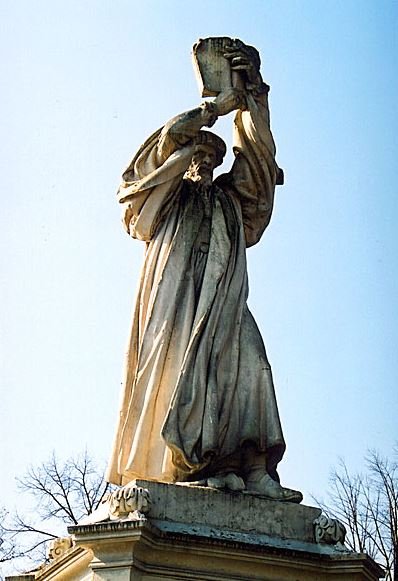
William Farel’s work predominantly spanned the Principality of Neuchâtel, the Republic of Geneva, and the Swiss cantons of Bern and Vaud, the latter being under Bernese control at the time. Image: Statue of Farel at Neuchâtel town in Switzerland.
Farel’s role in the Reformation highlights the complex interplay of personal convictions, intellectual rigor, and societal forces in shaping religious movements. His theological and educational endeavors, controversial though they were, played a critical role in defining the contours of Protestantism.
His partnerships with other reformers, his tenacious advocacy for his beliefs, and his ability to navigate the volatile political landscape of the time underscore the multifaceted challenges and achievements of those at the forefront of religious change. As such, Farel remains a figure of considerable historical significance, whose actions and legacy continue to be studied and appreciated in the context of European religious history.
Frequently Asked Questions
Who was William Farel, and why is he significant in the context of the Protestant Reformation?
William Farel was a French evangelist and a key figure in the Protestant Reformation. He played a crucial role in the establishment of the Calvinist Church and was instrumental in persuading John Calvin to stay in Geneva, significantly influencing the city’s religious and political landscape.
What was the relationship between William Farel and John Calvin, and how did it influence Geneva?
William Farel and John Calvin had a profound partnership that greatly impacted Geneva. Farel first persuaded Calvin to stay in Geneva in 1536 and again in 1541 after their temporary expulsion. Their collaboration led to significant reforms in the city’s governance, aligning it with Protestant doctrines and practices.

Originally from France, Farel became an influential evangelist and reformer who played a crucial role in the establishment of the Calvinist Church. Image: Farel’s statue (left) on the Reformation Wall along with other theologians, Calvin, Theodore Beza, and John Knox.
How did Farel and Calvin’s efforts affect dissenters in Geneva?
Farel and Calvin’s governance in Geneva was marked by a strict adherence to Protestant values, which included the active expulsion and sometimes persecution of dissenters, such as Catholics and Unitarians. In some instances, this harsh treatment escalated to execution, highlighting the era’s intense religious conflicts.
What role did Farel play in the spread of Protestantism beyond Geneva?
Beyond Geneva, Farel was instrumental in training missionary preachers as part of a broader strategy to extend Protestant doctrines. These missionaries, especially sent to places like France, played a key role in propagating the Calvinist interpretation of Christianity, thus aiding the spread and endurance of Protestantism across Europe.
How did Farel’s actions contribute to Geneva becoming known as the “Protestant Rome”?
Farel’s actions, along with Calvin’s, transformed Geneva into a central hub for Protestant reform, earning it the nickname “Protestant Rome.” The city became a stronghold of Protestant thought, attracting reformers and serving as a refuge for those fleeing religious persecution from other parts of Europe.
How did the collaboration between Farel and Calvin resume after their expulsion in 1538?
After their expulsion from Geneva in 1538, the collaboration between Farel and Calvin resumed in 1541 when Farel successfully lobbied for Calvin’s return. This renewal of their partnership further strengthened their influence over Geneva’s religious and social systems.
In what way did Farel’s methods reflect the complexities of the Reformation period?
William Farel’s methods during the Reformation reflected the period’s complexity, marked by fervent religious fervor and brutal conflicts over faith. His severe and sometimes controversial approaches to promoting Protestantism underscored the deep ideological and leadership interconnectedness in driving religious and social reform during that era.
What lasting impact did William Farel have on European religious history?
William Farel’s lasting impact on European religious history is seen in his pivotal role in promoting Protestantism and reshaping the religious landscape of Geneva and beyond. His efforts not only helped solidify the Protestant doctrine in various regions but also influenced subsequent religious and social reforms across Europe.





