Who were the Amorites?
The Amorites were an ancient Northwest Semitic-speaking people who emerged during the Bronze Age. Originating from the Levant, they were first recorded in Sumerian texts around 2500 BC. Over the next several centuries, they played a pivotal role in shaping the political and cultural landscapes of the Levant, Mesopotamia, and parts of Egypt, particularly from the 21st to the 17th centuries BC. Known for establishing significant city-states and empires, the Amorites are considered a cornerstone of early Western Asian civilization.

Artifacts from the Amorite Kingdom of Mari, dating to the early 2nd millennium BCE.
Historical Background
The term mar.tu appears in early Sumerian texts, referring to Amorites as nomadic, rural peoples. In Sumerian mythology, such as The Marriage of Martu, Amorites are depicted as primitive and uncultured, reflecting biases of settled city-dwellers toward nomadic groups. Archaeological findings at Ebla and Akkadian royal inscriptions also reference the Amorites, locating them near the middle and upper Euphrates in northern Syria.
During the Akkadian Empire, Amorites were considered one of the “Four Quarters” surrounding Akkad. They were both a trading partner and military adversary, with rulers like Naram-Sin recording victories against them near Jebel Bishri. By the late third millennium BC, Amorite incursions into Mesopotamia increased, compelling rulers like Shu-Sin of Ur to construct defensive walls.
Amorite Ascendancy (Second Millennium BC)
As the Third Dynasty of Ur declined, Amorite rulers began to dominate Mesopotamian city-states. This period saw the emergence of prominent Amorite-led polities, including:
- Isin and Larsa: Key players in southern Mesopotamia.
- Babylon: Initially a small city-state, it rose to prominence under Amorite kings like Hammurabi, who founded the Old Babylonian Empire.
- Mari and Yamhad: Centers of Amorite culture and administration in northern Mesopotamia and Syria.
The Amorites also exerted influence in Egypt. Rulers with Amorite names, such as Yakbim Sekhaenre, led the Fourteenth Dynasty during the Second Intermediate Period. The Hyksos, who dominated Lower Egypt during this era, are believed to have included Amorites within their ranks, as evidenced by cultural and religious parallels with northern Syria.
Cultural Contributions
The Amorites established advanced city-states with robust administrative and legal systems. Hammurabi’s reign is particularly notable for the codification of laws, which had a lasting impact on legal traditions.
Amorite, a Northwest Semitic language, is closely related to Canaanite and Aramaic. While limited in written records, it is primarily known through personal names and loanwords in Akkadian texts. Amorite influence is also seen in the development of Ugaritic, another Northwest Semitic language.
Amorite religion integrated local deities with their own pantheon. Key gods included:
- Amurru (or Martu): Chief deity associated with the Amorite identity.
- Dagan: A prominent god in cities like Mari and Tuttul.
- Asherah (Ašratum): A goddess linked to fertility and worshiped alongside Amurru.
Recent translations of bilingual deity lists have provided new insights into their religious practices.
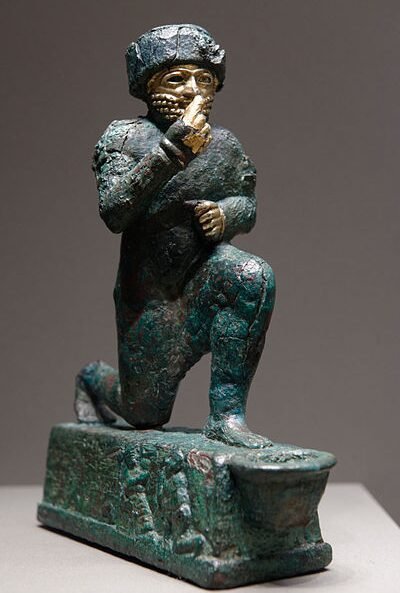
Worshipper of Larsa at Louvre. The statuette was offered in dedication to the god Amurru.
Interactions with Neighboring Civilizations
Amorites alternated between being allies and adversaries of Mesopotamian powers. They contributed to the collapse of the Third Dynasty of Ur and later ruled over cities like Babylon and Mari. However, the Amorite dominance in Mesopotamia ended with the Kassite conquest of Babylon around 1595 BC.
In the western regions, Amorites established powerful kingdoms such as Yamhad, centered at Aleppo. Their influence extended into Canaan, where they interacted with emerging Israelite populations.
Amorite rulers in Egypt influenced the political and cultural framework during the Hyksos era. Their legacy persisted through architectural and religious traditions linked to the Levant.
READ MORE: Reasons why Mesopotamia is often called the Cradle of Civilization
Decline and Legacy
By the 16th century BC, Amorite power waned due to invasions by Hittites, Kassites, and other groups. They were absorbed into or displaced by Arameans and other West Semitic peoples. The Amorite name survived in biblical texts, often associated with Canaan’s pre-Israelite inhabitants.

A stele depicting a sacrificial offering to the god Dagan, circa 13th century BCE.
Amorites in the Bible
The Amorites are frequently mentioned in the Hebrew Bible, where they are depicted as a powerful and imposing people. Genesis describes them as descendants of Canaan, occupying key territories in and around the Jordan Valley. They are sometimes equated with the Canaanites but are also portrayed as distinct tribal groups.
Interactions with Israelites
Key events involving the Amorites include:
- Defeat by Joshua in the conquest of Canaan.
- Subjugation of Amorite kings Sihon and Og, leading to Israelite control over their lands.
- Covenant-making with the Gibeonites, described as Amorite descendants.
Amorite Identity and Origin
The Amorites were Semitic-speaking people likely originating from central Syria. Jebel Bishri, a mountainous region, is often cited as their ancestral homeland. Genetic studies of remains from Amorite cities like Alalakh indicate a mix of Levantine and Mesopotamian ancestry, reflecting their interconnected role in the ancient Near East.

Clay tablets with cuneiform script from Mari, Amorite Kingdom, early 2nd millennium BCE.
Misconceptions and Modern Interpretations
In the 19th and early 20th centuries, some scholars inaccurately depicted the Amorites as “Aryan” nomads based on racial theories of the time. Modern archaeology and genetics have debunked such claims, reaffirming the Amorites’ Semitic origins.
Conclusion
The Amorites were a transformative force in the ancient Near East, contributing significantly to the political, cultural, and religious evolution of the region. From their early depictions as nomadic outsiders to their establishment of influential city-states and empires, their legacy endures through historical texts, archaeological discoveries, and biblical narratives. While their distinct identity faded over time, the Amorites remain a testament to the dynamic interplay of cultures in the ancient world.





