Who were the Young Ottomans?
by World History Edu · January 2, 2025
The Young Ottomans, a secretive society formed in 1865, emerged during the Tanzimat reform period of the Ottoman Empire. Dissatisfied with the reforms’ scope, the society’s members sought a constitutional framework grounded in Islamic principles, liberalism, and European governance models. While the group comprised various ideological factions, it unified in its objective to modernize the empire without dismantling its Islamic foundation.
Origins and Formation
The Tanzimat reforms (1839–1876) aimed to modernize the Ottoman state through legal, administrative, and educational changes. However, the Young Ottomans criticized these measures for their perceived failure to establish a participatory governance structure.
The movement’s origins trace back to a picnic in Belgrad Forest near Istanbul, where six Ottoman intellectuals—Mehmed Bey, Namık Kemal, Menâpirzâde Nuri, Reşat Bey, Ayetullah Bey, and Refik Bey—conceived the idea of an ideological reform group. Their shared goal was to transform Ottoman governance by incorporating European ideas while preserving Islamic traditions.
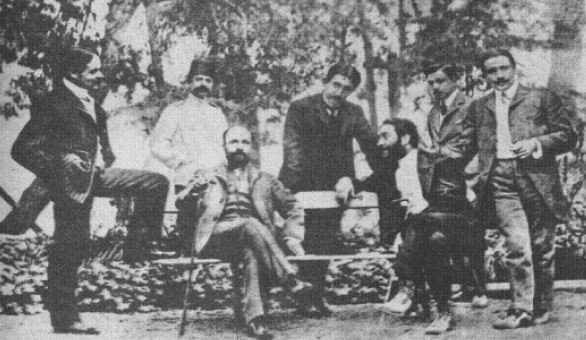
An 1860s photo of Young Ottomans.
Ideological Foundations of the Young Ottomans
The Young Ottomans rejected the bureaucratic autocracy established during the Tanzimat. Inspired by European constitutional models, particularly the French system, they called for a governance structure that ensured individual freedoms and limited centralized power.
The movement promoted an inclusive Ottoman identity to bridge the divide between the empire’s diverse religious and ethnic communities. This ideology sought to foster unity by emphasizing territorial patriotism over sectarian or ethnic affiliations.
The Young Ottomans reconciled Islamic jurisprudence with liberal ideals, advocating for a parliamentary democracy that aligned with Islamic principles. Influenced by thinkers like Montesquieu and Rousseau, they believed governance should uphold justice, liberty, and equality.
Early Activities and Publications
The Young Ottomans used the press to disseminate their ideas, with key periodicals such as Tasvir-i Efkâr, Hürriyet, and Ibret. These publications critiqued the Ottoman government, introduced new political concepts, and shaped public opinion.
After clashing with the Ottoman authorities, several Young Ottomans, including Namık Kemal and Ziya Pasha, sought refuge in Paris. Supported by Egyptian prince Mustafa Fazıl Pasha, they continued their advocacy through publications and political discourse.
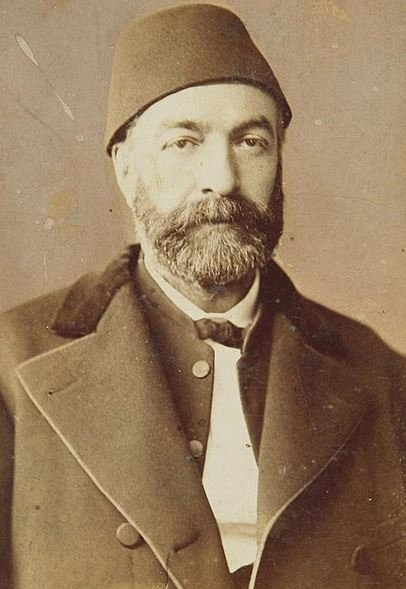
Ziya Pasha’s photo, taken by Abdullah Frères.
Defining Moments: The First Constitutional Era
The financial and agricultural crises of the 1870s, compounded by revolts in the Balkans, heightened the empire’s instability. This turbulent period presented an opportunity for the Young Ottomans to press their demands for reform.
In 1876, Sultan Abdul Hamid II introduced the Kanûn-u Esâsî (Basic Law), the Ottoman Empire’s first constitution. Though the Young Ottomans influenced this milestone, their vision was short-lived; Abdul Hamid II suspended the constitution and parliament in 1878, reverting to autocratic rule.
Key Figures and Contributions
Prominent Members
- Namık Kemal: A leading thinker and writer, Kemal’s works, including his play Vatan, championed constitutionalism and patriotism.
- Ziya Pasha: Collaborated with Kemal in Paris to publish influential periodicals.
- Ali Suavi: A preacher and journalist, Suavi focused on Islamic reform and social justice.
- Mehmed Bey: A founding member advocating for structural reforms.

Namık Kemal
Political Allies
- Midhat Pasha: Instrumental in drafting the 1876 constitution, Midhat Pasha aligned with the movement’s goals.
- Mustafa Fazıl Pasha: The group’s financial patron during its Paris exile.
Challenges and Fragmentation
The Young Ottomans lacked a cohesive ideology, with members often diverging on priorities and strategies. This fragmentation undermined their ability to present a united front.
While some members returned to Istanbul after prominent reformist opponents died, internal disagreements persisted. These divisions, coupled with Sultan Abdul Hamid II’s centralization efforts, limited the group’s influence.
Legacy and Influence
The Young Ottomans laid the groundwork for later reformist movements, including the Young Turks, who initiated the Second Constitutional Era in 1908.
Through their writings, the Young Ottomans redefined key political concepts like liberty (hürriyet) and patriotism (vatan). Their use of the press as a political tool became a hallmark of future reformist endeavors.
Conclusion
The Young Ottomans’ efforts to blend Islamic values with modern governance models marked a pivotal chapter in Ottoman history. Despite their limited immediate success, their ideas influenced subsequent generations of reformers and contributed to the eventual transformation of the Ottoman Empire into a modern state.





