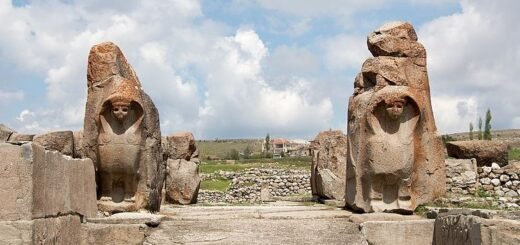
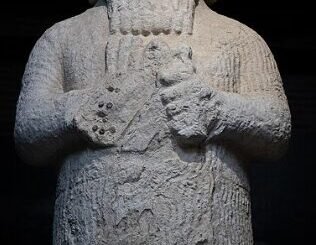
Yazılıkaya in the Hittite Empire
Yazılıkaya, meaning “Inscribed Rock” in Turkish, stands as one of the most remarkable archaeological sites from the Hittite Empire. Located near the ancient capital of Hattusa in present-day Çorum Province, Turkey, this sanctuary offers profound insights into Hittite artistry, religion, and cosmology.
Below World History Edu explores the history and significance of Yazılıkaya, highlighting its role within the Hittite Empire and its enduring legacy.
Location and Description
Nestled within walking distance of the fortified gates of Hattusa, Yazılıkaya occupies a strategic and sacred position. The sanctuary comprises two primary chambers carved directly into natural rock outcrops, accessible through elaborate gateways and supporting structures.
Although only the foundations of these structures remain today, the rock-cut chambers themselves are remarkably well-preserved, showcasing intricate reliefs that depict the gods of the Hittite pantheon. These reliefs are considered the pinnacle of Hittite artistic achievement, reflecting the empire’s sophisticated religious and cultural life.
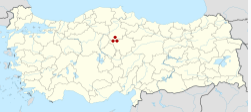
Image: The exact location of Yazılıkaya in Turkey.
Historical Timeline
Yazılıkaya’s origins date back to at least the late 16th century BCE, during the height of the Hittite Old Kingdom. However, the site reached its artistic and functional peak in the late 13th century BCE under the reigns of Kings Tudhaliya IV and Suppiluliuma II.
During this period, significant restoration efforts were undertaken, resulting in the elaborate carvings that are admired today. These restorations not only enhanced the sanctuary’s aesthetic appeal but also reinforced its importance as a religious and possibly astronomical center within the empire.
Religious Significance
As a sacred sanctuary, Yazılıkaya played a central role in Hittite religious practices. The Hittites were polytheistic, worshipping a pantheon of gods that mirrored those of neighboring cultures, reflecting their extensive interactions and cultural exchanges.
The sanctuary’s two chambers were dedicated to different aspects of the divine, serving as a space for rituals, ceremonies, and possibly state-sponsored religious events such as New Year’s celebrations. The presence of numerous deities in the rock reliefs underscores the importance of divine patronage in legitimizing the Hittite kings’ rule and maintaining cosmic order.
Artistic Significance
Yazılıkaya is renowned for its exceptional rock reliefs, which are among the most important examples of Hittite art. Chamber A, the larger of the two, features a procession of 64 deities, meticulously carved into the rock.
The left wall depicts male gods adorned in traditional kilts, pointed shoes, and horned hats, while mountain gods are depicted with scaled skirts to symbolize their dominion over rugged terrains.
The right wall showcases female deities wearing elegant crowns and flowing skirts, creating a harmonious visual balance. The only deviation from this gendered division is Shaushka, the goddess of love and war, who appears among the male gods, highlighting her unique dual nature.
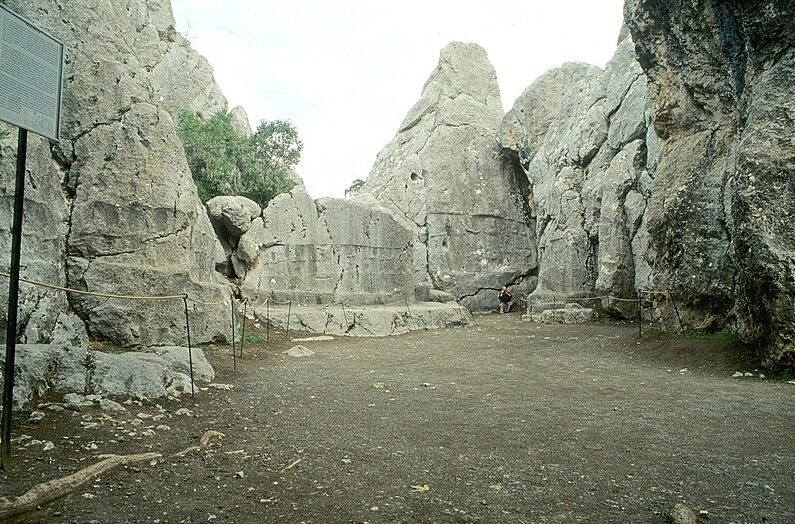
Chamber B, though smaller, houses fewer but larger and better-preserved reliefs. This chamber is believed to have served as a mortuary mausoleum or memorial for King Tudhaliya IV, integrating royal authority with divine reverence. The grandeur of Chamber B reflects the Hittites’ practice of intertwining their monarchy with religious legitimacy, emphasizing the king’s role as both a temporal and spiritual leader.
Syncretism and Cultural Integration
One of Yazılıkaya’s most significant aspects is its demonstration of religious syncretism—the blending of different religious traditions. The Hittites were adept at assimilating deities from other cultures into their pantheon, reflecting their interactions with neighboring civilizations such as the Mesopotamians and Hurrians.
For example, the Mesopotamian god of wisdom, Ea (Enki), is depicted in the male procession, while Teshub, originally a Hurrian storm god, was syncretized with the Hittite counterpart. Similarly, Hebat, the sun goddess, was merged with the Hattic sun goddess of Arinna, illustrating the Hittites’ inclusive approach to religion.
This cultural fusion was significantly influenced by figures like Queen Puduhepa, a Hittite queen of Hurrian descent. Puduhepa played a pivotal role in integrating Hurrian religious elements into the Hittite belief system, further enriching the sanctuary’s religious system. This syncretism not only enhanced the diversity of the Hittite pantheon but also reinforced the empire’s cosmopolitan nature and its capacity to incorporate and harmonize various cultural influences.
READ MORE: Most Famous Ancient Mesopotamian Deities
Cosmological and Astronomical Importance
Beyond its religious functions, Yazılıkaya may have served as an astronomical observatory and a time-keeping device. Scholars Rita Gautschy and Eberhard Zangger proposed that the sanctuary’s carvings mark lunar and solar movements, suggesting that Yazılıkaya played a role in tracking celestial cycles. This would have been essential for the Hittites in planning agricultural activities, religious festivals, and administrative events.
A 2021 study delved deeper into the cosmological symbolism embedded in Yazılıkaya’s reliefs. The sanctuary’s carvings depict the cosmos’s three fundamental levels: earth, sky, and the underworld. Additionally, they illustrate cyclical processes such as day and night, lunar phases, and the changing seasons, effectively functioning as a lunisolar calendar.
Chamber A is associated with the northern stars, while Chamber B represents the netherworld, indicating a sophisticated understanding of celestial and earthly realms. This dual representation highlights the Hittites’ advanced knowledge of astronomy and their ability to integrate this knowledge into their religious and cultural practices.
Restoration and Preservation
The late 13th century BCE marked a significant period of restoration for Yazılıkaya under Kings Tudhaliya IV and Suppiluliuma II. These restoration efforts were likely motivated by a desire to reinforce the sanctuary’s religious significance and to ensure its continued role as a center for state-sponsored rituals and ceremonies. The elaborate carvings created during this period not only enhanced the site’s aesthetic and religious value but also preserved it for future generations.
Today, Yazılıkaya remains remarkably well-preserved, allowing historians and archaeologists to study its intricate reliefs and understand the Hittites’ artistic and religious endeavors. Ongoing preservation efforts are crucial in maintaining the site’s integrity, ensuring that Yazılıkaya continues to be a valuable resource for understanding the Hittite Empire’s history and culture.
Legacy and Modern Importance
Yazılıkaya’s legacy extends far beyond the Hittite Empire. As one of the most important groups of Hittite art, the sanctuary offers invaluable insights into the religious beliefs, artistic achievements, and astronomical knowledge of an ancient civilization that once dominated the Near East. Its rock reliefs not only showcase the Hittites’ artistic prowess but also their ability to assimilate and harmonize diverse cultural influences, reflecting the empire’s cosmopolitan nature.
Today, Yazılıkaya is a major archaeological and tourist site, attracting scholars and visitors from around the world. Its enduring legacy lies in its ability to communicate the Hittites’ sophisticated worldview and their intricate relationship with the divine and the cosmos. Through its impressive reliefs and profound symbolism, Yazılıkaya stands as a timeless monument to human creativity and the enduring quest to understand the divine and the universe.
Questions and Answers
Yazılıkaya, meaning “Inscribed Rock” in Turkish, is a sacred sanctuary of the Hittite Empire located near the ancient gates of Hattusa in today’s Çorum Province, Turkiye.
What is the historical significance of Yazılıkaya?
Yazılıkaya served as a holy site integral to Hittite religious practices from at least the late 16th century BCE, reaching its artistic peak in the late 13th century BCE during the reigns of Tudhaliya IV and Suppiluliuma II.
What are the main features of Yazılıkaya’s sanctuary?
The sanctuary comprises two main roofless chambers carved into natural rock outcrops, accessed through gateways and structures whose foundations remain today. The most notable features are the intricate rock reliefs in Chambers A and B depicting Hittite gods.
What is depicted in Chamber A of Yazılıkaya?
Chamber A features a procession of 64 deities carved into the rock, with male gods on the left wall, female gods on the right, and the supreme divine couple, Teshub and Hebat, at the center. It also includes Shaushka, the goddess of love and war, among the male gods.
What is the purpose of Chamber B in Yazılıkaya?
Chamber B is smaller and houses fewer but larger and better-preserved reliefs. It is believed to have served as a mortuary mausoleum or memorial for King Tudhaliya IV, reflecting the intertwining of royalty with divine reverence.
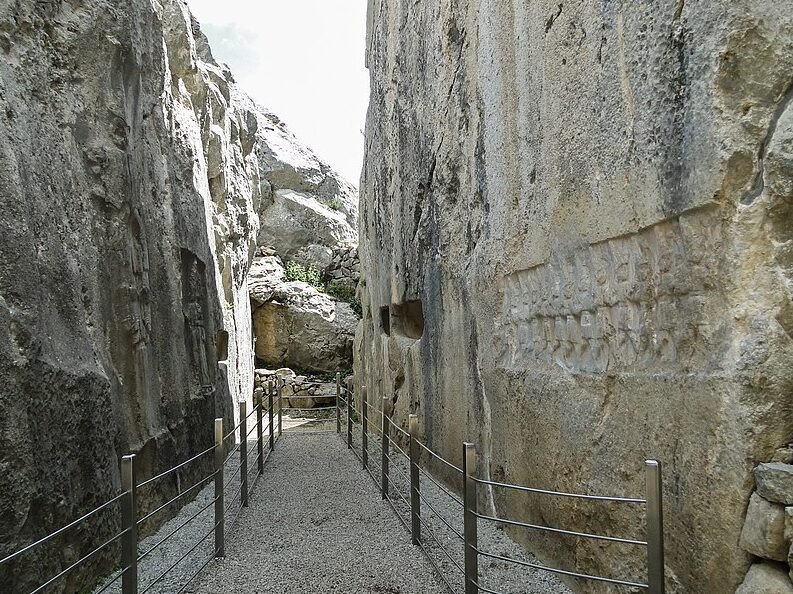
Image: A view of Chamber B
How did Yazılıkaya exemplify Hittite syncretism and cultural fusion?
Yazılıkaya showcases the Hittites’ assimilation of deities from other cultures, such as the Mesopotamian god Ea (Enki) and the Hurrian storm god Teshub. This syncretism was influenced by figures like Queen Puduhepa, integrating Hurrian religious elements into the Hittite pantheon.
What role might Yazılıkaya have played in time-keeping and astronomy?
Scholars Rita Gautschy and Eberhard Zangger suggested that Yazılıkaya functioned as a sophisticated time-keeping device, with its carvings marking lunar and solar movements, potentially used in New Year’s celebrations and as a lunisolar calendar.
What cosmic symbolism is present in Yazılıkaya’s carvings?
The sanctuary’s reliefs depict the cosmos’s three levels—earth, sky, and underworld—and illustrate cyclical processes like day/night, lunar phases, and seasons. Chamber A is associated with the northern stars, while Chamber B represents the netherworld.
Who are the supreme deities depicted in Yazılıkaya, and what do they symbolize?
The supreme deities are Teshub, the storm god, depicted atop two mountain gods, and Hebat, the sun goddess, standing on a panther. They are accompanied by their children, symbolizing divine lineage and the continuity of the pantheon.
What is the enduring legacy of Yazılıkaya today?
Yazılıkaya remains a symbol of Hittite artistry and spirituality, offering insights into their religious beliefs and astronomical knowledge. It continues to inspire awe and scholarly interest, standing as a timeless monument to ancient human creativity and the quest to understand the divine.