The 1958 Lebanon Crisis
The 1958 Lebanon Crisis was a complex political crisis stemming from religious, political, and geopolitical tensions within Lebanon, compounded by the broader context of the Cold War. The crisis prompted a U.S. military intervention, known as Operation Blue Bat, lasting three months and aimed at stabilizing Lebanon under President Camille Chamoun’s government. This intervention ended with the peaceful transfer of power when Chamoun’s term concluded.
Background: The Arab Cold War and U.S. Policy
The Cold War rivalry between the United States and the Soviet Union influenced the Middle East through the Arab Cold War, where pan-Arab nationalism, led by Egypt’s President Gamal Abdel Nasser, challenged pro-Western regimes. In response to increasing Soviet influence, especially after the Suez Crisis of 1956, the U.S. introduced the Eisenhower Doctrine in 1957. This policy pledged economic and military aid to Middle Eastern nations resisting communism, signaling America’s commitment to containing Soviet expansion in the region.
Lebanon, a young nation independent since 1943, had a fragile political structure based on the National Pact, which sought to balance power among religious groups, including Maronite Christians, Sunni and Shia Muslims, and Druze. However, tensions grew under the presidency of Camille Chamoun (elected in 1952), who pursued pro-Western policies, including endorsing the Eisenhower Doctrine, which alienated many Lebanese Muslims who favored closer ties with Nasser’s United Arab Republic (UAR).
Events Leading to the Crisis
The roots of the crisis lay in the parliamentary elections of 1957, which were marked by allegations of U.S.-backed vote-rigging to secure a pro-Chamoun majority. Many Lebanese Muslims, led by figures like Druze leader Kamal Jumblatt and Sunni leader Rashid Karami, accused Chamoun of violating the National Pact by aligning too closely with the West. These tensions escalated in May 1958 with the assassination of journalist Nasib Al Matni, a critic of Chamoun, sparking widespread protests and sectarian violence.
Chamoun’s rumored attempt to amend the constitution to secure a second term further inflamed opposition. The situation worsened with the rise of the UAR, uniting Egypt and Syria, which many Lebanese Muslims viewed as a model for Arab unity. Chamoun’s refusal to join the UAR deepened divisions, with Muslim factions receiving arms from Syria, and fighting breaking out across Beirut and other regions.
Operation Blue Bat
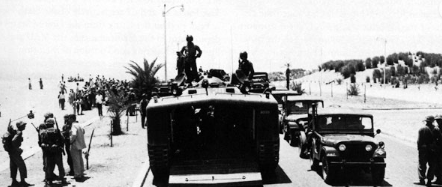
Amid rising violence, Chamoun requested U.S. assistance under the Eisenhower Doctrine. Although the U.S. saw no overt communist aggression, it feared Lebanon’s instability could compromise Western influence in the region. On July 15, 1958, Operation Blue Bat commenced as U.S. Marines and Army troops landed in Beirut to stabilize the situation and protect the pro-Western government. More than 14,000 U.S. troops participated, supported by naval and air forces. Their primary objectives included securing Beirut International Airport and the city’s port.
Resolution and Aftermath
The crisis was resolved diplomatically, with U.S. envoy Robert Daniel Murphy mediating a compromise. Chamoun agreed not to seek re-election, and moderate Christian general Fouad Chehab was elected president, bridging the gap between Lebanon’s factions. Chamoun remained in office until his term ended in September, ensuring a peaceful transition.
Following the crisis, Prime Minister Rashid Karami formed a national reconciliation government, reflecting a fragile yet critical effort to maintain Lebanon’s delicate sectarian balance. The U.S. withdrew its forces by October 25, 1958, marking a successful, albeit temporary, intervention.
Significance
The 1958 Lebanon Crisis highlighted the intersection of local sectarian dynamics and global Cold War politics. It underscored the U.S. commitment to preventing communist influence in the Middle East but also exposed the challenges of intervening in deeply divided societies. While the crisis ended with a compromise, it foreshadowed the recurring sectarian conflicts that would plague Lebanon in subsequent decades.