Mikhail Gorbachev: History, Accomplishments and Facts

Mikhail Gorbachev became the general secretary of the Communist Party in March 1985.
Mikhail Gorbachev, serving as both general secretary and president of the Soviet Union, played a pivotal role in enacting policies that pushed for disarmament and demilitarization in Eastern Europe. As the last general secretary of the Communist Party of the Soviet Union and the last president of the Soviet Union, his leadership marked a significant period in Soviet history.
Early Life
Mikhail Sergeevich Gorbachev was born on March 2, 1931, in the Russian village of Privolnoye. From an early age, he worked on a farm, helping his family with their agricultural duties. Despite these responsibilities, Gorbachev excelled academically, earning a law degree from Moscow State University. During his time at the university, he joined the Communist Party and quickly rose through its ranks, becoming the Secretary of the law department’s youth wing.
Gorbachev’s family background included devout Russian Orthodox Christians, with his grandparents being particularly religious. This upbringing influenced his worldview and ethical outlook, even as he climbed the ranks of the Communist Party.

Image: Gorbachev and his Ukrainian maternal grandparents, late 1930s
Political Career and Reforms

Image: Gorbachev at the Brandenburg Gate in 1986 during a visit to East Germany
In the early 1990s, Gorbachev was a dedicated Marxist-Leninist, who later embraced elements of social democracy. His most significant contributions include his efforts to end the Soviet Union’s dominance over Eastern Europe, which had persisted since World War II. Gorbachev was instrumental in advocating for the removal of the ‘Iron Curtain,’ which had long separated Eastern communist territories from the Western noncommunist world. His policies aimed at establishing stronger ties with noncommunist countries, especially the United States.
Gorbachev’s collaboration with then-US President Ronald Reagan was crucial in reducing political and military tensions between the US and the Soviet Union, leading to the end of the Cold War. This partnership symbolized a new era of diplomacy and cooperation between the two superpowers.
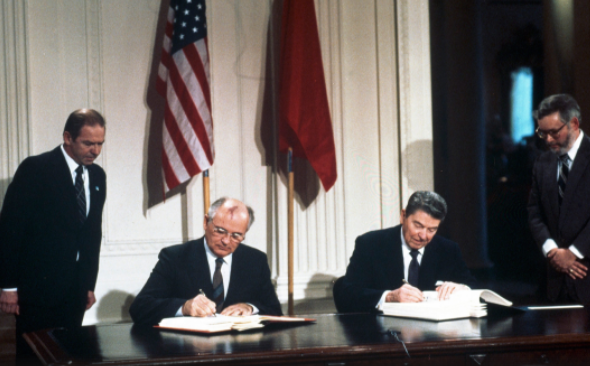
Mikhail Gorbachev’s tenure as the last general secretary and president of the Soviet Union was marked by significant reforms and efforts to democratize and modernize the country. Image: Ronald Reagan and his Soviet counterpart Mikhail Gorbachev signed the Intermediate-Range Nuclear Forces (INF) Treaty in 1987
Key Political Roles
Gorbachev was recognized as a philanthropist and reformist, striving to modernize the Soviet Union while promoting a form of democratic socialism. His reputation for transformation and proactive leadership won him significant support within his political sphere. As Minister of Agriculture and later as a party leader, he was elected to the Supreme Soviet in 1970.
By 1989, reformist sentiments had spread to the Soviet satellite states in Central Europe. Gorbachev informed the communist leaders of these countries that he would not use military force to keep them in power, a sharp departure from his predecessors’ policies. This stance allowed these dictatorships to yield to democratic opposition without the support of the Red Army, and Gorbachev began withdrawing Soviet forces from Central Europe.
In 1996, Gorbachev unsuccessfully ran for the presidency of Russia. Despite this setback, he continued to be active in politics and public life.
Later Achievements and Activities
In 2001, Gorbachev founded the Social Democratic Party of Russia, though it gained limited traction. He also held a stake in the tabloid Novaya Gazeta, known for its opposition to President Vladimir Putin and Prime Minister Dmitry Medvedev’s ruling party. Despite his criticism of American foreign policy, particularly interventions in the former Yugoslavia and Iraq, Gorbachev supported some of Medvedev’s foreign policy ideas, including military action in South Ossetia.
Gorbachev stepped down as Party Chairman in 2004, and the party was later decertified by the national government. In 2007, he established the Union of Social Democrats but soon left it to join billionaire financier Alexander Lebedev in founding the Independent Democratic Party.
Contributions to Disarmament and Demilitarization
Gorbachev’s most notable success was in dismantling the totalitarian aspects of the Soviet state and guiding the country toward representative democracy. However, he was less willing to free the Soviet economy from centralized state control. He rejected the totalitarian use of power that had previously sustained the Soviet economy but also opposed a decisive shift to private ownership and free-market mechanisms.
For six years, Gorbachev performed a delicate balancing act, implementing reforms against resistance from the old guard while managing the demand for change from radical reformers within and outside the Communist Party. He allowed unprecedented freedom of expression in the Soviet Union and ended the disastrous Soviet military involvement in Afghanistan.
Distinctions and Awards
Gorbachev’s pioneering role earned him numerous awards, including the Nobel Peace Prize in 1990. He also received the first Ronald Reagan Freedom Award, the American Academy of Achievement’s Golden Plate Award, and the Freedom of the City of Dublin.

Gorbachev’s role in ending the Cold War and promoting disarmament had a lasting impact on global politics. Although his economic policies faced criticism, his commitment to reducing totalitarian control and enhancing freedom of expression was a testament to his visionary leadership. Image: Former US president Ronald Reagan awards the first Ronald Reagan Freedom Award to Gorbachev at the Reagan Library, 1992.
Legacy

Königsberg was renamed by the Soviets Kaliningrad after Mikhail Kalinin, one of the senior leaders of the Bolshevik revolution. Image: The monument to Soviet leader Mikhail Kalinin on the Kalinin Square, built in 1959
Mikhail Gorbachev’s legacy is complex and multifaceted. His leadership during a transformative period in Soviet history had a profound impact on global politics. By advocating for disarmament and demilitarization, he helped to reduce the threat of nuclear war and paved the way for more peaceful international relations. His efforts to modernize the Soviet Union and promote democratic principles contributed to the eventual dissolution of the Soviet Union and the emergence of independent states in Eastern Europe.
Despite facing significant challenges and opposition, Gorbachev’s commitment to reform and openness changed the course of history. His policies not only transformed the Soviet Union but also influenced global political dynamics, leading to a more interconnected and cooperative world.
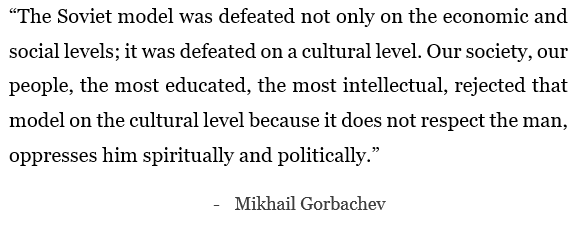
Gorbachev’s reforms of the 1980s were aimed at changing the social, economic and political fabric of the Soviet Union. The Soviet leader hoped that those reforms would help keep the Union thriving and robust in a world that was fast changing.
Frequently Asked Questions

Gorbachev’s vision was to have a Soviet economy that was a mix between capitalism and communism. Unfortunately, those economic liberalization policies ended up being one of the straws that broke the Soviet Union’s back. Image: Gorbachev in 1985 at a summit in Geneva, Switzerland
Who was Mikhail Sergeyevich Gorbachev?
Mikhail Sergeyevich Gorbachev was a pivotal Soviet and Russian politician who served as the last leader of the Soviet Union from 1985 until its dissolution in 1991.
What key leadership roles did Gorbachev hold?
Gorbachev held multiple leadership roles, including General Secretary of the Communist Party of the Soviet Union from 1985, Chairman of the Presidium of the Supreme Soviet from 1988 to 1989, Chairman of the Supreme Soviet from 1989 to 1990, and President of the Soviet Union from 1990 to 1991.
How did Gorbachev’s ideological stance change over time?
Initially a Marxist-Leninist, Gorbachev transitioned towards social democracy by the early 1990s.
Where and when was Gorbachev born?
Gorbachev was born on March 2, 1931, in Privolnoye, Russian SFSR.
What was Gorbachev’s early life like?
Gorbachev came from a poor peasant family of Russian and Ukrainian descent, worked on a collective farm, and joined the Communist Party. He earned a law degree from Moscow State University in 1955 and worked for the Komsomol youth organization in Stavropol.
What significant reforms did Gorbachev support during his early political career?
After Stalin’s death, Gorbachev supported Nikita Khrushchev’s de-Stalinization reforms.
What major project did Gorbachev oversee as First Party Secretary of the Stavropol Regional Committee?
As First Party Secretary of the Stavropol Regional Committee, Gorbachev oversaw the construction of the Great Stavropol Canal.
When did Gorbachev become a member of the Politburo?
Gorbachev became a non-voting member of the Politburo in 1979 and a voting member in 1980.
What were some of Gorbachev’s significant actions as the leader of the Soviet Union?
Gorbachev withdrew Soviet troops from the Afghan War, engaged in summits with U.S. President Ronald Reagan to reduce nuclear arsenals and end the Cold War, implemented the glasnost policy to enhance freedom of speech and press, and the perestroika policy to decentralize economic decision-making.
How did Gorbachev’s democratization measures affect the Soviet state?
Gorbachev’s democratization measures and the establishment of the elected Congress of People’s Deputies weakened the one-party state.
What was Gorbachev’s response to the abandonment of Marxist-Leninist governance by Warsaw Pact countries in 1989?
Gorbachev refrained from military intervention as Warsaw Pact countries abandoned Marxist-Leninist governance.

Image: Berlin Wall, Thank you, Gorbi!, October 1990
What event in 1991 significantly impacted the Soviet Union’s stability and Gorbachev’s leadership?
A failed coup by Communist hardliners in August 1991 significantly impacted the Soviet Union’s stability and Gorbachev’s leadership.
What did Gorbachev do after resigning from the presidency?
After resigning, Gorbachev founded the Gorbachev Foundation, criticized Russian presidents Boris Yeltsin and Vladimir Putin, and supported Russia’s social-democratic movement.
How is Gorbachev regarded in the West and in Russia?
In the West, Gorbachev is praised for ending the Cold War and introducing political and economic freedoms in the Soviet Union. In Russia, his legacy is mixed, with initial positive views declining as the Soviet Union’s collapse led to economic turmoil and diminished global influence.
What prestigious award did Gorbachev receive for his contributions?
Gorbachev received the Nobel Peace Prize for his contributions.