Russian Revolution of 1905: Origins, Major Causes and Outcome
The Russian Revolution of 1905 was a momentous event that shook the foundations of the Russian Empire, exposing deep systemic flaws within the autocracy of Tsar Nicholas II. This revolution, although ultimately unsuccessful in toppling the monarchy, served as a precursor to the more decisive revolutions of 1917. The upheaval reflected widespread dissatisfaction across all levels of Russian society, from urban workers and intellectuals to peasants and military personnel.
In the article below, World History Edu takes an-depth look at the origins, causes, and outcomes of this revolution, providing essential insight into the broader narrative of Russia’s political and social transformation in the early 20th century.

December 1905, Moscow’s Arbat Street: Workers from the Schmidt factory defending barricades.
Origins of the Revolution
The roots of the revolution lie in the autocratic governance of Tsarist Russia, which failed to modernize politically despite undergoing some industrial and economic advancements. By the late 19th and early 20th centuries, the Russian Empire lagged behind Western European nations in terms of democratic reforms and industrialization. Political power remained centralized in the hands of the Tsar, with little input from the broader population. The absence of a constitution, elected legislative bodies, or guaranteed civil liberties exacerbated social tensions.
While limited industrialization efforts, spearheaded by figures like Sergei Witte, had brought economic growth, they also introduced social dislocation. Urbanization created a new working class that faced harsh labor conditions, low wages, and limited legal protections. Similarly, the vast majority of Russians—rural peasants—were burdened by high taxes, land scarcity, and lingering effects of serfdom, which had been abolished only a few decades earlier in 1861. This created fertile ground for unrest.
The Empire’s failure to address growing discontent was compounded by the rise of political ideologies and organizations advocating radical change. Revolutionary groups such as the Socialist Revolutionaries, the Mensheviks, and the Bolsheviks gained influence among workers, students, and other marginalized groups, promoting visions of a more equitable society. Liberal factions like the Kadets also pushed for constitutional governance, but their approach remained less radical compared to the revolutionary left.
The immediate backdrop to the revolution was the disastrous Russo-Japanese War (1904–1905), a conflict initiated by Russia’s imperial ambitions in East Asia. Defeat in this war exposed the inefficiency of the Russian military and the incompetence of the Tsarist administration. The loss to Japan, a nation many Russians considered inferior, was both a strategic and psychological blow, fueling calls for reform and undermining public confidence in the regime.
Major Causes of the Revolution
Political Repression and Autocracy
The political structure of Tsarist Russia left no room for meaningful participation by the population. Nicholas II ruled as an autocrat, believing in the divine right of kings and resisting all efforts to limit his power. The absence of democratic institutions meant that grievances, whether related to economic conditions, civil liberties, or governance, went unaddressed. Political dissent was met with censorship, imprisonment, or exile, pushing opposition groups underground. This climate of repression fostered widespread frustration and radicalism.
Social Inequality and Economic Hardship
The Russian population was deeply divided between the wealthy aristocracy and the impoverished masses. Peasants, who made up the majority of the population, struggled under a system that left them with insufficient land to sustain their livelihoods. Although serfdom had ended, the lack of meaningful land reform meant that peasants remained economically dependent on wealthy landowners. High taxes and grain requisitions further impoverished rural communities, leading to periodic famines and unrest.
In urban areas, the rise of factories brought a new set of problems. Industrial workers faced grueling working conditions, long hours, and minimal wages. Factory environments were often unsafe, and strikes or protests were met with harsh reprisals. Workers lacked representation or legal recourse, intensifying resentment toward employers and the state.
Russo-Japanese War and Military Weakness
The war with Japan, fought over control of territories in East Asia, proved disastrous for Russia. Military defeats, including the destruction of the Baltic Fleet at the Battle of Tsushima, humiliated the nation. Soldiers and sailors, demoralized by poor leadership and logistical failures, began to question their loyalty to the regime. The war also strained Russia’s economy, diverting resources away from domestic needs and worsening living conditions for ordinary citizens.
Urbanization and Rise of a Proletariat
Rapid industrial growth had led to significant urbanization, particularly in cities like St. Petersburg and Moscow. The influx of rural workers into urban centers created crowded living conditions, fostering the spread of disease and crime. This urban working class became increasingly politically aware and susceptible to the influence of revolutionary groups. Strikes and protests became common as workers demanded better conditions and wages.
“Bloody Sunday” as a Catalyst
The immediate trigger for the revolution was the Bloody Sunday massacre on January 22, 1905. On that day, a peaceful march of workers, led by Father Georgy Gapon, approached the Winter Palace in St. Petersburg to deliver a petition to Tsar Nicholas II. The petition requested better labor conditions, fair wages, and basic civil liberties. However, the demonstrators were met with gunfire from the Imperial Guard, resulting in hundreds of deaths and injuries.
Bloody Sunday shattered the image of the Tsar as a paternal figure who cared for his people. Public outrage over the massacre sparked a wave of strikes, uprisings, and protests across the empire. Factories shut down, transport networks were paralyzed, and peasant revolts erupted in the countryside. Even the military, long considered a reliable pillar of the regime, experienced mutinies, including the famous rebellion aboard the battleship Potemkin.
The Course of the Revolution
The unrest that began with Bloody Sunday spread rapidly throughout the empire. Strikes and demonstrations took place in major cities, while peasants attacked landowners’ estates in rural areas. Various groups—workers, students, peasants, and military personnel—joined the uprising, although their goals often diverged. The lack of coordination among these factions limited their overall effectiveness.
To quell the unrest, Tsar Nicholas II issued the October Manifesto on October 17, 1905. Drafted under the guidance of Sergei Witte, the manifesto promised:
- The creation of a State Duma (parliament) with limited legislative powers.
- The introduction of civil liberties, including freedom of speech, assembly, and association.
- A move toward a multi-party political system.
While the October Manifesto temporarily calmed the situation, it fell short of addressing deeper structural issues. The promised Duma was heavily restricted, with the Tsar retaining the power to dissolve it and veto legislation. The 1906 Russian Constitution, which followed, institutionalized these limitations, ensuring that the monarchy remained dominant. Radical groups, dissatisfied with the superficial reforms, continued to agitate for more fundamental change.

Image: A 1912 portrait of Tsar Nicholas II
Outcome and Legacy
The 1905 Revolution failed to overthrow the Tsarist regime but had profound consequences for Russia. It marked the first significant challenge to autocracy in the 20th century and set the stage for future revolutionary movements.
Short-Term Impact
- The creation of the Duma provided a platform for political debate, though its powers were curtailed.
- Repression continued, with the government cracking down on dissent through arrests, executions, and exile.
- Some segments of the population, particularly liberals, were temporarily appeased by the October Manifesto, weakening the revolutionary coalition.
Long-Term Consequences
- The revolution exposed the incompetence and fragility of the Tsarist regime, demonstrating its inability to adapt to modern political and social realities.
- Revolutionary movements, particularly the Bolsheviks, gained momentum. Figures like Vladimir Lenin viewed the events of 1905 as a “dress rehearsal” for the October Revolution of 1917.
- Social and economic grievances persisted, as the root causes of discontent—land reform, workers’ rights, and political representation—remained unresolved.

Image A depiction of Bloody Sunday in St. Petersburg.
Significance in Russian History
The revolution represented a turning point in Russian history, highlighting the growing divide between the ruling elite and the broader population. Although the Tsar retained power, his inability to implement meaningful reforms alienated key segments of society, including workers, peasants, and intellectuals. The events of 1905 demonstrated that change was inevitable, even if it would take another decade for the monarchy to fall completely.
Conclusion
While the Russian Revolution of 1905 failed to bring about immediate change, it exposed the unsustainable nature of autocratic rule and galvanized revolutionary movements. The grievances that fueled the revolution—ranging from political repression to economic inequality—remained unaddressed, ensuring that the revolutionary spirit would resurface with even greater force in 1917. The legacy of 1905 lies in its role as both a catalyst for reform and a harbinger of the eventual collapse of Tsarist Russia.
Frequently Asked Questions
What event marked the beginning of the Russian Revolution of 1905?
The revolution began on January 22, 1905, with Bloody Sunday, when peaceful protesters were fired upon by Tsarist troops in St. Petersburg.
What were the main causes of discontent that led to the revolution?
The revolution was fueled by grievances against the Tsarist autocracy, nobility, and ruling class, including poor working conditions, economic exploitation, lack of political representation, and the defeat in the Russo-Japanese War.
How did the Russo-Japanese War contribute to the revolution?
Russia’s defeat in the war exposed its military weaknesses, economic backwardness, and administrative inefficiency, intensifying public calls for reform and eroding trust in Tsar Nicholas II.
What happened on Bloody Sunday, and why was it significant?
On January 22, 1905, troops fired on peaceful demonstrators who were petitioning for better working conditions and civil liberties, killing hundreds. This event shattered the image of the Tsar as a benevolent ruler and sparked widespread unrest.
What actions followed Bloody Sunday?
The massacre triggered strikes, protests, and uprisings across Russia. Factories shut down, transport networks were disrupted, peasants rebelled in the countryside, and even the military experienced mutinies, such as the one on the battleship Potemkin.
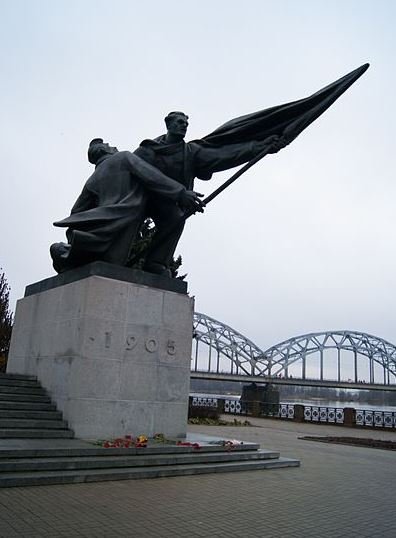
The Bloody Sunday Monument in Riga, located along the Daugava River, commemorates the tragic events of January 13, 1905.
What was the October Manifesto, and what reforms did it promise?
- Issued on October 17, 1905, the manifesto promised:
- The establishment of a State Duma (parliament) with limited powers.
- Recognition of civil liberties, including freedom of speech and assembly.
- A move toward a multi-party system.
Why was the October Manifesto considered insufficient by many?
The reforms were largely superficial. The Tsar retained absolute authority, could dissolve the Duma, and imposed limitations through the 1906 Russian Constitution, ensuring the monarchy’s dominance.
What were the main groups involved in the revolution, and what were their goals?
- Industrial Workers: Demanded better wages, shorter hours, and improved labor conditions.
- Peasants: Sought relief from land hunger, high taxes, and economic exploitation.
- Intelligentsia and Liberals: Advocated political reform and constitutional governance.
- Military Personnel: Resented poor treatment and defeats in war, leading to mutinies.
What challenges did the revolutionaries face in achieving their goals?
The revolutionaries lacked coordination and unity among diverse groups, which weakened the overall impact of their efforts and allowed the regime to suppress the movement.
How did the revolution influence future revolutionary movements?
The 1905 Revolution exposed the Tsarist regime’s fragility and served as a “dress rehearsal” for the October Revolution of 1917, as described by Vladimir Lenin.
What was the role of the Duma in the aftermath of the revolution?
The Duma, established after the revolution, was meant to provide representation. However, its powers were heavily restricted, and the Tsar dissolved it multiple times when it opposed him.





