Papyrus of Ani
The Papyrus of Ani is one of the most well-known and best-preserved examples of the Book of the Dead, an ancient Egyptian funerary text designed to guide the deceased through the trials of the afterlife.
Written around 1250 BCE during Egypt’s Nineteenth Dynasty of the New Kingdom, it was prepared specifically for Ani, a Theban scribe.
The Papyrus of Ani is considered one of the finest surviving manuscripts of the Book of the Dead, a collection of prayers, hymns, incantations, and rituals intended to ensure the soul’s safe passage and acceptance into the afterlife.
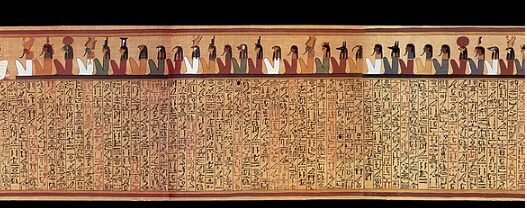
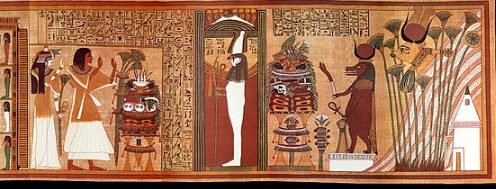
Created over 3,000 years ago, the Papyrus of Ani was designed to guide the scribe Ani through the trials of the afterlife, ensuring his safe passage to the paradise of the Field of Reeds. Image: A section from the Papyrus of Ani
Historical Context
The New Kingdom of Egypt, in which the Papyrus of Ani was created, was a period of tremendous prosperity and power for ancient Egypt. Spanning roughly from 1550 to 1070 BCE, this era saw Egypt expand its empire, build massive monuments such as the temples at Karnak and Luxor, and strengthen its religious institutions, including the belief in the afterlife, which was central to Egyptian culture.
The Egyptians believed that after death, a person’s soul would journey through the underworld (the Duat), where it faced various trials and judgments. Success in navigating these challenges was essential for achieving eternal life in the paradise of the afterlife, known as the Field of Reeds.
However, this journey was perilous and full of obstacles, so texts like the Book of the Dead were placed in the tombs of the deceased to provide them with the knowledge, protection, and spells needed to ensure a favorable outcome in the afterlife.
The Book of the Dead
The Book of the Dead, known to the Egyptians as The Book of Going Forth by Day, was not a singular or uniform document. Instead, it was a compilation of spells and texts that could vary greatly from one manuscript to another.
The Book of the Dead evolved over time, with its origins traceable to earlier funerary texts like the Pyramid Texts and the Coffin Texts.
Different versions of the Book of the Dead were customized for individuals, often inscribed on papyrus scrolls that were placed in the tomb with the deceased. These texts were meant to be read by the soul after death, helping it to overcome dangers in the afterlife, avoid evil spirits, and navigate the various gates, rivers, and trials it would face before entering paradise.
The Book of the Dead evolved over time, with its origins traceable to earlier funerary texts like the Pyramid Texts and the Coffin Texts. By the time of the New Kingdom, it had become an essential part of the burial practices for the elite and was sometimes included even for non-royal individuals, such as Ani.
The Papyrus of Ani
The Papyrus of Ani is a richly illustrated and beautifully written scroll that contains several chapters from the Book of the Dead. The papyrus measures about 78 feet (24 meters) in length and is divided into different sections. It contains both text written in cursive hieroglyphs and elaborate illustrations (vignettes), which depict scenes from the afterlife. The vignettes are particularly noteworthy for their detailed artistry, providing vivid visual representations of the Egyptian beliefs about the soul’s journey after death.
This manuscript was created specifically for Ani, a high-ranking official in Thebes, who likely commissioned it to be buried with him upon his death. His wife, Tutu, is also mentioned in the text. The papyrus is personalized for Ani, with his name and titles appearing throughout the text. This level of customization was common in the Book of the Dead, as the document was designed to assist a specific individual in navigating the challenges of the afterlife.
Content and Structure

As the god of the afterlife and resurrection, Osiris represented the cycle of life, death, and rebirth, which was intricately tied to the process of mummification.
The Papyrus of Ani, like other versions of the Book of the Dead, is divided into a number of chapters or spells, each serving a different purpose. Some of the most important sections include:
- Weighing of the Heart: One of the most famous scenes in the Papyrus of Ani is the depiction of Ani’s heart being weighed against the feather of Maat, the goddess of truth, justice, and cosmic order. This judgment scene was a crucial moment in the journey of the deceased, as it determined whether their soul was pure enough to enter the afterlife. If the heart was lighter than the feather, the soul could pass into the Field of Reeds; if it was heavier, it would be devoured by the monstrous Ammit, condemning the soul to eternal destruction. Ani is shown standing before Osiris, the god of the underworld, as his heart is weighed in a balance.
- Spells for Protection and Guidance: The text contains numerous spells meant to protect Ani during his journey through the underworld. These spells include instructions for how to avoid or overcome specific dangers, such as demons or hostile deities. Other spells were designed to help Ani navigate the various gates and portals he would encounter, as well as to ensure that he could recognize and recite the correct passwords to gain entry into different parts of the afterlife.
- Hymns to the Gods: The Papyrus of Ani includes several hymns and prayers dedicated to the gods, especially to Osiris, the ruler of the underworld, and Ra, the sun god. These hymns were meant to invoke the favor and protection of the gods, ensuring that Ani’s soul would be treated favorably in the afterlife.
- The Field of Reeds: The final goal of Ani’s journey through the afterlife was to reach the Field of Reeds, a paradisiacal realm where the soul could live in eternal peace and happiness. The text describes this field as a place of abundance, where the deceased could enjoy an idealized version of life on earth. The Papyrus of Ani includes spells to help Ani achieve this ultimate reward, such as spells for reaping and cultivating crops in the Field of Reeds.

Depiction of Ammit
Discovery and Acquisition
The Papyrus of Ani was discovered in Luxor in 1888 by local Egyptians who were involved in the illegal trade of antiquities. At the time, Egypt was under British control, and the international demand for ancient artifacts had led to widespread looting and smuggling. The papyrus was obtained by E. A. Wallis Budge, a British Egyptologist working for the British Museum, as described in his autobiography By Nile and Tigris.
Budge purchased the Papyrus of Ani along with several other artifacts from local antiquities dealers. However, shortly after the transaction, Egyptian authorities arrested many of the dealers and sealed their properties, including the house where Budge’s purchases were hidden. To recover the papyrus, Budge devised a plan: he distracted the guards by offering them a meal, while local workers dug beneath the house to retrieve the artifacts. The papyrus was then packed in custom tin containers and smuggled to the principal librarian at the British Museum.
In recognition of his efforts in acquiring the papyrus, Budge received a £150 reward from the British Treasury on behalf of the British Museum. The Papyrus of Ani has remained in the British Museum’s collection ever since and is considered one of the institution’s most prized Egyptian artifacts.

Image: English Egyptologist, Orientalist, and philologist E.A. Wallis Budge
Significance and Legacy
The Papyrus of Ani is widely regarded as one of the finest surviving examples of the Book of the Dead. Its illustrations and text offer a rich and detailed insight into ancient Egyptian beliefs about death and the afterlife. The document is not only a religious text but also a work of art, with its vibrant colors and intricate designs providing a window into the craftsmanship and religious devotion of the ancient Egyptians.
The Papyrus of Ani has also played a significant role in modern understanding of ancient Egyptian culture. E. A. Wallis Budge’s English translation of the papyrus, published in 1895, was one of the first comprehensive translations of the Book of the Dead, making it accessible to a wider audience. Budge’s work on the papyrus helped to popularize the study of Egyptian religion and funerary practices in the West, and his translation remains influential in Egyptology today.
The Book of the Dead, as represented by the Papyrus of Ani, continues to capture the imagination of scholars, historians, and the general public alike. Its depictions of the afterlife, with its detailed descriptions of the judgment of the soul, the trials of the underworld, and the promise of eternal life, reflect universal themes about death, morality, and the human desire for immortality.
Its combination of vivid illustrations, hymns, spells, and prayers offers a fascinating glimpse into the Egyptian worldview, where death was not seen as an end but as a transition to a new, eternal existence.
Today, the Papyrus of Ani remains one of the most important artifacts from ancient Egypt. Its survival, despite the challenges of time and the illicit antiquities trade, allows modern audiences to connect with the distant past and to explore the profound questions of life, death, and the afterlife that have fascinated humanity for millennia.
What is the Hall of Truth in Ancient Egyptian Mythology and Religion?
Frequently Asked Questions
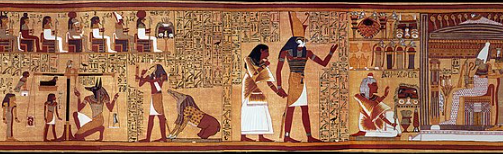
The Papyrus of Ani is an ancient Egyptian manuscript created around 1250 BCE during the Nineteenth Dynasty of the New Kingdom. It is written in cursive hieroglyphs and contains colorful illustrations.
What is the original name of the text commonly known as the Book of the Dead?
The original name of the Book of the Dead is The Book of Going Forth by Day.
What was the purpose of the Book of the Dead?
The Book of the Dead was created for specific individuals upon their death and contained declarations and spells designed to guide the deceased through the afterlife.
Who was the Papyrus of Ani created for?
The Papyrus of Ani was created for Ani, a scribe from Thebes.
Where is the Papyrus of Ani housed today?
The Papyrus of Ani is housed in the British Museum.
How was the Papyrus of Ani discovered, and by whom?
The Papyrus of Ani was discovered in Luxor in 1888 by individuals involved in the illegal trade of antiquities. It was acquired by British Egyptologist E. A. Wallis Budge.
After discovering the papyrus, Budge faced the challenge of authorities arresting antiquities traders and sealing their properties, where his purchases were hidden. Budge distracted the guards while locals tunneled under the house to recover the objects.
The items were packed in custom tin containers and smuggled to the principal librarian of the British Museum.
What reward did Budge receive for acquiring the Papyrus of Ani?
Budge received a £150 reward from the British Treasury on behalf of the British Museum.
Why is the Papyrus of Ani considered significant?
The Papyrus of Ani is regarded as one of the finest examples of the Egyptian Book of the Dead, offering valuable insights into ancient Egypt’s religious beliefs and funerary practices.

A section from the Papyrus of Ani in Ancient Egypt