Taxes in Ancient Egypt
Ancient Egypt was a complex and highly organized society, and one of its most significant bureaucratic achievements was its taxation system. At the heart of this system was the Cattle Count (also known as the Census of Pharaoh or Hsb-Ihwy), a method used to assess wealth and determine tax obligations. This system ensured that the state could function efficiently, funding everything from construction projects to military campaigns.
READ MORE: 10 Major Events in Ancient Egyptian History
The Purpose of Taxation in Ancient Egypt
Taxation was essential for maintaining the Egyptian state. Unlike modern systems that use monetary currency, taxation in ancient Egypt was largely based on goods and services. The primary objectives of taxation were:
- Supporting the Pharaoh‘s rule: Taxes funded royal construction projects, military campaigns, and administrative expenses.
- Temple maintenance: Egyptian temples served as religious, economic, and administrative centers, and they required significant resources.
- Infrastructure development: Taxes provided labor and materials for building pyramids, tombs, irrigation systems, and roads.
- Social and economic stability: The redistribution of wealth through taxation ensured food security and economic stability for the kingdom.
The Cattle Count: The Backbone of Taxation
The Cattle Count was the most significant taxation event in Ancient Egypt. It was a national census, primarily designed to measure livestock holdings, agricultural yields, and the wealth of individuals and estates. This assessment determined how much tax a person or entity owed.
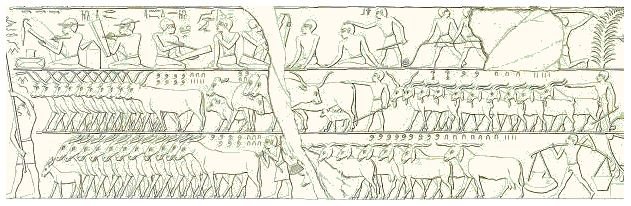
A relief depicting cattle count. The relief work was discovered in Mastaba tomb at Giza.
Origins of the Cattle Count
The Cattle Count was conducted at least as early as the Old Kingdom (c. 2686–2181 BCE). The earliest records date back to the reign of Pharaoh Djoser (c. 2670 BCE), who is credited with organizing the taxation system. The event became an essential feature of royal administration and continued throughout Egyptian history.
Initially, the census took place every two years but eventually became an annual event, particularly under the Middle and New Kingdoms. It was primarily a way for the state to keep track of economic production and ensure that taxes were collected efficiently.
Procedures of the Cattle Count
The process of the Cattle Count involved several key steps:
- Royal Decree: The Pharaoh issued an order for the census to take place.
- Mobilization of Officials: Scribes, tax collectors, and overseers traveled across Egypt to record livestock, grain production, and other taxable assets.
- Inspection and Recording: Officials visited farms, workshops, and temples to assess the wealth of landowners and commoners.
- Calculation of Taxes: Based on the recorded assets, scribes determined how much tax each person or institution owed.
- Collection and Redistribution: Taxes were collected in the form of grain, livestock, textiles, or labor contributions.
Forms of Taxation in Ancient Egypt
The Egyptian taxation system was diverse and included different types of taxes depending on a person’s occupation, land ownership, and economic status.
Agricultural Taxes
The majority of Egypt’s population was engaged in agriculture, making land taxes one of the most important forms of taxation. Farmers were required to give a portion of their harvest—usually grain—to the state. The amount depended on the results of the Cattle Count and the annual flooding of the Nile.
- A good flood meant a higher tax burden because of increased production.
- A poor flood could lead to lower taxes but also food shortages.
The collected grain was stored in state granaries and redistributed to officials, soldiers, and workers.
Livestock Taxes
As the name suggests, the Cattle Count was particularly focused on livestock taxation. Owners of cattle, sheep, and other animals were required to pay taxes based on the number of animals they possessed. The wealthier individuals or temples with large herds had greater tax obligations.
Labor and Corvée Tax

A depiction of peasants captured for failing to pay taxes in Egypt’s Old Kingdom.
Instead of money, many Egyptians paid taxes through labor, known as corvée labor. This was a mandatory service where peasants and craftsmen were conscripted to work on state projects, such as:
- Pyramid construction
- Temple building
- Canal and irrigation system maintenance
While corvée labor was unpaid, workers were often provided with food, housing, and basic necessities.
Trade and Market Taxes
Merchants and traders were taxed on their goods. Officials monitored marketplaces and collected levies on:
- Imported goods
- Sales transactions
- Craftsmanship and artisan products
This ensured that even non-agricultural professions contributed to the economy.
Temple and Religious Taxes
Temples were significant economic entities in Ancient Egypt. They controlled vast amounts of land, livestock, and workers. Although temples were often tax-exempt, they still contributed to the state through tribute and donations to the Pharaoh.
Ancient Egypt’s taxation system, centered on the Cattle Count, was a highly organized and essential mechanism for sustaining the state.
Role of Scribes and Tax Collectors
The efficiency of Egypt’s taxation system depended on a well-organized bureaucracy. Scribes played a crucial role in recording tax obligations and enforcing the rules.
Duties of Scribes
- Recording the results of the Cattle Count
- Calculating and documenting taxes
- Keeping track of debts and exemptions
- Monitoring tax evasion
Scribes held a prestigious position in society, as literacy was rare, and they had direct connections to government and temple authorities.
Tax Collectors and Enforcement
Tax collectors, often appointed by the Pharaoh, ensured compliance. They had the authority to confiscate property or impose penalties on those who failed to pay their taxes.
- Punishments for Non-Payment: Harsh penalties, including beatings, forced labor, or property seizure, were imposed on those who attempted tax evasion.
- Corruption: While the system was highly efficient, some officials engaged in bribery and fraud.
Economic and Social Impact of Taxation
The taxation system had a profound impact on Egyptian society, influencing economic development, labor structures, and social hierarchies.
Taxes enabled the construction of monumental projects such as the Pyramids of Giza, temples at Karnak and Luxor, and irrigation networks essential for agriculture.
While taxes helped the ruling elite and temples amass wealth, they also provided for state workers, soldiers, and laborers. Granaries ensured food security during famines.
Taxation reinforced social divisions. The wealthy elite, including temple priests and high officials, benefited from tax exemptions, while peasants and artisans bore most of the burden.
Decline and Evolution of the System
Although the taxation system remained effective for centuries, it evolved with changing political and economic conditions.
- Late Period (c. 664–332 BCE): Increased foreign invasions led to heavier tax burdens on peasants.
- Ptolemaic Era (332–30 BCE): The Greek rulers introduced coin-based taxation, marking a shift from the barter system.
- Roman Period (30 BCE–395 CE): The Romans intensified taxation, leading to social unrest and economic decline.

Frequently asked questions
What was the primary basis of the ancient Egyptian economy?
The economy of ancient Egypt was based on agriculture and barter, as it remained a cashless society until the Persian Period (c. 526 BCE).
What was the monetary unit used in ancient Egypt?
The monetary unit was the deben, approximately 90 grams of copper, though transactions were based on an imaginary deben rather than physical currency.
How did taxation work in Egypt’s barter economy?
Taxes were collected by seizing a portion of produce, property, or merchandise, with agriculture being the easiest sector to tax due to its measurable yields.
What was the Egyptian Cattle Count?
The Egyptian Cattle Count, or Shemsu Hor (Following of Horus), was an annual (later bi-annual) event where the king (i.e. pharaoh)ph and his officials assessed agricultural wealth to determine tax obligations.
When did the tradition of the Cattle Count begin?
Some scholars have noted that the Cattle Count dates back to the reign of Hor-Aha (c. 3100-3055 BCE) and was institutionalized during the Second Dynasty (c. 2890-2670 BCE).
What purposes did the Cattle Count serve?
It allowed the king to be visible among his people, enabled officials to monitor local affairs, enforce policies, settle disputes, administer justice, and facilitate systematic tax collection.
How was Egypt divided for tax collection?
Egypt was divided into districts called nomes, each governed by a nomarch, with the king personally visiting each district to ensure fair tax assessment.
Through agricultural levies, labor contributions, and trade taxes, the Pharaohs maintained control over resources, infrastructure, and the economy.
What goods were taxed during the Cattle Count?
Taxes were levied on grain, oil, beer, ceramics, livestock, and other goods, though grain was the most important taxable commodity.
Why was grain essential to the Egyptian economy?
Grain fed the population, facilitated trade, and was stored in surplus to ensure food security during years of poor harvest.
How did the taxation system help sustain the state?
Tax revenue supported government functions, paid for large construction projects, and redistributed essential goods based on social rank.
What role did taxation play in funding the pyramids?
Taxes collected from the Cattle Count and trade financed the massive construction projects of the Old Kingdom, including the pyramids at Giza.

The Pyramid of Giza
Why did financial strain contribute to the collapse of the Old Kingdom?
The costs of maintaining temples and clergy, along with tax exemptions for the priesthood, drained state resources, weakening the central government.
What happened to taxation during the First Intermediate Period?
After the fall of the Old Kingdom, the power to tax shifted to local nomarchs, who retained most revenue for personal use rather than funding state projects.
How did taxation change during the Middle Kingdom?
Mentuhotep II (c. 2061-2011 BCE) reunified Egypt, restoring a strong central government and reinstituting taxation to finance large-scale projects like the Temple of Karnak.

A relief depicting Mentuhotep II
READ MORE: 9 Famous Middle Kingdom Pharaohs
What was the role of tax collectors during the New Kingdom?
By the end of the Old Kingdom, tax collection was handled by designated officials rather than the king, with strict penalties for those who withheld state revenue.
How did the New Kingdom finance its empire?
Tax revenue funded professional armies, grand construction projects, and monuments built by rulers such as Hatshepsut, Thutmose III, and Ramesses II.
How were taxes assessed during the New Kingdom?
Tax assessments depended on nilometers, which measured the annual Nile inundation—higher floods meant higher taxes, while lower floods led to reduced obligations.
What economic changes occurred during the Third Intermediate and Late Periods?
Power became fragmented, tax exemptions weakened the economy, and heavy taxation forced some Egyptians into debt servitude.
How did people pay off tax debt in the Late Period?
Some Egyptians sold themselves into labor, or entered “adoption” agreements where a benefactor paid their debts in exchange for lifelong service.
Records of the Cattle Count provide an annual or bi-annual historical record, helping modern historians accurately date events in Egyptian history.





