Hamidian Massacres
The Hamidian massacres, often referred to as the Armenian massacres, marked a period of intense brutality against Armenians under Sultan Abdul Hamid II in the Ottoman Empire during the mid-1890s.
Summary
Historians estimate that between 100,000 and 300,000 Armenians were killed during the Hamidian Massacres. The tragedy left tens of thousands of children orphaned. This wave of violence, attributed primarily to the Ottoman government’s efforts to quash dissent and maintain its dwindling empire, targeted not only Armenians but, in certain areas, other Christian communities as well.
The name “Hamidian” is derived from Sultan Abdul Hamid II, who embraced pan-Islamism as a unifying state ideology to bolster his rule. Although the Armenian population bore the brunt of these attacks, the violence sometimes expanded into all-out anti-Christian assaults, resulting in devastation for Assyrian groups in places such as Diyarbekir. This introduction sets the stage for examining the roots, magnitude, and repercussions of the Hamidian massacres, along with the global responses they provoked.
READ MORE: Slavery in the Ottoman Empire: History and Major Facts
Historical Context
By the late nineteenth century, the Ottoman Empire was under considerable strain, having lost extensive territory in Europe and suffering from dire financial instability. European nationalism spread swiftly, prompting subject peoples under Ottoman rule to demand self-determination, which further tested the empire’s political cohesion.
Armenians, historically relegated to second-class status, insisted on reforms that would improve their plight, including protection from frequent Kurdish raids and the fair collection of taxes.
The Ottoman leadership, notably Abdul Hamid II, viewed these demands for equality as threats to its sovereignty, suspecting that foreign powers might use the Armenian cause to intervene in Ottoman affairs.
In 1878, Armenian representatives journeyed to the Congress of Berlin to seek guarantees for their communities, but their appeals went largely unaddressed, fueling additional frustration. Coupled with the conviction among some Armenians that Russia could eventually preside over their ancestral lands, this neglect heightened tensions and shaped a climate of suspicion and fear throughout the empire.
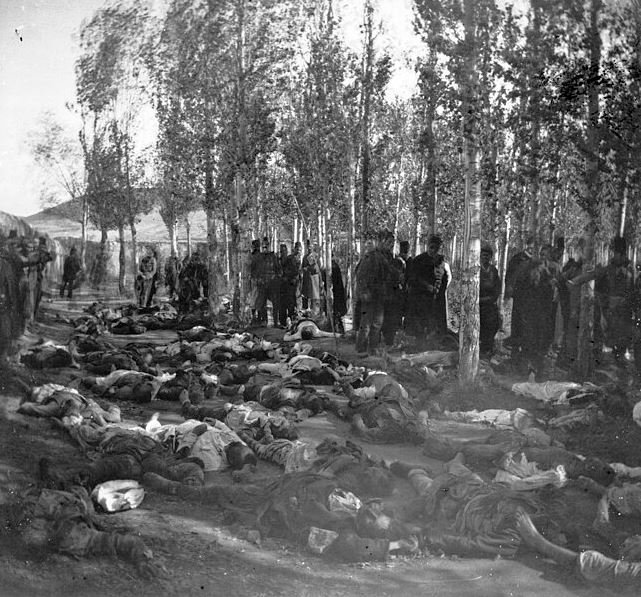
A photograph captured by American photographer William Sachtleben in November 1895 depicts Armenians who were killed in Erzurum.
Motives for Persecution
Sultan Abdul Hamid II firmly believed that external hostility, led by Christian nations, undermined the empire’s Islamic identity. He suspected Armenians of collaborating with foreign forces—particularly Britain—to weaken Ottoman control in the eastern provinces.
Sultan Abdul Hamid II’s determination to preserve his empire at any cost resulted in ferocious policies directed chiefly at Armenians, yet also harming other Christian groups.
Furthermore, interpretations of Sharia Law, which threatened severe punishment for Christian subjects who sought outside support against Ottoman authority, emboldened harsh government policies. The establishment of Hamidiye Regiments, primarily staffed by Kurdish tribes, bestowed an official license to commit violence with minimal accountability.
Meanwhile, Armenian revolutionary organizations such as the Social Democrat Hunchakian Party and the Armenian Revolutionary Federation emerged, further alarming Ottoman officials who saw these groups’ activities as harbingers of widespread insurrection.
Escalation of Violence
Tensions climaxed in Sasun in 1894, where Armenians resisted oppressive taxation and other abuses orchestrated by local Kurdish leaders. The Ottoman retaliation was swift and severe, with regular troops and irregular bands—often made up of local Muslims—carrying out massacres that spared neither the elderly nor infants.
Soon, the violence engulfed other regions populated by Armenians, including Van, Erzurum, and even Constantinople, where peaceful demonstrations demanding reforms met with brutal force. Ottoman authorities habitually distorted these events, blaming “Armenian agitation” in official reports while minimizing casualty figures.
Nevertheless, foreign correspondents, missionaries, and consular officials shared eyewitness accounts of extensive killings marked by extreme cruelty, such as mutilation and the incineration of Armenians who had sought sanctuary in churches. In the Diyarbekir region, at least one source indicated that up to 25,000 Assyrians were also targeted, illustrating how the brutality extended to various Christian minorities.
International Reactions and Consequences
Word of the massacres spread swiftly via telegraph and global media outlets, triggering outrage in Europe, Russia, and the United States. Public opinion in Britain, France, and elsewhere denounced Abdul Hamid II, with newspapers branding him the “bloody Sultan.”
Although voices clamored for intervention, conflicting national interests prevented concerted action by the Great Powers, each wary of risking its stake in Ottoman affairs.
Humanitarian organizations and missionaries mobilized to assist survivors, providing crucial relief for orphaned children through food distribution and medical care. Yet the diplomatic pressure that led the sultan to sign new reform measures never produced tangible results, thwarted by the empire’s internal turmoil and the competing priorities of foreign governments.
Despite these limitations, the massacres’ widespread media coverage moved philanthropists and religious leaders in the United States to lobby Washington to adopt a stronger moral stance on the crisis.
Conversion and Forced Islamization
Confronted with relentless danger, numerous Armenian Christians either converted to Islam or went through the motions of conversion to avoid imminent death. Contemporary accounts describe men outwardly embracing Muslim rites, such as circumcision, while many women were taken into Muslim households.
These conversions did provide immediate physical safety, yet they carried long-lasting psychological and social ramifications. Some survivors later declined to return to their former communities, fearing the stigma or lacking the resources to rebuild their shattered lives.
End of the Massacres and Aftermath
The Hamidian massacres lost momentum by 1897, partly because of universal condemnation abroad and the diminishing reputation of Sultan Abdul Hamid II. Conservative tallies suggest around 80,000 Armenian deaths, while higher estimates put the toll at closer to 300,000, encompassing both Armenians and other Christians.
For survivors, the traumas of displacement and loss shaped entire generations, and the vast population of orphans reflected the decimation of Armenian communities.
In their wake, countless villages were incinerated, thousands subjected to forced conversion, and numerous churches looted or demolished. Armenian revolutionaries either died in the upheaval or fled, while the Ottoman government clamped down on surviving institutions with renewed vigor.
In a desperate bid for international awareness, Armenian militants seized the European-managed Ottoman Bank in 1896, sparking fresh killings in Constantinople. Although the sultan insisted the “Armenian Question” was definitively resolved, unresolved grievances persisted and foreshadowed further atrocities in the ensuing decades.
Global Legacy
The Hamidian massacres exposed the vulnerability of minority populations in a crumbling empire, exemplifying the catastrophic outcomes of sanctioned violence. They influenced subsequent diplomatic engagements, weakening the Ottoman Empire’s relations with Britain and prompting global powers to confront ongoing abuses.
Despite considerable popular indignation, clashing geopolitical priorities prevented decisive foreign measures, setting a precedent for how the international community might respond to later humanitarian crises. In the long run, these events highlighted the perils of unchecked authority and underscored the urgent necessity of protective frameworks for at-risk groups.
Historical Interpretations
Many scholars have investigated archival documents, diplomatic cables, and first-person testimonies to illustrate how Ottoman accounts often contradicted local reports. European observers who traversed the affected provinces, including various missionary groups, portrayed scenes of profound destruction, directly challenging Istanbul’s claims of isolated “disturbances.”
German pastor Johannes Lepsius meticulously compiled statistics on ravaged Armenian villages and forced conversions, painting a stark picture of widespread misery. French officials such as Gustave Meyrier shared detailed descriptions of crimes against women and children, further discrediting Ottoman narratives.
These divergent sources have fueled ongoing debates, with considerable evidence suggesting that the massacres were orchestrated as systematic policy, rather than erupting spontaneously from regional tensions.
Frequently Asked Questions
Why did they happen?
Ottoman authorities saw Armenian demands for reform as a threat to the empire’s Islamic character and sovereignty. Sultan Abdul Hamid II, believing the Armenians were aligned with foreign powers, aimed to suppress them through brutal repression.
Which groups were mainly targeted?
Although most victims were Armenians, in some areas Assyrians and other Christian minorities were also attacked. In the Diyarbekir region, up to 25,000 Assyrians may have been killed.
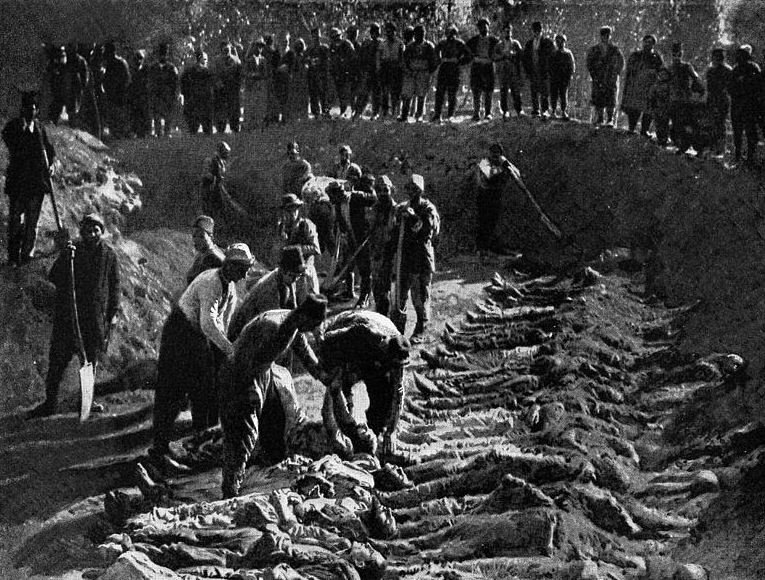
Armenian victims of the massacres being laid to rest in a mass grave at the Erzerum cemetery.
How did the violence escalate?
It began in the Ottoman interior around 1894, then spread to Armenian-populated regions such as Bitlis, Diyarbekir, Erzurum, Sivas, and Van. Massacres often involved both government troops and irregular Kurdish forces (the Hamidiye), who had official backing to attack Armenians with impunity.
What was the international response?
Telegraph communications led to widespread reporting in Europe, Russia, and North America. While public outcry was strong—especially in Britain, France, and the United States—the Great Powers did not intervene decisively, allowing the massacres to continue largely unchecked until 1897.
Were there forced conversions?
Yes. Significant numbers of Armenians, hoping to survive, converted to Islam under duress. Modern scholars argue these conversions were predominantly coerced or done out of desperation rather than true religious conviction.
What role did Armenian revolutionary groups play?
Organizations like the Armenian Revolutionary Federation (ARF) and Social Democrat Hunchakian Party advocated for resistance and self-defense. While some Armenians did resist—most notably in Sasun—these efforts were ultimately overwhelmed by superior Ottoman forces.
How did this period influence later events?
The lack of decisive international intervention and the empire’s handling of minority populations foreshadowed future atrocities against Armenians. The Hamidian massacres are often viewed as a precursor to the more extensive and systematic Armenian Genocide of 1915.
FACT CHECK: At World History Edu, we strive for utmost accuracy and objectivity. But if you come across something that doesn’t look right, don’t hesitate to leave a comment below.





