
Tomb of Karl Marx
The tomb of Karl Marx stands as a powerful testament to the enduring influence of one of history’s most significant thinkers. Located in Highgate Cemetery, North London, this memorial not only honors Marx but also serves as a historical and ideological landmark. Below is an exploration of its history, design, significance, and the controversies that have surrounded it.
Historical Context
Karl Marx arrived in London in June 1849 as a political exile, seeking refuge from political persecution in continental Europe. Initially residing in Soho, Marx eventually moved to Belsize Park in 1875, where he spent the remainder of his life. During his time in London, Marx completed some of his most influential works, including The Eighteenth Brumaire of Louis Napoleon and Das Kapital. Financially supported by his close collaborator Friedrich Engels, Marx endured economic hardship throughout his life.
Marx died on March 14, 1883, after battling bronchitis, pleurisy, and complications from a lung abscess. He was buried in Highgate Cemetery alongside his wife, Jenny von Westphalen, who had passed away 18 months earlier. The funeral was a modest affair, attended by approximately 13 close friends and family members, including Engels, Eleanor Marx, and Wilhelm Liebknecht.
The Creation of the Marx Tomb
Originally, Marx and his wife were buried in an unassuming part of Highgate Cemetery. In 1954, the Marx Memorial Committee, with the consent of Marx’s descendants, secured permission to exhume and reinter the remains at a more prominent location. This relocation was part of a larger plan to construct a memorial befitting Marx’s global impact. The reburials occurred discreetly overnight on November 26-27, 1954.
English sculptor Laurence Bradshaw aimed to create a monument honoring Marx’s intellect and philosophy. The bust was designed to appear at eye level, symbolizing Marx’s connection with the people.
The tomb, designed by artist and sculptor Laurence Bradshaw, was unveiled on March 15, 1956, during a ceremony led by Harry Pollitt, General Secretary of the Communist Party of Great Britain. The monument, funded by the Communist Party, was intended to reflect Marx’s intellectual contributions and philosophical legacy.
Architecture and Design
Bradshaw sought to design a monument that transcended mere commemoration. He envisioned it as a tribute to Marx’s intellect and his role as a revolutionary thinker. The central feature of the tomb is a bronze bust of Marx’s head and shoulders, set on a marble pedestal.
Karl Marx’s tomb is in the Eastern Cemetery of Highgate Cemetery, North London, England.
The pedestal bears inscriptions of two famous quotes from Marx’s works. The front displays the concluding words of The Communist Manifesto: “Workers of all lands unite,” while the back features the closing line from Theses on Feuerbach: “The philosophers have only interpreted the world in various ways • the point however is to change it.”
The tomb’s design is both symbolic and functional. The marble plinth contains a central panel listing the names and life dates of Marx, his wife, their daughter Eleanor, their grandson Harry Longuet, and their housekeeper Helene Demuth. The sides of the pedestal feature sculpted wreaths, further emphasizing the monument’s solemnity.
Although Bradshaw intended the bust to appear approachable and at eye level, the sheer scale of the structure has invited mixed reviews. Some view it as a fitting tribute, while others consider it aesthetically overbearing.
Significance of the Tomb
Since its unveiling, the tomb has become a pilgrimage site for Marxists and political activists worldwide. Visitors often leave flowers, notes, and other tokens of respect, reflecting the ongoing relevance of Marx’s ideas in various struggles for social justice and equality. Notable figures such as anti-apartheid activist Yusuf Dadoo and Claudia Jones, founder of the Notting Hill Carnival, are buried nearby, further cementing the area’s historical significance.
Through its design, inscriptions, and history, the tomb encapsulates both the reverence and controversy that have surrounded Marx’s work for over a century.
In 1974, the tomb was officially listed by Historic England as a structure of architectural and historical significance. In 1999, its designation was elevated to Grade I, the highest level, recognizing its “exceptional interest.”
Target of Attacks
The prominence of Marx’s tomb has also made it a target for vandalism and ideological opposition. Notable incidents include:
- 1960: Swastikas and pro-Nazi slogans were painted on the tomb.
- 1970s: Two bombing attempts damaged the structure.
- 2011: Blue paint was splashed on the tomb, though it caused no lasting harm.
In February 2019, the original marble plaque was struck with a hammer, causing visible damage. Days later, the tomb was defaced again, this time with red paint and phrases such as “doctrine of hate” and “architect of genocide.” In response, the Marx Grave Trust installed 24-hour surveillance to deter further attacks.
How is the tomb maintained?
The Friends of Highgate Cemetery Trust, which manages the cemetery, charges an entrance fee to maintain the site. This practice has drawn criticism, with some arguing that access to Marx’s grave should be free, given his philosophy of equality and opposition to capitalism.
Architectural Criticism and Legacy
Critics of the tomb’s design have varied opinions. Architectural historian Clive Aslet described it as “overweening” and the least aesthetically pleasing monument in Highgate Cemetery. Others, however, view the monument as a powerful representation of Marx’s enduring intellectual force. Bradshaw’s own intent was for the bust to capture the “dynamic force of [Marx’s] intellect.”
The tomb of Karl Marx is more than just a burial site; it is a physical manifestation of his profound influence on political thought and activism.
Despite the controversies, Marx’s tomb remains one of the most visited graves in the world. It stands as a symbol of revolutionary thought and social change, drawing visitors who continue to be inspired by Marx’s ideas.
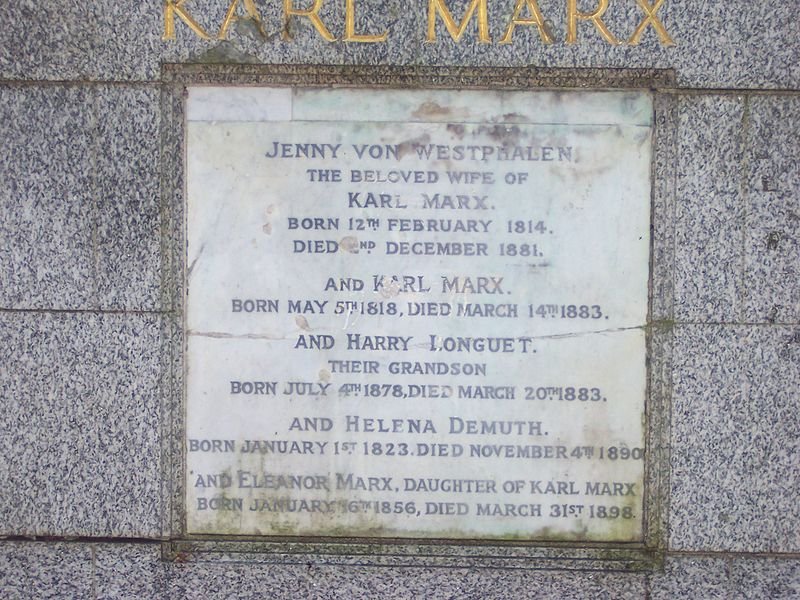
A detailed view of the central panel of Karl Marx’s tomb, which originally formed the gravestone.

Frequently Asked Questions
Who is buried at Karl Marx’s tomb?
The tomb includes Karl Marx, his wife Jenny von Westphalen, other family members, and their housekeeper Helene Demuth.
What is the history of the tomb’s location?
Marx was originally buried elsewhere in Highgate Cemetery in 1883. In 1954, his remains were reburied at the current site, along with other family members, following an exhumation license granted by the Home Office.
Who designed Karl Marx’s tomb, and when was it unveiled?
The tomb was designed by Laurence Bradshaw, and it was unveiled in 1956 during a ceremony led by Harry Pollitt, General Secretary of the Communist Party of Great Britain.
What features does the tomb include?
The tomb features a large bronze bust of Marx on a marble pedestal. Inscribed on the pedestal are quotes from Marx’s works, including “Workers of all lands unite” and “The philosophers have only interpreted the world in various ways; the point, however, is to change it.”
What is the tomb’s significance?
The tomb serves as a site of pilgrimage for Marxists and has been described as “one of the most recognizable graves in the world.” It is a Grade I listed structure, signifying its exceptional historical interest.





