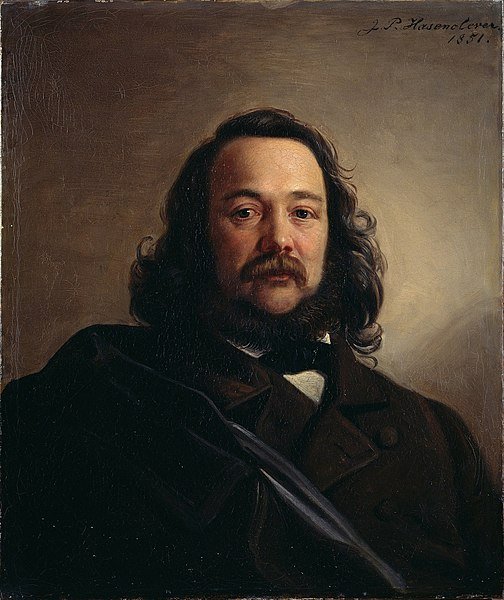
Ferdinand Freiligrath
Ferdinand Freiligrath (17 June 1810 – 18 March 1876) was a notable German poet, translator, and political agitator, celebrated as part of the Young Germany literary movement. His journey as a literary figure and revolutionary thinker spanned multiple countries and genres, encompassing lyrical poetry, political agitation, and profound translations of English and French works into German. Freiligrath’s legacy reflects a rich blend of artistic creativity and political engagement, making him a distinctive figure of 19th-century European literary and revolutionary movements.
Early Life and Education
Born in Detmold, in the Principality of Lippe, Freiligrath was the son of a teacher. His formative years were marked by a departure from traditional academic pursuits, leaving a gymnasium at 16 to train for a commercial career in Soest. During this period, he cultivated a passion for literature, delving into French and English works that later influenced his poetic voice. By his late teens, Freiligrath had begun contributing verses to local journals, laying the foundation for his literary career.
Career Beginnings
Freiligrath’s early professional life saw him working as a banker’s clerk in Amsterdam (1831–1836). However, his literary aspirations began to take shape during this period. He published translations of Victor Hugo’s Odes and Chants du crépuscule, alongside editing a literary journal, the Rheinisches Odeon (1836–1838). In 1839, he took on the role of bookkeeper in Barmen while continuing to write poetry for periodicals like the Musen-Almanach and Morgenblatt.
As a member of the Young Germany movement, Freiligrath’s work inspired democratic aspirations and resonated with both literary and political audiences.
His debut poetry collection, Gedichte (1838), gained widespread acclaim. This work included notable pieces such as Löwenritt, Prinz Eugen, and Der Blumen Rache. Freiligrath’s early poetic style was heavily inspired by Victor Hugo’s Orientales, often focusing on exotic themes, as exemplified by Der Mohrenfürst, the poignant tale of a black prince’s fall from glory. The collection’s success prompted Freiligrath to pursue literature full-time by 1839.
Literary Development and Recognition
Freiligrath’s early career gained momentum with the support of influential literary figures like Adelbert von Chamisso and Gustav Schwab. His vivid imagery and mastery of verse won him admiration, and in 1842, he received a royal pension from Frederick William IV of Prussia. This financial security enabled him to focus on his art, and he settled in St. Goar, where he formed a close friendship with American poet Henry Wadsworth Longfellow. Their mutual interest in English and American poetry led to numerous discussions and an enduring correspondence.
Transition to Political Poetry
The 1840s marked a turning point in Freiligrath’s life. Encouraged by fellow poet Hoffmann von Fallersleben and disillusioned by increasing political repression in Germany, Freiligrath adopted a more overtly political tone in his works. In 1844, he renounced his royal pension and published Glaubensbekenntnis (Confession of Faith), aligning his poetic talent with the democratic movements of the time. Poems like Trotz alledem, Die Freiheit, and Das Recht resonated with revolutionary fervor.
Freiligrath’s early exoticism transitioned into a more grounded and politically charged style, reflecting the evolving socio-political climate of 19th-century Europe.
Fleeing political persecution, Freiligrath sought refuge in Belgium, Switzerland, and eventually London. During this exile, he published Ça ira, a collection of political songs, and Englische Gedichte aus neuerer Zeit, a translation of modern English poetry. Despite his exile, Freiligrath remained deeply connected to the revolutionary cause, returning to Germany briefly during the Revolution of 1848.
Revolutionary Engagement and Exile
Freiligrath’s return to Germany in 1848 positioned him as a democratic leader and cofounder of the Neue Rheinische Zeitung alongside Karl Marx, Friedrich Engels, and Wilhelm Wolff. His poem Die Toten an die Lebenden (The Dead to the Living) stirred significant controversy, leading to his arrest on charges of lèse-majesté. The subsequent trial, the first jury trial in Prussian history, ended in his acquittal.
However, Freiligrath’s continued association with the democratic movement made him a target of suspicion. In 1851, he returned to London, where he resumed his commercial career while continuing his literary pursuits. During his time in England, Freiligrath translated works such as Longfellow’s Hiawatha and Shakespeare’s Cymbeline and The Winter’s Tale. His anthology The Rose, Thistle, and Shamrock (1854) highlighted his dedication to English and Scottish poetry.
Return to Germany and Later Years
After receiving an amnesty in 1868, Freiligrath returned to Germany, settling in Stuttgart and later Cannstatt. His later works reflected a shift towards nationalism, particularly during the Franco-Prussian War. Patriotic poems such as Hurrah, Germania! and Die Trompete von Vionville celebrated German victories, cementing Freiligrath’s status as a nationalist poet. His earlier poem, In Kümmernis und Dunkelheit, attributed military symbolism to the colors of the German tricolor flag, showcasing his deep connection to German identity.
Freiligrath spent his final years in Cannstatt, where he passed away in 1876.
Contributions to German Literature
Freiligrath’s influence on German literature extended beyond his original works. He was instrumental in introducing German audiences to English and American poetry through his translations. Notable among these efforts were his translations of Longfellow’s Hiawatha and selections from Shakespeare. His poetry often blended romanticism with political themes, reflecting the spirit of his times.
Freiligrath’s works were also recognized internationally, with translations of his poems appearing in English, notably by Irish poet James Clarence Mangan. His daughter compiled a selection of English translations in the Tauchnitz Collection of German Authors in 1869, ensuring his legacy extended beyond Germany.
Timeline of Ferdinand Freiligrath’s Life and Achievements
Frequently Asked Questions
FACT CHECK: At World History Edu, we strive for utmost accuracy and objectivity. But if you come across something that doesn’t look right, don’t hesitate to leave a comment below.





