First Anglo–Ashanti War
The First Anglo-Ashanti War (1823-1831) was a conflict between the Ashanti Empire and an alliance led by the British, Fante Confederacy, Denkyira, and Denmark, resulting in a British victory and the weakening of the Ashanti.
Background
The First Anglo-Ashanti War (1823-1831) was a major armed conflict between the Ashanti Empire and an alliance comprising the United Kingdom, the Fante Confederacy, the Denkyira, and Denmark. The Ashanti, under King Osei Bonsu, clashed with British-led forces commanded by Sir Charles MacCarthy, marking the beginning of a prolonged struggle for dominance in the Gold Coast region.
The First Anglo-Ashanti War was a defining moment in West African history, shaping the future of the Gold Coast.
The Ashanti Empire had grown into a dominant force in West Africa by the 17th century, expanding its influence over neighboring territories. However, their expansionist policies brought them into conflict with British colonial interests and their coastal allies, particularly the Fante. The British sought to curb Ashanti power to secure their trading posts and maintain regional stability.

Emblem of the Ashanti Empire and the Asantehene, King of Ashanti
READ MORE: Meaning and Origin Story of the Flag of the Ashanti
Causes of the War
The immediate cause of the war was an incident in May 1822 when an Ashanti trader insulted a British official. In retaliation, a British policeman mistreated the Ashanti ruler’s representative. The situation escalated when the Ashanti captured and executed Sergeant Otetfo in early 1823, prompting an outraged MacCarthy to mobilize British forces against the Ashanti.
MacCarthy initially sent a military expedition to Dunkwa, but the operation ended in failure. The Ashanti responded by launching a large-scale invasion of the Fante Confederacy in December 1823, marking the beginning of the war.
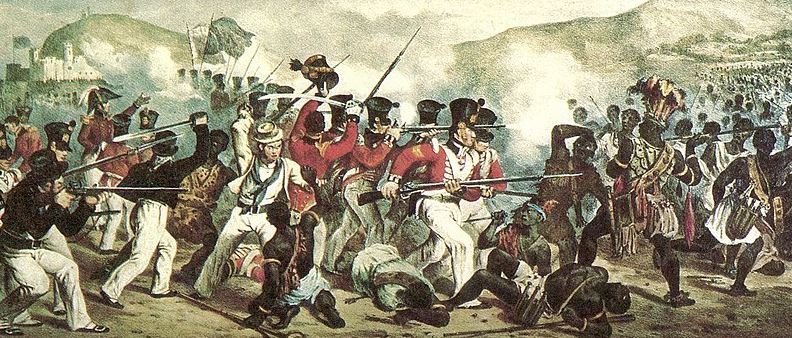
An illustration depicting the battle between the Ashanti warriors and the British.
Key Battles and Events
Battle of Nsamankow (January 21, 1824)
The first major engagement occurred at Nsamankow, where MacCarthy, leading a force of about 500 British troops and several thousand local allies, confronted an Ashanti army of 10,000. The British suffered a crushing defeat as their ammunition ran out during battle. MacCarthy was mortally wounded and reportedly took his own life to avoid capture. His skull was later used as a drinking cup by the Ashanti as a war trophy. The British forces were decimated, with only a few survivors escaping.
British Reorganization and Disease Impact
Following the disaster at Nsamankow, the British reorganized their military forces. Reinforcements were sent to the Gold Coast, but disease took a heavy toll. Hundreds of European soldiers succumbed to tropical illnesses, and British authorities realized they had to rely more on locally recruited African forces. Colonel Purdon led the efforts to train and arm native troops to strengthen defenses against future Ashanti offensives.
Battle of Dodowa (August 7, 1826)
A decisive battle took place at Dodowa, where a combined British, Danish, and Fante force of approximately 11,000 men faced an equally matched Ashanti army. The British employed newly developed Congreve rockets, which caused disarray in the Ashanti ranks. The Ashanti forces suffered heavy losses, with 5,000-6,000 warriors killed or captured, leading to their retreat from the coastal region. This marked a turning point in the war, signaling the decline of Ashanti military dominance.
Peace Negotiations and Treaty of 1831

On April 27, 1831, a treaty at the Great Hall of the Cape Coast Castle required the Ashanti Kingdom to cede gold, surrender royal hostages, recognize independent kingdoms, and accept British control south of the Pra River. Image: Cape Coast Castle as seen in 2025
Following the British victory at Dodowa, both sides sought peace. However, the Fante Confederacy, eager to weaken the Ashanti further, delayed negotiations. After years of intermittent skirmishes, a formal treaty was signed on April 27, 1831, at Cape Coast Castle.
The treaty imposed harsh conditions on the Ashanti:
- The Ashanti had to pay 600 ounces of gold as reparations.
- Two members of the Ashanti royal family were taken as hostages to ensure compliance.
- The Ashanti had to recognize the independence of Denkyira, Akyem, and Assin.
- The territory south of the Pra River was ceded to British control.
These terms significantly weakened the Ashanti and marked the beginning of their gradual decline as a regional power.
The First Anglo-Ashanti War set the stage for future Anglo-Ashanti conflicts, ultimately leading to British colonial rule in the region.
Impact and Aftermath
The war had lasting consequences for both the Ashanti and the British. For the Ashanti, the war exposed their vulnerability, leading to internal strife and economic setbacks. Their failure to maintain dominance over coastal trade routes weakened their influence over the Gold Coast.
For the British, the war reinforced the need for better military organization and disease management in West Africa. They continued to expand their influence, eventually establishing the Gold Coast Colony in 1874 after subsequent conflicts with the Ashanti.
Timeline of the First Anglo-Ashanti War
May 1822 – Incident Sparks Conflict
An Ashanti trader verbally insults a British official, leading to tensions. Later in November, a British policeman is kidnapped, escalating hostilities.
February 2, 1823 – Execution of Sergeant Otrefo
The Ashanti publicly execute a British sergeant, displaying his remains in Kumasi. This solidifies British resolve for war.
December 1823 – War Officially Begins
The Ashanti army invades the Fante Confederacy, marking the start of the conflict.
January 21, 1824 – Battle of Nsamankow
British Governor Charles MacCarthy leads 500 troops but suffers a crushing defeat against 10,000 Ashanti warriors. MacCarthy is killed, and his skull is later used as a trophy.
August 7, 1826 – Battle of Dodowa
A combined British, Fante, and Danish force of 11,000 troops defeats the Ashanti, marking a turning point in the war.
April 27, 1831 – Peace Treaty Signed
The Ashanti surrender 600 ounces of gold, recognize British territorial gains, and hand over royal hostages, signaling their decline.
Frequently Asked Questions
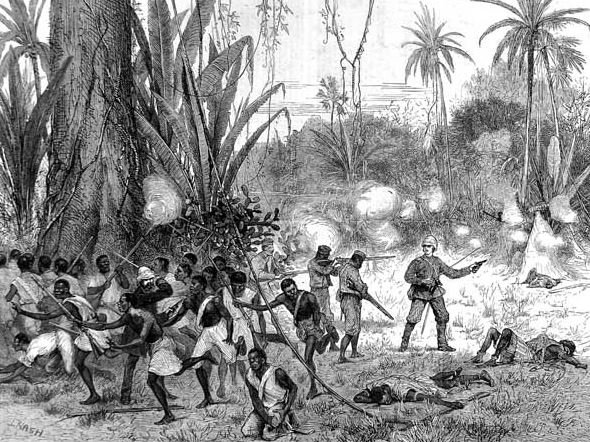
An encounter between the Ashanti soldiers and the British.
Why did the war begin?
The war started due to rising tensions between the Ashanti and British, sparked by the execution of Sergeant Otetfo in 1823, leading Governor Sir Charles MacCarthy to declare war and attempt to curb Ashanti power.
What happened at the Battle of Nsamankow?
On January 21, 1824, British forces under MacCarthy suffered a crushing defeat against the Ashanti. MacCarthy was killed, and his skull was later used as a war trophy, marking a significant Ashanti victory.
How did disease affect the British war effort?
Tropical diseases severely impacted British troops, leading to high casualties among European soldiers and forcing them to rely more on locally recruited African militias.
What was the significance of the Battle of Dodowa?
Fought on August 7, 1826, the battle saw British, Danish, and Fante forces using Congreve rockets to break Ashanti lines, leading to a decisive Ashanti defeat and their retreat from the coastal regions.
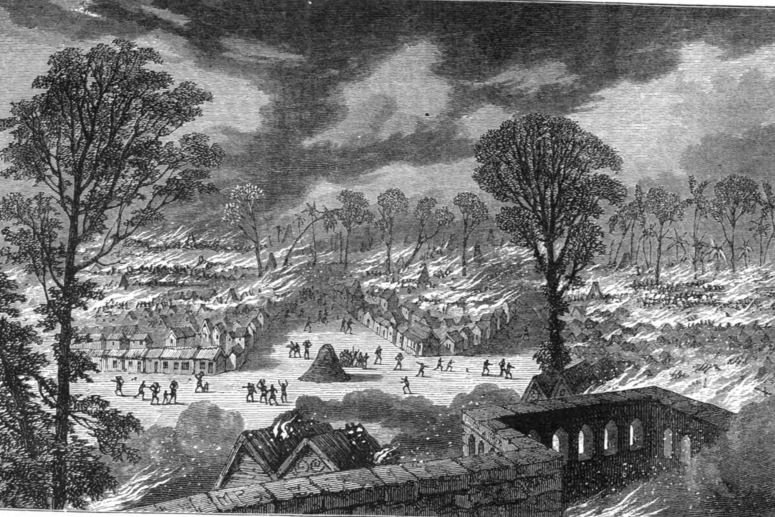
An illustration depicting the attack on Kumasi. Artwork by Welsh-American artist Henry Morton Stanley.
What were the terms of the 1831 peace treaty?
The Ashanti had to pay gold reparations, surrender two royal hostages, recognize the independence of several states, and cede land south of the Pra River to British control.
How did the war impact the Ashanti Empire?
The war weakened the Ashanti militarily and economically, reducing their influence over the Gold Coast and marking the beginning of their decline as a regional power.
What was the long-term effect on British colonial expansion?
The war reinforced British dominance in the region, laying the foundation for future conflicts that eventually led to the full colonization of the Gold Coast in 1874.





