History of the Dolmens of Ancient Korea
Dolmens (Goindol) are among the most significant archaeological features of prehistoric Korea, providing crucial insights into the social structures, burial customs, and religious beliefs of early Korean societies. These large stone tombs, built primarily during the Neolithic and Bronze Ages, serve as remnants of an ancient civilization that thrived on the Korean Peninsula thousands of years ago.
Dolmens are not unique to Korea, as they are found across Europe, Asia, and parts of Africa. However, Korea has the largest concentration of dolmens in the world, with an estimated 40% of all known dolmens located within its borders. These monuments are widely recognized for their cultural and historical importance, leading to the designation of several major dolmen sites as UNESCO World Heritage Sites in 2000.

A dolmen on Ganghwa Island, South Korea.
Origins and Distribution of Korean Dolmens
Dolmens belong to a broader category of megalithic structures that emerged across the world during the Neolithic and Bronze Ages. These stone tombs are found in diverse regions such as Western Europe (e.g., France, Ireland, and Spain), India, China, and Japan. They are generally believed to be associated with early agricultural societies that required permanent burial sites for elites or significant individuals.
Among the world’s dolmen sites, Korea stands out due to the sheer density and variety of these structures. The three most significant dolmen-rich regions in Korea are:
- Gochang (고창)
- Hwasun (화순)
- Ganghwa (강화)
These sites, recognized by UNESCO, contain thousands of well-preserved dolmens that provide insights into early Korean culture, technology, and burial customs.
As one of the most significant archaeological treasures of Korea, dolmens (고인돌, Goindol) continue to captivate scholars and the public alike, serving as a bridge between Korea’s distant past and its cultural identity today.
Classification of Korean Dolmens
Korean dolmens come in several types, classified primarily by their structure and burial methods. The three main types are:
Table-Type Dolmens (북방식 고인돌, Northern Style)
- These dolmens consist of a massive horizontal capstone supported by upright stones, forming a chamber beneath.
- The table-like appearance gives them their name.
- This style is closely related to dolmens found in Manchuria and suggests connections between early Korean societies and northern East Asian cultures.
- Some scholars believe these dolmens housed remains of elites or warriors.
Goindol Pit-Type Dolmens (남방식 고인돌, Southern Style)
- These dolmens feature a large capstone placed directly over an underground burial pit.
- Unlike the table-type dolmens, these structures often lack visible upright supporting stones.
- They are more commonly found in the southern regions of Korea.
- The burial pit beneath the capstone was sometimes lined with stone slabs or wooden materials.
Capstone-Type Dolmens (기반식 고인돌, Hybrid Type)
- This is a transitional form between the table-type and pit-type dolmens.
- The capstone rests on a small number of supporting stones but does not form a full chamber.
- Found in various locations across Korea, these dolmens reflect diverse regional variations in burial practices.
Cemeteries with 20 to 90 dolmens suggest that the individuals buried there were part of elite lineages or ruling dynasties.
Construction Techniques and Labor
Quarrying and Transporting Massive Stones
The construction of dolmens required advanced knowledge of engineering, quarrying, and teamwork. Some capstones weigh over 100 tons, raising questions about how ancient societies moved such massive stones without modern tools.
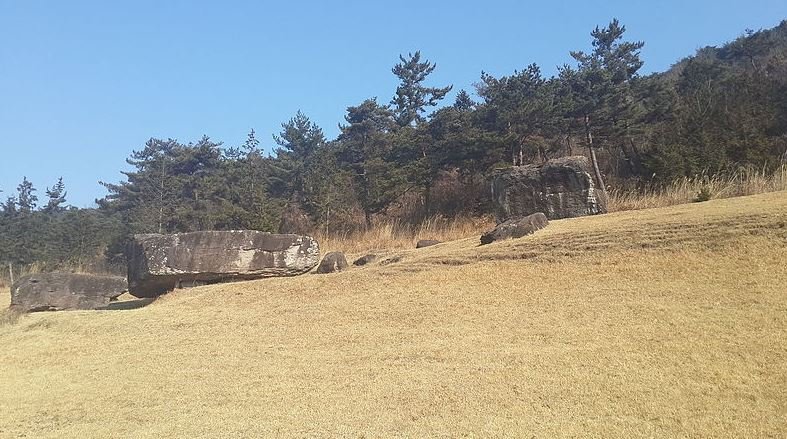
A number of dolmens located at the Hwasun Dolmen site.
Possible Construction Methods
Several theories explain how early Koreans transported and placed these giant stones:
Rolling on Logs
- Logs were placed under the stones to facilitate rolling over long distances.
- This method was common in megalithic construction across the world.
Sled and Ice Transport
- During winter, ice sheets could have been used to slide the stones over frozen ground.
Leverage and Earth Ramps
- Earth ramps may have been constructed to slowly elevate the stones into position.
Human and Animal Labor:
- Given the estimated weight, hundreds of workers would have been required to move the capstones using ropes, wooden supports, and sheer manpower.
Social Implications of Dolmen Construction
The effort required to construct dolmens suggests a highly organized society with leaders who could mobilize large labor forces. This reinforces the idea that dolmens were likely burial sites for elite individuals, such as chieftains, shamans, or influential figures.
Gogok are crescent-shaped beads found in dolmens, later seen in the golden crowns of the Silla kingdom (57 BCE – 935 CE).
Purpose and Cultural Significance
Funerary and Ritual Functions
Dolmens primarily served as burial tombs, with evidence of human remains and grave goods found in several excavated sites.
The goods discovered within these tombs include bronze weapons, pottery, jade ornaments, and ritual objects, indicating that these were tombs for high-status individuals.
Connection to Ancestor Worship
The construction and maintenance of dolmens may have been linked to ancestor veneration, a practice still important in Korean culture today.
Some scholars suggest that dolmens served as sacred sites where rituals were performed to honor the deceased.
Astronomical Alignments and Rituals
Some dolmens appear to have astronomical alignments, with capstones positioned to align with celestial bodies such as the sun and moon.
This suggests that dolmens might have played a role in seasonal festivals, religious ceremonies, or agricultural cycles.

The Decline of Dolmen Culture
By the later Bronze Age and early Iron Age (c. 300 BCE), dolmens began to decline as burial practices evolved.
The introduction of new burial customs, including stone cists and mounded tombs, replaced dolmens as the primary burial structures.
As Korean societies became more interconnected with China and steppe cultures, social structures changed, and burial practices reflected new influences.
The emergence of metal tools and weapons also contributed to shifts in construction techniques.
UNESCO World Heritage Designation
In 2000, the dolmen sites of Gochang, Hwasun, and Ganghwa were recognized as UNESCO World Heritage Sites due to their archaeological significance and well-preserved state.
Role in Korean National Identity
The dolmens are seen as an essential part of Korean cultural heritage, linking the modern Korean people to their ancient ancestors.
Archaeological discoveries from dolmens help historians reconstruct Korea’s prehistoric period.
Tourism and Preservation Efforts
Today, Korean dolmens attract tourists, historians, and researchers from around the world. Efforts are ongoing to protect these sites from environmental damage and urban expansion.
Questions and answers about the Dolmens of Ancient Korea
Where are most Korean dolmens located?
The dolmens of ancient Korea, known as koindol or chisongmyo, are megalithic stone structures dating back to the late Neolithic period and the Bronze Age (1st millennium BCE). They served as tombs for elite members of early Korean societies.
Korea has over 180,000 dolmens, with 85% located in South Korea, where they are recognized as protected monuments.
How large can Korean dolmens be?
Some dolmens are immense, with the largest measuring 5.5 meters wide and 7.1 meters tall, and many weighing over 70 tons.
How did the Bronze Age influence dolmen construction in Korea?
Bronze Age culture likely spread from Manchuria, particularly the Sungari and Liao River basins, merging with the indigenous Neolithic population and forming an elite class that commissioned dolmens.
What evidence suggests cultural diffusion beyond Korea?
Similar dolmens found on Jeju Island, Ganghwa Island, and parts of Japan indicate that this cultural influence extended beyond the Korean mainland to the Japanese archipelago.
What are the three main types of Korean dolmens?
The three primary types of Korean dolmens are table-type dolmens, paduk-type dolmens, and capstone-type dolmens.
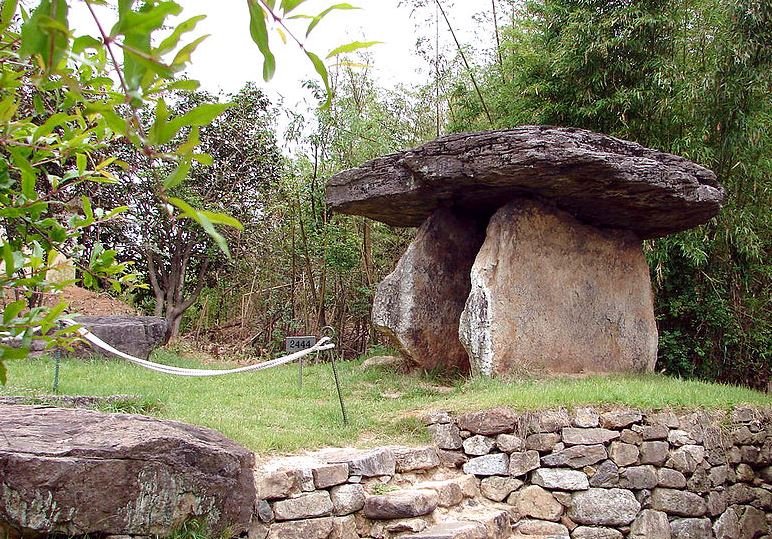
A huge dolmen at the Gochang Dolmen site.
What characterizes table-type dolmens?
Table-type dolmens, or Takcha form, are found mainly north of the Han River. They feature a horizontal capstone supported by multiple upright stones, resembling a table, and often stand alone.
What defines paduk-type dolmens?
Paduk-type dolmens consist of a large flat stone placed atop a mound of smaller stones. They are found in both northern and southern regions, sometimes in clusters.
What are capstone-type dolmens?
Capstone-type dolmens, more common in the south, have a single large stone laid flat above a rectangular underground tomb lined with stone slabs. Some tombs contained stone-lined graves or jar burials, possibly for children.
Where can notable table-type dolmens be found?
A significant collection of table-type dolmens exists on Ganghwa Island, dating to around 1000 BCE.
What are menhirs, and how do they relate to dolmens?
Menhirs are single standing stones found across Korea that are not linked to burials. They may have served as marker stones.
What types of artifacts have been found in dolmens?
Excavated dolmens have contained bronze weapons (daggers, swords, axes), polished stone tools, burnished pottery, jade and amazonite beads, and lacquered items.
What makes the Namsong-ri tomb significant?
The Namsong-ri tomb is among the richest dolmens, containing over 100 bronze objects, including mirrors, chisels, a lacquered scabbard, and tubular jade beads.
What is the mystery surrounding tomb wealth and dolmen size?
Some of the smallest dolmens contain the most valuable artifacts, raising questions about the correlation between tomb grandeur and the status of the buried individual.
How were dolmens likely constructed?
Scholars debate whether rolling logs, sleds, ramps, or ice transport were used to move the massive stones.
What is the unresolved connection between Korean and European dolmens?
Korean dolmens are strikingly similar to European dolmens, such as those in Carnac and Locmariaquer, France, despite no known contact between the two regions at the time of construction.

FACT CHECK: At World History Edu, we strive for utmost accuracy and objectivity. But if you come across something that doesn’t look right, don’t hesitate to leave a comment below.