Pharaoh Shoshenq II
Shoshenq II was a pharaoh of the Twenty-second Dynasty of Egypt, notable for being the only ruler of this dynasty whose tomb was discovered intact.

Golden funerary mask of Shoshenq II.
Summary
Heqakheperre Shoshenq II, also known as Shoshenq IIa, was a ruler of Egypt’s Twenty-second Dynasty. Unlike other monarchs of this period, he is notable for having the only unplundered tomb of the dynasty. His final resting place was discovered in 1939 by French Egyptologist Pierre Montet within an antechamber of Psusennes I’s tomb at Tanis. The discovery revealed an array of valuable burial goods, including a silver coffin and a gold funerary mask. This finding provided significant insights into the burial practices and wealth of the Third Intermediate Period. However, the identity and historical placement of Shoshenq II remain subjects of scholarly debate.
READ ALSO: Most Famous Pharaohs of Ancient Egypt
Discovery of the Tomb
The tomb of Shoshenq II was found by Pierre Montet during excavations at Tanis. On March 20, 1939, in the presence of King Farouk of Egypt, Montet removed the coffin lid, revealing a treasure trove of artifacts. Among these were jewel-encrusted bracelets, finely crafted pectorals, and an extraordinary hawk-headed silver coffin. The king’s face was covered with a beautifully designed gold funerary mask, demonstrating the craftsmanship of the period. Montet’s subsequent discoveries at Tanis included the intact tombs of Psusennes I and Amenemope in 1940, further cementing the importance of this site in Egyptian archaeology.
The Identity of Shoshenq II
One of the most enigmatic aspects of Shoshenq II’s rule is his lineage. Some scholars suggest he was the son of Shoshenq I, the founder of the dynasty. This theory is supported by items found in his tomb, including two bracelets inscribed with Shoshenq I’s name and a pectoral bearing the title “Great Chief of the Ma Shoshenq,” a designation Shoshenq I used before ascending to the throne. However, these objects could have been heirlooms rather than indicators of direct parentage.
Egyptologists remain divided on his familial connections. A forensic examination of his mummy by Dr. Douglas Derry indicated that Shoshenq II was around 50 years old at the time of his death. Given that Osorkon I reigned for approximately 35 years, Shoshenq II could have ruled briefly after Osorkon I and before Takelot I. This aligns with Sextus Julius Africanus’ version of Manetho’s Epitome, which lists three unnamed kings between Osorkon I and Takelot I. Another candidate for one of these intermediate rulers is Tutkheperre Shoshenq, whose presence is attested in both Upper and Lower Egypt.
Chronological Placement
Evidence suggests that Shoshenq II may have been a contemporary of Harsiese A, a ruler associated with Osorkon II. The hawk-headed design of Shoshenq II’s silver coffin closely resembles a similar lid found on the granite coffin of Harsiese A at Medinet Habu. This stylistic similarity supports the argument that Shoshenq II ruled shortly before or alongside Harsiese A. Some scholars, such as Jürgen von Beckerath, propose that Shoshenq II was an elder brother of Takelot I, while others believe he reigned independently between Osorkon I and Takelot I.

Pectoral of pharaoh Shoshenq II.
Coregency Debate
A controversial hypothesis proposed by Kenneth Kitchen suggests that Shoshenq II was identical to Shoshenq C, the High Priest of Amun and son of Osorkon I. Kitchen argues that Shoshenq C was designated as a junior coregent before predeceasing his father. This interpretation is based on linen bandages found on the Ramesseum mummy of Nakhtefmut, which are inscribed with the dates “Year 3 [Blank]” and “Year 33 Second Heb Sed.” Since Nakhtefmut owned a ring inscribed with Osorkon I’s prenomen, Kitchen suggests that Shoshenq II’s Year 3 corresponds with Osorkon I’s Year 33.
However, this argument is not widely accepted. The bandages bearing the two dates were written on separate linen strips rather than a single continuous piece, indicating that they were not necessarily used contemporaneously.
Additionally, Shoshenq C’s own children never referred to him with royal titles in their funerary inscriptions. His son, the priest Osorkon, described himself as “son of the High Priest Shoshenq” rather than “King’s Son.” This absence of royal designation undermines the theory that Shoshenq C was a coregent who became king.
Independent Rule
Further supporting the idea that Shoshenq II was an independent ruler is the absence of any objects bearing Osorkon I’s name in his burial chamber. This lack of Osorkon I-related artifacts is peculiar if Shoshenq II were indeed his son. Other pharaohs, such as Amenemope and Takelot I, included heirlooms from their parents in their tombs. Instead, Shoshenq II’s burial goods contained references only to Shoshenq I, strengthening the argument that he may have been Shoshenq I’s son rather than Osorkon I’s.
The Egyptologists Rolf Krauss and David Alan Warburton propose that Shoshenq II ruled independently for one to two years. Their assessment aligns with Thomas Schneider’s analysis of Manetho’s Epitome, which lists three rulers between Osorkon I and Takelot I. The use of silver for Shoshenq II’s coffin is particularly noteworthy, as silver was rarer than gold in ancient Egypt, symbolizing his considerable status and wealth.
What was Shoshenq II’s association with Egyptian god Sokar?
Cause of Death and Reburial
Forensic analysis of Shoshenq II’s remains revealed a massive head wound that led to a fatal septic infection. The nature of the injury suggests that he may have died from battle wounds or an assassination attempt.
His burial at Tanis appears to have been a secondary interment. Evidence of plant growth on the base of his coffin suggests that his original tomb had suffered from flooding, necessitating his reburial within the tomb of Psusennes I. Aidan Dodson highlights the rough handling of Shoshenq II’s coffin as further evidence of a later reburial. This practice was not uncommon in ancient Egypt, where tombs were frequently reused due to environmental or political factors.
Frequently Asked Questions
Where was Egyptian pharaoh Shoshenq II buried?
His final resting place was within the tomb of Psusennes I at Tanis, discovered by Pierre Montet in 1939.
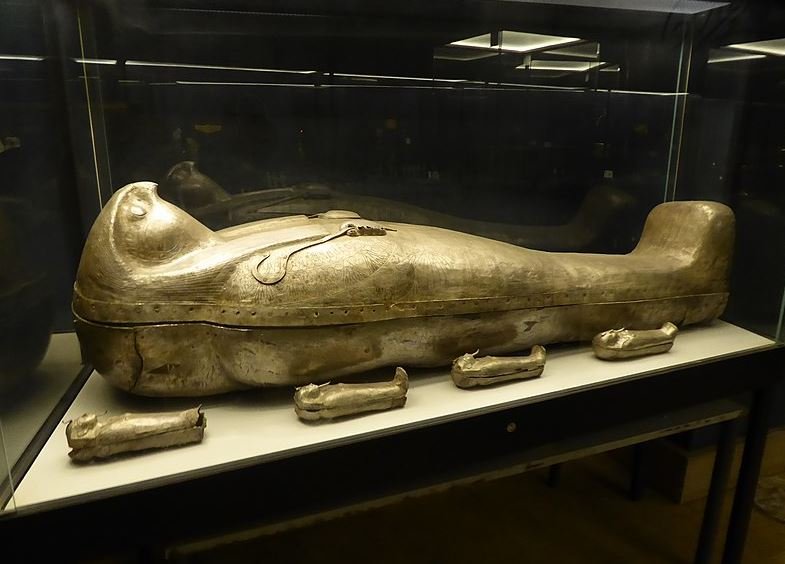
Coffin of Shoshenq II.
What significant artifacts were found in his tomb?
His burial included a silver hawk-headed coffin, a gold funerary mask, and jewel-encrusted pectorals and bracelets.
Was Shoshenq II related to Shoshenq I?
While some artifacts in his tomb reference Shoshenq I, scholars debate whether they indicate a direct filial link or were merely heirlooms.

Pharaoh Shoshenq I (center) presenting offerings to Amun, with His Son Iuput, as depicted by Italian artist Ippolito Rosellini.
Did Shoshenq II rule independently?
Yes, evidence suggests he had an independent reign of about one to two years, rather than being a mere coregent.
How did Shoshenq II die?
A forensic examination of his body revealed he died from a severe head wound that led to a fatal infection.
Why was he reburied in Psusennes I’s tomb?
His original tomb likely became waterlogged, necessitating his reburial in a more secure location.
What does his burial reveal about his status?
The exclusive use of silver for his coffin suggests significant wealth and power, as silver was rarer than gold in ancient Egypt.





