Queen Nzinga
Queen Nzinga was a 17th-century ruler of the African kingdoms of Ndongo and Matamba, located in present-day Angola. She is renowned for her military leadership, diplomatic acumen, and resistance to Portuguese colonialism.
Early Life and Background
Nzinga Ana de Sousa Mbande was born around 1583. She emerged from the royal lineage of the Kingdom of Ndongo, a Mbundu-speaking polity in what is today northern Angola. Her father, Ngola Kilombo Kia Kasenda, held the title of “Ngola,” which denoted rulership and later lent its name to the modern nation of Angola. Her mother, Kengela ka Nkombe, was a slave concubine—an origin that would later fuel disputes about Nzinga’s legitimacy as a ruler.
According to tradition, Nzinga’s birth was difficult; the umbilical cord reportedly wrapped around her neck, giving rise to her name—derived from the Kimbundu verb “kujinga,” meaning “to twist or turn.” This auspicious yet painful entry into the world was interpreted by elders as a sign of future greatness.
As a child, Nzinga stood out for her intelligence, fearlessness, and charisma. Unlike many young noblewomen, she received military instruction and was trained to wield weapons such as the battle axe. She was also taught statecraft, joining her father in war councils and legal tribunals. Exposure to Portuguese missionaries introduced her to Christianity and the Portuguese language, a skill that would serve her well in future diplomatic exchanges.

A depiction of Queen Nzinga.
Rise Amid Crisis
The late 16th and early 17th centuries were tumultuous for Ndongo. The Portuguese, with the cooperation of their longstanding allies in the Kingdom of Kongo, established a foothold in Luanda in 1575. Initially commercial, this relationship rapidly turned hostile, with Portugal seeking to subjugate Ndongo and control the local slave trade. Violent incursions, territorial seizures, and alliances with mercenary Imbangala warriors plunged Ndongo into prolonged instability.
Following the death of Nzinga’s father in 1593, her brother Ngola Mbandi took the throne. His rule was characterized by paranoia and brutality, including the execution of potential rivals and the forced sterilization of Nzinga and her sisters. However, despite their fraught relationship, Mbandi turned to Nzinga when diplomacy with the Portuguese became urgent. In 1621, she was dispatched to Luanda as a royal envoy.
Tippu Tip: One of the most powerful and wealthiest slave traders in Africa
Diplomatic Triumph
Nzinga’s embassy to Luanda marked the beginning of her legend. Fluent in Portuguese and well-versed in state affairs, she impressed the colonial officials. Most famously, she refused to sit on the floor during negotiations, prompting a servant to kneel and act as her human chair—an assertion of dignity in the face of intended humiliation. During talks, she advocated for peace while defending Ndongo’s sovereignty. She agreed to the baptism, taking the Christian name Ana de Sousa after the Portuguese governor’s wife, and secured a treaty that temporarily halted Portuguese aggression.
Nzinga assumed the throne of Ndongo in 1624 after her brother’s death and later conquered Matamba, transforming it into her political base.
Upon returning to Ndongo, Nzinga faced mounting challenges. Her brother’s mental health and leadership waned under pressure. After his suspicious death—possibly suicide or even poisoning—Nzinga seized the reins of power in 1624. Her ascension, however, was contested. As the daughter of a concubine, she was considered illegitimate by some nobles, while her gender also drew criticism in a patriarchal society. Nevertheless, she consolidated her authority through a combination of ritual, diplomacy, and military alliances.
Exile and Reinvention
Following Portuguese recognition of a rival claimant to the throne, Ngola Hari, hostilities resumed. A Portuguese invasion in 1626 forced Nzinga into retreat, and she endured years of displacement. During this time, she formed an alliance—sealed by marriage—with the Imbangala, a feared warrior society. Embracing their rites and customs, Nzinga adopted a hybrid identity that melded traditional Mbundu leadership with the militarized Imbangala ethos. This reinvention allowed her to build a new, formidable power base.
Between 1631 and 1635, Nzinga used her revitalized army to conquer the neighboring Kingdom of Matamba. The move was strategic: Matamba had a tradition of female rulers and lay further from Portuguese influence. Nzinga established herself as queen and began incorporating displaced Ndongan nobility and escaped slaves into her court. By providing land and titles, she fostered loyalty and established Matamba as a new center of resistance.
A New Power in the Region
From her Matamban stronghold, Nzinga orchestrated a campaign to reassert control over parts of Ndongo and disrupt Portuguese operations. She expanded her influence northward, controlling trade routes and strategically diverting slaves away from Portuguese markets. In the process, she came to dominate much of the interior, connecting with the Kingdom of Kongo and establishing ties with Dutch merchants.
The geopolitical landscape shifted in 1641 when the Dutch West India Company captured Luanda with Kongolese support. Sensing an opportunity, Nzinga entered into a formal alliance with the Dutch. Their partnership enabled her to recapture key territories, reclaim Ndongan land, and stage military campaigns that challenged Portuguese control. Although she failed to take the critical fortress of Massangano, her victories elevated her standing, both regionally and across the Atlantic world.

Conflict and Diplomacy
Despite her successes, Nzinga’s ambitions alarmed neighboring rulers and former allies alike. Kasanje, her former Imbangala husband and ally, turned against her, forming an anti-Nzinga coalition. Meanwhile, the Dutch faced internal problems and waning interest in their Angolan venture. In 1648, the Portuguese—led by Salvador Correia de Sá—retook Luanda and forced the Dutch out of Angola. Nzinga was left isolated.
Trained in military and diplomatic strategy from a young age, Queen Nzinga emerged as a powerful leader during a turbulent era marked by Portuguese colonial expansion and the transatlantic slave trade.
Though she continued to resist Portuguese expansion, her strategy shifted. Recognizing the limits of sustained warfare, she adopted a policy of containment—disrupting Portuguese trade, fomenting unrest, and leveraging diplomatic overtures. Nzinga reintroduced Christian customs at her court and began corresponding with European leaders, including the Pope. Her overtures aimed to secure international legitimacy and protect her kingdom from future invasions.
Religious Transformation
While Nzinga had initially adopted Christianity for diplomatic reasons, by the 1650s she began embracing it more sincerely. She requested Capuchin missionaries, particularly those unaffiliated with the colonial administration. These missionaries, including Father Calisto Zelotes do Reis Mago, became trusted advisors and helped integrate Christian rites into court life. Nzinga sponsored churches, encouraged conversion, and incorporated Christian ethics into her legal reforms.
At the same time, Nzinga suppressed traditionalist opposition. Priests of rival religions were expelled or punished, and shrines destroyed. Her policies drew criticism, but they strengthened her authority and aligned Matamba more closely with European Christian kingdoms. This religious pivot also helped her position Matamba as a legitimate Christian monarchy in the eyes of foreign powers.
Treaty of Tordesillas and the division of the New World between Spain and Portugal
Treaty with Portugal
The protracted wars between Matamba and Portugal had left both sides drained. After several failed negotiations, Nzinga and the Portuguese finally reached a peace agreement in 1656. Under the treaty, she ceded some western territories and allowed Portuguese merchants into Matamba. In exchange, Portugal recognized her authority, ceded Kituxela to her, and agreed to protect Matamba from hostile neighbors.
One of Nzinga’s main goals in the negotiation was the release of her sister Kambu, captured years earlier. Kambu’s return symbolized both personal and political triumph. Though the treaty involved concessions, it marked a rare moment in colonial African history where an African ruler secured peace with a European power on largely equal terms.
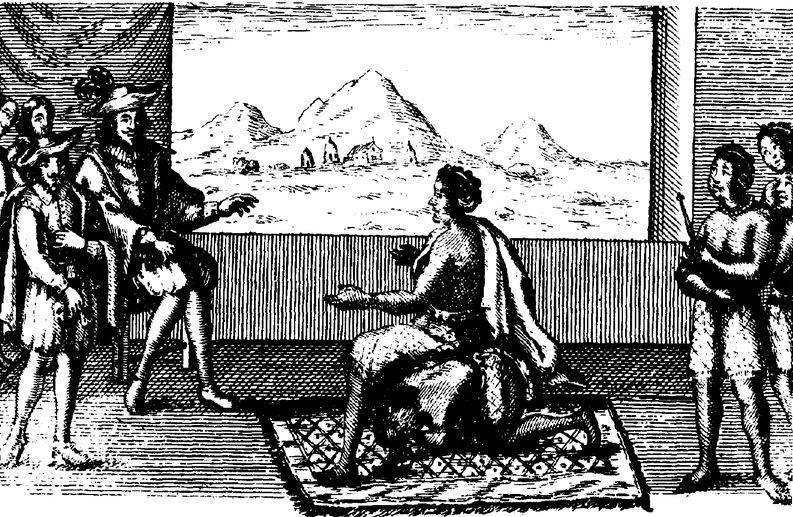
Queen Nzinga negotiates with the Portuguese governor
Governance and Legacy Building
In her final years, Nzinga turned to state-building. She abolished many of the austere Imbangala practices—such as bans on childbirth—and encouraged population growth and agriculture. She also restructured her administration, introducing a hybrid legal code that blended Mbundu customs with Christian ethics. Nzinga established Matamba as a hub of regional commerce, capitalizing on its position in the Central African trade network.
She also sought to ensure a smooth succession. Nzinga appointed her sister Kambu (also known as Dona Barbara) as her heir. To consolidate royal authority, she distanced the monarchy from the more egalitarian tendencies of the Imbangala and emphasized dynastic continuity. Her court became more feminine and ceremonial, adopting silk attire, court etiquette, and Christian marriage customs.
Death and Succession
Nzinga died on 17 December 1663 after a brief illness. Her passing marked the end of one of the most remarkable reigns in African history. She had transformed herself from a regional diplomat to a warrior queen, religious convert, and respected ruler. Her funeral combined Catholic and Mbundu traditions, symbolizing the syncretic nature of her reign.
After her death, her sister Kambu assumed the throne. Though tensions remained within the court, particularly between Christian elites and traditionalists, Nzinga’s political and administrative reforms allowed for a relatively stable transition. Her model of leadership influenced Matamba’s governance for generations, and women continued to hold the throne for most of the next century.
READ ALSO: History of the Catholic Church: How and When Did Catholicism Begin?
Historiographical Perspectives
Over the centuries, Nzinga’s image has evolved. Portuguese accounts from the 17th century were often ambivalent—acknowledging her diplomatic skill while framing her eventual Christian conversion as a divine victory. The Capuchin priests Antonio da Gaeta and Antonio Cavazzi, who knew her personally, described her as both awe-inspiring and ruthless. Western interpretations, particularly in the 18th and 19th centuries, often emphasized her sexuality and alleged cruelty, reflecting Eurocentric biases.
In the 20th century, scholars and activists reassessed Nzinga’s legacy. Angolan nationalists portrayed her as a symbol of anti-colonial resistance. Feminist writers praised her political savvy, while some historians criticized her use of the slave trade to fund her campaigns. In recent decades, scholars like Linda Heywood and John Thornton have offered more balanced perspectives, portraying her as a pragmatic leader who adeptly navigated gender, religion, and colonial power dynamics.
Cultural Legacy
Nzinga remains a towering figure in Angolan national identity. A major street and a prominent statue in Luanda commemorate her, and the central bank issued a coin in her honor. She has been the subject of academic works, poems, films, and even video games. In 2023, Netflix released African Queens: Njinga, a dramatized account of her life. Her story continues to inspire, especially among African women who see in her a symbol of strength, resilience, and independence.

Statue of Queen Nzinga, located in Luanda, Angola.
Frequently Asked Questions
Who was Queen Nzinga – and what was her relationship with the Portuguese?
How did Nzinga rise to power?
Nzinga assumed power after the death of her brother in 1624. Though her succession was contested due to her gender and maternal lineage, she consolidated authority through strategic alliances, military strength, and political maneuvering.
What role did diplomacy play in Nzinga’s leadership?
Nzinga was a skilled diplomat. Her 1622 embassy to the Portuguese in Luanda resulted in a temporary peace treaty. She later aligned with the Dutch to counter Portuguese influence and negotiated treaties to secure her kingdom’s sovereignty.
Nzinga Ana de Sousa Mbande (c. 1583–1663) was a formidable ruler of the Mbundu-speaking kingdoms of Ndongo and Matamba in present-day Angola.
How did Nzinga use military alliances?
She allied with the Imbangala, a formidable warrior society, adopting some of their customs and military practices. This alliance helped her rebuild her army and conquer the Kingdom of Matamba, establishing a new base of power.
What was her relationship with the Portuguese?
Nzinga both fought against and negotiated with the Portuguese. She resisted their territorial expansion, disrupted their slave trade, and later signed a peace treaty in 1656 that recognized her rule and ended decades of conflict.
How did religion influence her rule?
Initially baptized for diplomatic reasons, Nzinga later embraced Christianity more deeply. She invited missionaries, built churches, and integrated Christian practices into her court, using religion as a tool for legitimacy and diplomacy.

What changes did she make in her later reign?
Nzinga shifted focus from warfare to state-building. She reformed Matamba’s legal code, promoted trade, encouraged population growth, and strengthened central authority, preparing her sister to succeed her peacefully.
What is Nzinga’s legacy today?
Nzinga is celebrated as a national heroine in Angola and a symbol of resistance against colonialism. Her legacy endures through monuments, literature, film, and historical scholarship recognizing her as a powerful and complex leader.





