The Aquila in Ancient Rome
The aquila, or eagle, was a powerful and iconic symbol in ancient Rome. More than just a standard or insignia, it held religious, military, and political significance. Each Roman legion was symbolized by an aquila, carried by the aquilifer, the eagle-bearer. The eagle’s role in the Roman military went beyond serving as a mere military banner; it was a representation of Roman identity, power, and the honor of the Roman state.
Below, World History Edu will explore the history, importance, and cultural significance of the Roman aquila, including the impact of its loss in battle, and its evolution in later empires.

A modern replica of a Roman Aquila.
Origins and Early Usage of the Aquila
The eagle was initially not the sole symbol of the Roman legions. According to historical sources, early Roman military standards (signa militaria) were simple objects, including a bundle of straw, hay, or fern fixed atop a spear. The soldiers who carried these standards were part of a “maniple,” the name of which originated from the Latin term manipulus, referring to the bundle of straw. Over time, this early standard evolved into representations of various animals. Pliny the Elder, a Roman naturalist, listed several animals used as military symbols, including the eagle, wolf, boar, ox with a human head, and horse.
The first significant shift in Roman military symbolism occurred during the consulship of Gaius Marius in the late 2nd century BCE. After the disastrous Roman defeat at the Battle of Arausio (105 BCE), Marius reformed the Roman military and decided that the eagle should become the sole symbol of the legions. This move was likely influenced by the importance of the eagle as a symbol of imperial power and authority in the Mediterranean world. The eagle was made of silver or bronze, often with outstretched wings, signifying strength and divinity.
READ ALSO: Significance of Olive in Ancient Mediterranean
Religious Significance of the Aquila
The aquila held quasi-religious importance in the Roman military. Roman soldiers saw the eagle as more than just a symbol of their unit; it represented the divine protection of the Roman gods, particularly Jupiter, the king of the gods. This spiritual connection meant that the aquila was an object of deep reverence and sanctity. Losing the eagle in battle was considered an enormous dishonor, akin to a personal and collective disgrace. To Romans, the eagle embodied the soul of the legion and its sacred duty to Rome.
The importance of the aquila is evident in the Roman military’s efforts to safeguard and recover these standards. In many cases, Roman soldiers would go to great lengths, even sacrificing their lives, to protect the aquila. The recovery of lost aquilae was not just a matter of military pride but also of restoring the moral and spiritual integrity of the legion. As a result, the aquilae were fiercely defended, and those who lost or failed to recover them were seen as disgraceful.
The Role of the Aquilifer
Each Roman legion had a designated individual responsible for carrying and guarding the aquila—the aquilifer. The aquilifer was typically a senior soldier, highly trusted with the honor of the legion. The aquilifer’s role was crucial, and his duties extended beyond simply carrying the eagle. During times of battle, the aquilifer was expected to protect the aquila at all costs. Should the eagle fall or be lost, it was the aquilifer’s failure, and the responsibility of retrieving it fell to him or the soldiers under his command.
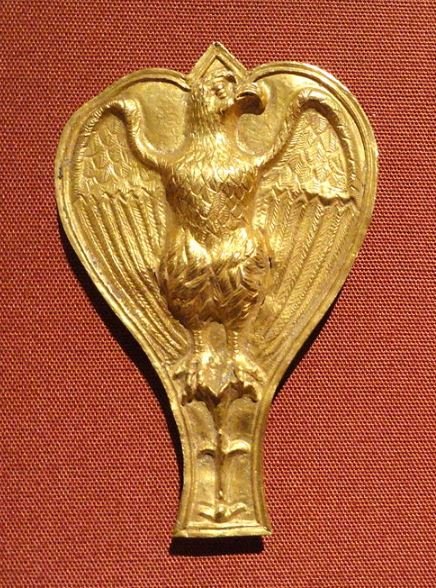
A Roman ornament, featuring an aquila on it.
The loss of an aquila was a profound disgrace, and the recovery of one was a powerful symbol of Roman resilience and determination.
In times of crisis, such as during the Battle of Teutoburg Forest in 9 CE, when three Roman legions were annihilated by Germanic tribes, the loss of the aquila was a symbolic as well as a military defeat. Roman soldiers, under the leadership of generals like Germanicus, would later go to great lengths to recover the lost eagles. This recovery was not only a military objective but also a vital part of restoring Roman honor. The act of retrieving a lost aquila was seen as a restorative event, often celebrated with much fanfare.

The Importance of Aquilae Losses and Recoveries
The consequences of losing an aquila were severe. A lost aquila symbolized more than a defeat; it represented a breakdown of Roman power and a dishonor that extended beyond the battlefield. The loss of an eagle could demoralize the troops, weaken their resolve, and shake the faith of the Roman public in the military’s strength and invincibility.
One of the most famous instances of lost aquilae occurred during the Battle of Teutoburg Forest in 9 CE. Three legions, namely the 17th, 18th, and 19th, were destroyed by an alliance of Germanic tribes under the leadership of Arminius. The eagles of these legions were lost during the battle, and their retrieval became a matter of Roman prestige. For example, Emperor Tiberius made multiple attempts to recover the lost eagles, which were considered vital to Roman honor. The recovery of two of the eagles was celebrated as a significant victory for Rome.
There were other occasions when Roman legions lost their aquilae. For instance, during the Third Servile War (73–71 BCE), five eagles were lost but were eventually recovered following the defeat of Spartacus. The loss of aquilae at the Battle of Carrhae in 53 BCE, following the defeat of Crassus by the Parthians, was another significant moment in Roman history. The aquilae lost in battle would not be returned until two decades later, in 20 BCE, demonstrating the long-lasting repercussions of such losses.
The Aquila in Roman Culture and Art
The aquila had a prominent place in Roman art and iconography. It was often depicted in reliefs, coins, and other forms of visual culture, symbolizing Roman power and military prowess. Roman emperors and military leaders used the aquila to reinforce their authority and the legitimacy of their rule.
For example, the return of the lost aquilae to Rome was a celebrated event, immortalized in the artistic representations of the period, such as the breastplate of the statue of Augustus of Prima Porta. In this artwork, Emperor Augustus is depicted triumphantly holding an aquila, symbolizing the recovery of the lost standards and his military success.
Coins also played an important role in showcasing the symbolism of the aquila. The reverse of Roman coins often featured the eagle, sometimes accompanied by a representation of the emperor or a military figure. These coins were used not only for economic transactions but also as a means of conveying political messages and reinforcing the divine authority of the emperor.
Additionally, the aquila was an important part of Roman funerary art. It often appeared on tombs and monuments, symbolizing the valor and honor of the deceased. The memorial to Lucius Duccius Rufinus, a standard-bearer of the Ninth Legion, is an example of how the aquila was used to commemorate those who served the Roman state.
The aquila symbol was adopted by later empires, including the Holy Roman Empire and the Byzantine Empire, continuing to represent power and authority in European heraldry.
The Decline and Legacy of the Aquila
Despite the aquila’s central role in Roman military culture, its significance began to diminish after the fall of the Western Roman Empire in the 5th century CE. However, the symbolism of the eagle persisted in various forms. The Holy Roman Empire, which sought to continue the legacy of Rome, adopted the eagle as its emblem, albeit with a new Christian significance. The Byzantine Empire also used the eagle, albeit more infrequently, often in the form of a double-headed eagle, symbolizing the unity of the Eastern and Western Roman Empires.
The eagle continued to hold symbolic power in European heraldry and later in various national emblems, including those of Germany and Russia. Even today, the eagle remains a powerful symbol of strength, authority, and freedom.
Frequently Asked Questions
Who carried the aquila?
The aquila was carried by the aquilifer, a senior soldier chosen to protect and display the eagle standard during battle.

Imperial Aquila of the Roman Empire.
What did the aquila symbolize to Roman soldiers?
The aquila had religious and military significance, representing divine protection, the power of Rome, and the honor of the legion.
What happened if an aquila was lost in battle?
Losing an aquila was considered a grave dishonor, symbolizing defeat and disgrace. The Romans would go to great lengths to recover any lost aquilae.
What were the consequences of losing the aquila?
The loss of an aquila demoralized soldiers and tarnished the reputation of the legion. Recovering the lost standard was crucial for restoring honor and morale.

How was the aquila used in Roman art and culture?
The aquila was depicted in Roman art, such as coins and reliefs, to reinforce the authority of emperors and symbolize military success and divine favor.
What were some key battles where aquilae were lost?
Notable losses of aquilae occurred at the Battle of Teutoburg Forest in 9 CE and the Battle of Carrhae in 53 BCE. The recovery of these eagles was a significant event in Roman military history.





