Anthony the Great
Anthony the Great, also known as Anthony of Egypt, Anthony the Abbot, or Anthony the Hermit, was a prominent Christian monk from Egypt, born in the early 3rd century and renowned as a key figure in the development of Christian monasticism. His legacy, spanning centuries, has earned him titles such as “Father of All Monks,” and he is celebrated as a saint in both Eastern Orthodox and Catholic traditions. His feast day is observed on January 17, and he remains an enduring influence on Christian spirituality. Anthony’s life and work have been chronicled by Athanasius of Alexandria, whose writings popularized the monastic ideals that shaped Christian asceticism.
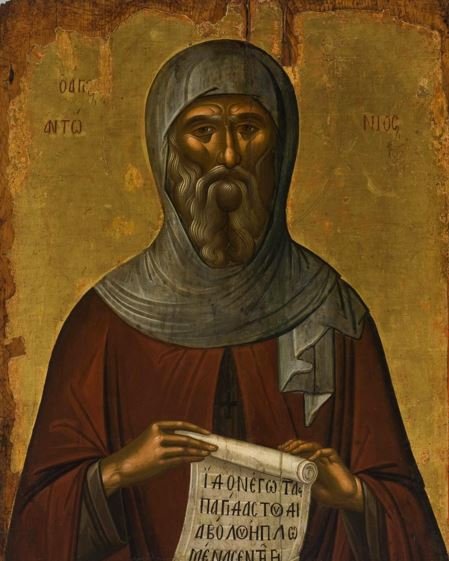
A 16th century painting of Anthony the Great. Artwork by Michael Damaskinos.
READ ALSO: History of the Catholic Church: How and When Did Catholicism Begin?
Early Life and Conversion
Anthony was born around 251 AD in Koma, in the Lower Egyptian region. His family was wealthy, and he inherited his parents’ land and property. However, at the age of 20, following the death of his parents, Anthony made a pivotal decision that would alter the course of his life. Inspired by the words of Jesus in Matthew 19:21, “If you want to be perfect, go, sell what you have and give to the poor,” Anthony sold the majority of his possessions and gave the proceeds to those in need. This act of generosity was accompanied by his decision to live an ascetic life, dedicating himself to spiritual growth rather than earthly wealth.
To care for his unmarried sister, Anthony placed her in the care of a group of Christian virgins, and he left his home to embrace a life of solitude and self-denial. This early decision to pursue asceticism, guided by his deep spiritual convictions, set him on a path that would define his life.
Life as a Hermit
After his initial withdrawal from society, Anthony sought solitude and ascetic discipline, which were already present in various forms in Egypt. Although he was not the first Christian hermit, Anthony distinguished himself by his intense dedication to the eremitic lifestyle. He became a disciple of another local hermit, learning the ways of asceticism, and it is during this period that many of the foundational aspects of his spiritual practices took shape.
At the age of 35, Anthony retreated into the Nitrian Desert, located about 95 kilometers west of Alexandria, marking a significant departure from the relative safety of the outskirts of his village. Here, he lived for 13 years in seclusion, enduring harsh conditions and fasting extensively, sometimes for days at a time. His diet consisted mainly of bread, water, and salt, while he avoided meat and wine altogether. During this period, he is said to have been tormented by demons, which appeared to him in various forms, testing his resolve and spiritual strength.
Athanasius of Alexandria, his most famous biographer, recorded how Anthony endured supernatural temptations. According to Athanasius, these trials involved temptations of laziness, lust, and boredom, which were often depicted as phantoms of women. However, through unwavering prayer and faith, Anthony overcame these challenges, gaining renown for his spiritual strength and resilience.
The Call to Lead
After 15 years of living in the desert, Anthony felt called to withdraw even further into absolute solitude. He moved to a mountain by the Nile called Pispir, near Arsinoë, where he lived in an abandoned Roman fort for over 20 years. During this time, food was thrown to him over the walls of the fort, and he continued to devote himself to prayer and contemplation. Although he was occasionally visited by curious pilgrims, Anthony avoided human contact, focusing entirely on his spiritual growth.
However, as his fame grew, more and more followers sought his guidance. Eventually, Anthony emerged from his solitude to become the spiritual leader of a growing community of ascetics. He devoted the next several years to organizing and instructing these followers, imparting his wisdom on the ascetic lifestyle and deepening their understanding of the monastic vocation.
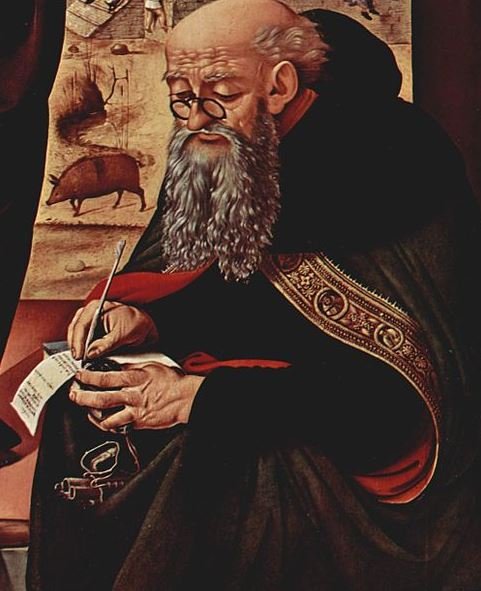
A depiction of Saint Anthony by Italian painter Piero di Cosimo
Anthony as the Father of Monasticism
Though Anthony was not the first Christian ascetic, he is often referred to as the “Father of Monasticism” due to his significant role in shaping the development of Christian monastic communities. His teachings emphasized the importance of solitude, prayer, and fasting, and he became a model for future generations of Christian monks. Under his guidance, the monastic community grew, and his disciples established their own hermitages, forming the foundation of monasticism in Egypt.
Anthony’s influence was far-reaching, as the fame of his life and teachings spread beyond Egypt. His interactions with Emperor Constantine, who sought Anthony’s prayers, demonstrated the growing recognition of his spiritual authority. Though he lived in seclusion, Anthony’s role as a spiritual leader became undeniable, and he played an important part in shaping the early monastic tradition.
Anthony the Great is regarded as the “Father of Monasticism” because he organized and led a growing community of monks, emphasizing the importance of solitude, prayer, and self-discipline.
His influence also extended to other monastic figures, such as Macarius the Great, a disciple of Anthony who later founded his own monastic community. Anthony’s guidance provided a spiritual framework for these individuals, inspiring them to live ascetically and cultivate a deeper relationship with God through prayer and solitude.
Temptations and Trials
One of the most significant aspects of Anthony’s life is his encounters with supernatural temptations, which have been depicted in various forms of art and literature. During his time in the desert, he faced numerous trials, including physical attacks from demons, as well as temptations to indulge in material wealth and pleasure. These trials were not only spiritual but also physical, as Anthony was often subjected to beatings and torments by evil forces. Despite these challenges, he remained steadfast in his faith, and his unwavering resolve became an inspiration to countless others.
A particularly famous story from Anthony’s life is his encounter with two mythical creatures, a centaur and a satyr, during his journey to find St. Paul of Thebes, another hermit. These creatures were interpreted as manifestations of demonic forces trying to thwart Anthony’s mission. However, Anthony remained undeterred, and his response to these trials demonstrated his deep spiritual maturity. These stories of temptation and triumph were often depicted in paintings by artists such as Hieronymus Bosch and Salvador Dalí, who captured the vivid and surreal nature of Anthony’s struggles in the desert.
Final Years and Death
In his later years, Anthony withdrew to a more secluded area between the Nile and the Red Sea, where he settled on Mount Colzim (now known as the Monastery of St. Anthony). It was here that he spent the last 45 years of his life, continuing his ascetic practices while remaining accessible to visitors who sought his guidance. Anthony’s life remained a testament to the power of faith, prayer, and self-discipline, even as the world around him changed.
Around 311 AD, during the Diocletian Persecution, Anthony visited Alexandria to encourage Christians who were imprisoned for their faith. He continued to play an active role in defending Christianity against heretical teachings, such as those espoused by Arius. Despite his increasing age, Anthony remained a vocal advocate for orthodoxy and the unity of the Christian church.
As he approached the end of his life, Anthony sensed that his time was near. He gave instructions to his disciples regarding his burial and the distribution of his belongings. Anthony passed away on January 17, 356 AD, and was buried in a grave near his cell, as per his wishes.
Roman Emperor Diocletian: Life, Family, Reign & Major Accomplishments
Legacy and Veneration
The legacy of Anthony the Great extends far beyond his death, as his influence on Christian monasticism continues to be felt today. His life and teachings were immortalized by Athanasius of Alexandria in “The Life of Anthony,” which became one of the most widely read Christian texts in the early centuries of the church. This biography helped spread the ideals of asceticism and monasticism to both Eastern and Western Christianity.
In the centuries following his death, Anthony became the subject of veneration and pilgrimage. His remains were eventually moved to various locations, including Alexandria and Constantinople, and later to France, where they became a focal point of Christian devotion. The Hospital Brothers of St. Anthony, founded in the 11th century, were established to care for victims of ergotism, a disease associated with the saint’s name, “St. Anthony’s Fire.”
Today, Anthony is revered as a saint in many Christian traditions, and his example continues to inspire those seeking a life of prayer, contemplation, and service. He is especially venerated by the Coptic Orthodox Church, the Maronite Church, and the Order of Saint Paul the First Hermit. His feast day is celebrated annually on January 17, and his influence on Christian monasticism remains profound.
9 Greatest Catholic Saints of All Time and Their Accomplishments