Abgar the Great

Abgar VIII, also known as Abgar the Great or Abgar bar Ma’nu, was an Arab king of Osroene who ruled from 177 to 212 CE. Image: Abgar VIII depicted as King on the obverse of Roman coinage.
Abgar VIII of Edessa, also known as Abgar the Great or Abgar bar Ma’nu, was an Arab king of Osroene, reigning from 177 CE to 212 CE. His reign was marked by notable political maneuvering, cultural developments, and a significant association with early Christianity. Osroene, a client state of the Roman Empire during his rule, played a complex role in regional geopolitics and religious transformations.
READ MORE: Saint Peter: Who was he, and what role did he play in early Christianity?
Early Reign and Political Dynamics
Abgar VIII ascended the throne of Osroene amidst the lingering influence of the Roman Empire. In 165 CE, the Romans reinstated Ma’nu VIII, a predecessor to Abgar, highlighting their control over the region. Despite this, Abgar VIII managed to pursue policies that hinted at a desire for autonomy. His coins, featuring the image of the Roman Emperor Commodus, symbolized a delicate balance between deference to Roman authority and a bid for independent influence.
Abgar’s geopolitical strategy aimed at maintaining neutrality between two major powers of the era—Rome and Parthia. By carefully navigating these allegiances, he sought to extend his influence without provoking Roman intervention. His reign exemplifies a nuanced approach to statecraft under the shadow of imperial dominance.
Conflict and Submission
Abgar VIII’s reign intersected with a period of civil conflict in Rome. In 193 CE, he supported Pescennius Niger in the latter’s claim to the Roman throne. However, Pescennius was defeated by Emperor Septimius Severus, necessitating Abgar’s submission. This event is commemorated on the Arch of Severus in Rome, where Abgar’s obeisance to the emperor is depicted.
As a ruler, Abgar the Great navigated the challenges of maintaining sovereignty while accommodating Roman dominance.
Despite his initial defiance, Abgar VIII successfully reconciled with Septimius Severus. His loyalty to Rome was demonstrated through his adoption of the Roman name Lucius Aelius Aurelius Septimus. This move secured his position as a regional leader, though his kingdom was significantly diminished, reduced to the city of Edessa.
READ ALSO: Greatest Kings of the Parthian Empire and their Accomplishments
Religious Significance and Christianity
One of the most enduring aspects of Abgar VIII’s legacy is his association with early Christianity. Around 200 CE, he is believed to have converted to Christianity and declared it the official religion of Edessa. This decision marked a pivotal moment in the region’s history, as Edessa became a center for the spread of Christianity in the Near East.
As a cultural and religious figure, Abgar the Great is remembered for his pivotal role in establishing Edessa as a bastion of Christianity, leaving a legacy that resonated long after his death.
The claim of Abgar’s Christian faith is supported by coins minted during his reign, which feature a cross on his tiara, interpreted as a symbol of Christian affiliation. Additionally, the Chronicle of Edessa, compiled in 540 CE, reports the existence of a Christian church building in Edessa that was damaged in a flood in 201 CE. Abgar’s court also included Bardaisan, a notable Christian philosopher, further underscoring his role in fostering a Christian intellectual and religious milieu.
The Lucius of Britain Theory
In 1904, German Lutheran theologian Adolf von Harnack proposed an intriguing hypothesis linking Abgar VIII to the legendary Lucius of Britain, a ruler mentioned in the Liber Pontificalis. According to Harnack, a transcription error transformed “Britio,” a citadel of Edessa, into “Britanio,” erroneously associating Abgar with Britain. This theory has faced criticism, particularly from British archaeologist David J. Knight, who highlighted the lack of contemporary sources identifying Abgar as Lucius of Britio or Birtha. Despite the debate, the theory reflects the enduring fascination with Abgar’s historical and religious impact.
Death and Succession
Abgar VIII’s reign came to an end with his death in 212 CE. He was succeeded by his son, Abgar IX, who briefly continued his father’s legacy. However, the political stability of Osroene did not last. In 213 CE, Emperor Caracalla summoned Abgar IX and his son to Rome, where they were executed. The following year, Osroene’s independence was extinguished as it was fully incorporated into the Roman Empire.
Timeline of Abgar VIII of Edessa (177–212 CE)
- 177 CE: Abgar VIII ascends the throne of Osroene, a client state of the Roman Empire.
- 193 CE: Supports Pescennius Niger’s claim to the Roman throne, but Niger is defeated by Septimius Severus.
- 194 CE: Submits to Septimius Severus; Osroene is reduced to Edessa. Abgar adopts the Roman name Lucius Aelius Aurelius Septimus.
- 200 CE: Allegedly converts to Christianity, declaring it Edessa’s official religion. Coins minted during his reign bear possible Christian symbols.
- 201 CE: A Christian church in Edessa is damaged by flooding, highlighting Christianity’s spread under Abgar’s rule.
- 212 CE: Dies and is succeeded by his son, Abgar IX.
- 213 CE: Abgar IX and his son are executed by Caracalla. Osroene’s independence ends in 214 CE as it becomes a Roman province.
Frequently Asked Questions about Abgar the Great
What is Abgar VIII most remembered for?
He is remembered for his alleged conversion to Christianity around 200 CE and declaring Christianity the official religion of Edessa.
What is the significance of the cross on Abgar’s coins?
The cross on Abgar VIII’s tiara has been interpreted as having Christian significance, reflecting his association with Christianity.
What was the relationship between Osroene and Rome during Abgar’s reign?
Osroene was a client state of the Roman Empire. While Abgar VIII minted coins bearing Roman Emperor Commodus’ image, he sought to maintain a degree of independence and extend his influence without provoking Rome or Parthia.
What was Abgar VIII’s role in Roman political conflicts?
In 193 CE, he supported Pescennius Niger in his claim for the Roman throne, but after Niger’s defeat by Septimius Severus, Abgar submitted to Severus. Osroene became a Roman province, though Abgar was reconciled with Severus and honored as a guest in Rome.
How did Christianity spread in Edessa under Abgar VIII?
Christianity grew significantly during his reign. The Chronicle of Edessa mentions a Christian church in the city as early as 201 CE, and the philosopher Bardaisan was part of Abgar’s court.
What happened after Abgar VIII’s death?
He was succeeded by his son Abgar IX in 212 CE. In 213 CE, Abgar IX and his son were murdered by Roman Emperor Caracalla, who fully annexed Osroene into the Roman Empire in 214 CE.
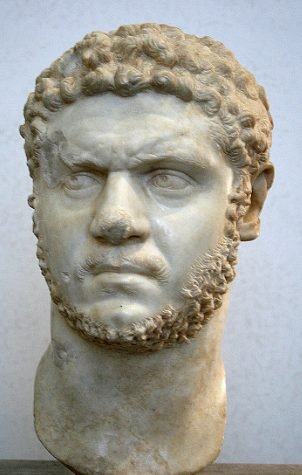
Bust of Roman Emperor Caracalla, Museo Nazionale Romano, 212–215 AD





