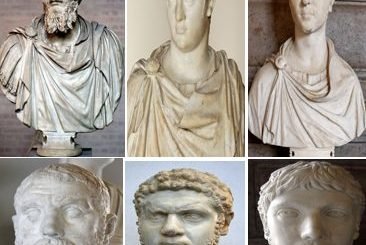
Julia Domna

Julia Domna’s life was marked by her extraordinary contributions to Roman imperial politics, culture, and society. As the first empress of the Severan dynasty, she navigated the complexities of power with intellect and determination. Image: Bust of Julia Domna, mother of Caracalla and Geta
Julia Domna was born around 160 AD in Emesa (modern-day Homs, Syria) to a prominent Arab family of priests devoted to the deity Elagabalus. Her father, Julius Bassianus, was the high priest of Baal, while her family’s wealth and influence elevated them to Roman senatorial aristocracy. The name “Domna,” derived from an archaic Arabic term meaning “black,” referenced the sun god Elagabalus, represented by a black stone. Her family’s wealth and political stature positioned them at the intersection of local and imperial powers, setting the stage for Domna’s rise.
Julia Domna was born around 160 AD in Emesa (modern-day Homs, Syria) to an Arab family of priests devoted to the deity Elagabalus.
Domna had an elder sister, Julia Maesa, who later played a crucial role in restoring the Severan dynasty. Through Maesa, Domna was the aunt of future Roman emperors Elagabalus and Severus Alexander. Prior to her marriage, Domna inherited a significant estate from her great-uncle, Julius Agrippa, further cementing her family’s prominence.
Marriage to Septimius Severus
Domna’s marriage to Septimius Severus in 187 AD was a turning point in her life. According to the Historia Augusta (an unreliable source but rich in anecdotes), Severus sought Domna after hearing a prophecy about a woman from Syria who would marry a king. At the time, Severus was the governor of Gallia Lugdunensis (modern-day Lyon, France). Their union proved harmonious, with Severus valuing Domna’s intellect and political counsel.
Julia Domna’s father was the high priest of Baal, and her family held significant wealth and status, being part of the Emesene dynasty.
The couple had two sons, Lucius Septimius Bassianus (later known as Caracalla) and Publius Septimius Geta. Domna’s active involvement in her husband’s career and her political acumen would later distinguish her as an influential empress.

The Severan Tondo, a famous piece of Roman artwork created during the reign of the Severan dynasty, portrays Roman emperor Septimius Severus, his wife Julia Domna, and their children Caracalla and Geta, whose face is removed.
Role in the Year of the Five Emperors
The turbulent Year of the Five Emperors (193 AD) saw Domna thrust into the center of imperial politics. Following the assassination of Emperor Commodus and the brief reigns of Pertinax and Didius Julianus, Severus declared himself emperor. Domna’s position as his wife bolstered her visibility and influence during these critical events. Severus defeated his rivals Pescennius Niger and Clodius Albinus, solidifying his rule by 197 AD. As empress-consort, Domna gained significant prestige and began accompanying Severus on military campaigns—an unusual role for a Roman empress.
Influence and Titles as Empress
Domna’s influence extended far beyond the traditional roles of an empress. She was deeply involved in political, philosophical, and social matters. Her honorary titles, such as “Mother of the Invincible Camps” (Mater Castrorum), reflected her unprecedented presence alongside the military. Coins bearing her image and titles like “Julia Augusta” highlight the respect and admiration she commanded.
Following Severus’ death in 211 AD, Domna received the title “Pia Felix Augusta,” which may have implied that she absorbed and continued her husband’s attributes. Her connection to Vestal iconography, as evidenced by medallions bearing the inscription “Vesta Mater,” symbolized her maternal role in the dynasty and her association with Rome’s sacred traditions.
Mediation Between Caracalla and Geta
After Severus’ death, Domna became a pivotal figure in the fraught relationship between her sons, Caracalla and Geta, who were supposed to rule jointly. Their discord culminated in Caracalla’s assassination of Geta in late 211 AD. Domna’s efforts to mediate the conflict were unsuccessful, and Geta’s memory was subjected to a damnatio memoriae (condemnation of memory), erasing his name and image from public records.
Later Life and Death
Domna continued to exert influence during Caracalla’s reign, accompanying him on military campaigns and managing imperial correspondence. Her presence in the court and on campaigns underscored her unique role as a female leader in a male-dominated empire.
In 217 AD, during Caracalla’s campaign against Parthia, he was assassinated by a Roman soldier. Domna, who had remained in Antioch, chose to end her life upon hearing the news. Some accounts suggest that her decision was hastened by her deteriorating health, possibly due to breast cancer, and her reluctance to return to private life. Her sister, Julia Maesa, later restored the Severan dynasty by placing her grandson Elagabalus on the throne.
Domna’s remains were initially placed in the Mausoleum of Augustus but were later moved to the Mausoleum of Hadrian by Maesa.
Legacy and Contributions
Domna’s legacy is multifaceted, encompassing her roles as a political advisor, cultural patron, and symbol of maternal authority. She encouraged intellectual pursuits, commissioning Philostratus to write the Life of Apollonius of Tyana. Although she did not live to see its completion, the work reflected her philosophical interests and engagement with cultural life.
Domna’s influence extended beyond her death. She encouraged literary works, impacted Roman fashion, and her family, through her sister Julia Maesa, restored the Severan dynasty to power in 218.
Her influence extended to Roman fashion, particularly her elaborate hairstyles and the adoption of wigs, which became popular among Roman women. Her image and titles appeared frequently on coins, further solidifying her legacy as a powerful and respected empress.
Timeline
- c. 160: Born in Emesa (modern Homs, Syria) to an Arab family of priests devoted to the deity Elagabalus.
- 187: Marries Septimius Severus, governor of Gallia Lugdunensis; they have two sons, Caracalla and Geta.
- 193: Civil war erupts; Severus declares himself emperor, making Domna empress.
- 197: Severus defeats rivals, solidifying his rule; Domna gains influence as empress.
- 211: Severus dies; Domna mediates between sons Caracalla and Geta. Geta is assassinated by Caracalla’s forces.
- 217: Accompanies Caracalla on Parthian campaign; commits suicide in Antioch after his assassination.
- 218: Her sister Julia Maesa restores the Severan dynasty.
Frequently Asked Questions

Domna married Septimius Severus in 187, who later became emperor in 193. Her marriage elevated her to the position of empress, and she became a significant political figure during the Severan dynasty. Image: Portrait of a Roman lady, circa 200 CE, resembling Empress Julia Domna, with a likely wig-styled hairstyle
What titles and honors did Julia Domna receive as empress?
Domna received numerous titles, including “Mother of the Invincible Camps” and “Pia Felix Augusta.” These reflected her influence, especially after her husband’s death, symbolizing her continuation of his authority.
How did Julia Domna influence politics and society?
Domna was known for her intellectual pursuits, supporting philosophy and literature. She accompanied her husband on military campaigns and played a mediating role between her sons, Caracalla and Geta, during their co-rule.
What was Julia Domna’s role after Septimius Severus’s death?
After Severus’s death in 211, Domna acted as a mediator between her sons. However, their relationship ended in conflict when Caracalla had Geta assassinated later that year.
How did Julia Domna die?
In 217, Domna committed suicide in Antioch after learning of Caracalla’s assassination. She may have also been suffering from breast cancer and chose not to return to private life.
What role did Julia Domna play in cultural and religious practices?
Domna’s medallions and titles often carried religious significance, invoking Vesta and linking her role to familial and imperial continuity. She also popularized hairstyles and wigs influenced by her cultural background.