
Achilles versus Hector
The duel between Achilles and Hector stands as one of the most dramatic and pivotal moments in Greek mythology, encapsulating the themes of honor, fate, wrath, and the human condition amidst the backdrop of the Trojan War.
This confrontation, immortalized in Homer‘s epic poem The Iliad, not only marks the climax of the narrative but also delves deep into the complexities of heroism and mortality.
Both Achilles, the greatest warrior of the Greeks, and Hector, the noble defender of Troy, embody the pinnacle of martial prowess and virtue within their respective cultures. Their encounter is not merely a physical battle but a profound exploration of character and destiny.
READ MORE: Major Events in Greek Mythology
Background Leading to the Duel
The seeds of the duel are sown early in The Iliad with the quarrel between Achilles and Agamemnon, the leader of the Greek forces. Agamemnon’s appropriation of Briseis, a war prize rightfully belonging to Achilles, ignites a fierce dispute that leads Achilles to withdraw from the battle in anger. This absence significantly shifts the tide of the war in favor of the Trojans.

Ancient Greek polychromatic pottery painting (dating to c. 300 BC) of Achilles during the Trojan War
Without Achilles, the Greeks suffer heavy losses, and the Trojans, led by Hector, push the Greeks back towards their ships, threatening to destroy them and end the war.
In an attempt to save his compatriots, Patroclus, Achilles’ closest friend and confidant, persuades Achilles to let him lead the Myrmidons into battle, wearing Achilles’ distinctive armor to inspire the troops and intimidate the Trojans.

Patroclus and the Myrmidons
Patroclus succeeds in repelling the Trojan assault but becomes overzealous, pursuing the enemy all the way to the gates of Troy. There, he encounters Hector. Mistaking Patroclus for Achilles, Hector engages him in combat and ultimately kills him. As Patroclus dies, he foretells Hector’s impending death at the hands of Achilles.

The Funeral of Patroclus by French painter Jacques-Louis David, 1778.
The death of Patroclus is a turning point for Achilles. Overcome with grief and guilt, he is consumed by a desire for revenge. His mother, the sea-nymph Thetis, comforts him and commissions the god Hephaestus to forge new armor for him, including a magnificent shield adorned with intricate depictions of the world.

The Rage of Achilles, fresco by Italian painter Giovanni Battista Tiepolo (1757, Villa Valmarana ai Nani, Vicenza)
With his new armor and renewed purpose, Achilles sets aside his feud with Agamemnon and returns to the battlefield with a singular focus: to slay Hector.
The Duel Between Achilles and Hector
Achilles’ re-entry into the battle is marked by unparalleled fury. His wrath is so intense that it alarms even the gods. As he advances, he cuts down numerous Trojan warriors, creating a path of destruction. The Trojans, witnessing his approach, are filled with dread and retreat behind their city walls, but Hector chooses to remain outside, grappling with his sense of duty and honor.
Hector’s situation is fraught with internal conflict. Despite his parents’ pleas to seek refuge within the city, he feels compelled to face Achilles. He contemplates his options: to retreat and live with the shame, or to confront Achilles and uphold his honor, even at the cost of his life. Ultimately, Hector resolves to stand his ground, accepting that his fate may be sealed.
As Achilles approaches, Hector’s courage falters, and he begins to flee. What ensues is a dramatic chase around the walls of Troy, with Achilles in relentless pursuit. This scene is laden with symbolic significance, highlighting the inescapability of fate. The gods observe this chase with interest. Zeus weighs the destinies of both warriors on his golden scales and determines that Hector’s time has come.
Athena, the goddess of wisdom and war, intervenes to ensure that the duel takes place. Disguising herself as Hector’s brother Deiphobus, she appears beside Hector, convincing him to stop running and face Achilles, promising to stand by his side. Encouraged by this perceived support, Hector turns to confront his adversary. When he calls upon Deiphobus for assistance, Athena reveals her true form, and Hector realizes he has been deceived. Accepting that the gods have forsaken him, he steels himself for the inevitable.

Achilles fighting Trojan prince Hector
The confrontation between Achilles and Hector is charged with emotion and heightened by their exchange of words. Hector attempts to negotiate an agreement that the victor will respect the loser’s body, ensuring proper funeral rites. Achilles, however, consumed by rage, refuses any such pact, declaring that there can be no oaths between lions and men. This response underscores the depth of Achilles’ wrath and his desire for vengeance beyond mere victory.
The battle itself is swift yet momentous. Hector hurls his spear at Achilles, but it strikes the divine armor without effect. Achilles launches his own spear but misses. Hector retrieves a spear from his supposed brother, only to find none there. Realizing the futility of his situation, Hector draws his sword and charges. Achilles, knowing the weak points of his former armor now worn by Hector, spots an opening at the neck and drives his spear through, delivering a fatal blow.
As Hector lies dying, he beseeches Achilles once more to return his body to his family. Achilles coldly rejects the plea, proclaiming that he would rather let the dogs and vultures devour Hector’s flesh. This merciless response reflects the extent of Achilles’ bitterness and the dehumanizing effect of his all-consuming rage.

Achilles killed Trojan hero Hector to avenge the death of his great friend Patroclus | Image: Triumphant Achilles dragging Hector’s body around Troy, from a panoramic fresco of the Achilleion
Aftermath of the Duel
Achilles’ actions following the duel exacerbate the tragedy. He ties Hector’s body to his chariot and drags it around the walls of Troy, a deliberate act of desecration meant to dishonor Hector and inflict psychological torment on the Trojans. This sight causes immense grief to Hector’s family and the people of Troy, amplifying the pathos of the narrative.
The gods, witnessing this disrespect, intervene once more. Apollo protects Hector’s body from damage and decay, preserving it despite Achilles’ abuse. Zeus commands that Achilles must return the body to Hector’s family, recognizing the necessity of honoring the dead and upholding divine laws regarding proper burial rites.
In the Greek camp, Achilles hosts funeral games in honor of Patroclus, a series of athletic contests that serve both as a tribute to his fallen friend and a momentary respite from the relentless warfare. However, his sorrow remains unassuaged.

Priam asks Achilles to return Hector’s body by Russian painter Alexander Ivanov
Meanwhile, King Priam of Troy, guided by the god Hermes, bravely enters the Greek camp to plead with Achilles for the return of his son’s body. In a poignant encounter, Priam appeals to Achilles’ sense of empathy by invoking memories of Achilles’ own father, Peleus.
This emotional appeal penetrates Achilles’ hardened exterior, leading to a moment of shared humanity between the two men. Moved by Priam’s grief and recognizing the universal bonds of love and loss, Achilles agrees to return Hector’s body and grants a temporary truce for the funeral.
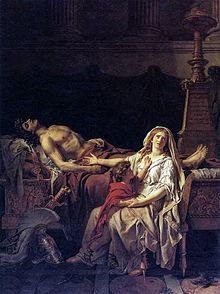
Hector in Greek mythology – The Grief and Recriminations of Andromache over the Body of Hector Her Husband (1783) by Jacques-Louis David
Hector’s funeral is conducted with great solemnity and reverence. The Trojans mourn their greatest hero, and the rituals underscore the importance of honor and remembrance in their culture. The epic concludes with this funeral, leaving the ultimate fall of Troy and the fate of Achilles beyond the scope of the poem but ever-present in the readers’ minds.
Themes and Analysis
The duel between Achilles and Hector encapsulates several central themes of Greek mythology and literature.
- Honor and Heroism: Both warriors embody the heroic ideals of their cultures. Hector fights to defend his city and family, while Achilles seeks to avenge his fallen comrade. Their actions are driven by a code of honor that values bravery and reputation above life itself.
- Fate and the Gods: The intervention of the gods highlights the belief in a predetermined destiny that even the mightiest heroes cannot escape. Hector’s fate is sealed despite his courage, and Achilles’ actions are both influenced and constrained by divine forces.
- Wrath and its Consequences: Achilles’ wrath serves as a central motif. His anger leads to personal and communal tragedy, illustrating the destructive power of unchecked emotions.
- Mortality and Glory: The duel underscores the transient nature of life and the enduring pursuit of glory. Both heroes are aware of their mortality but strive to achieve everlasting fame through their deeds.
- Humanization of the Enemy: Through Priam’s appeal and the shared grief over lost loved ones, the narrative humanizes both sides of the conflict, emphasizing common humanity amidst war.
- Hubris and Retribution: Achilles’ excessive pride and disrespect for Hector’s body invite divine reprimand, reinforcing the moral lesson against hubris.
Legacy and Cultural Impact
The duel has had a profound influence on Western literature and art. It has been depicted in countless works, from ancient vase paintings to Renaissance masterpieces and modern adaptations. The themes explored resonate across time, informing concepts of heroism and the tragic hero in literature.
In education, the story serves as a foundational text for discussions on ethics, leadership, and the human condition. The characters of Achilles and Hector have become archetypes representing different facets of heroism: Achilles as the invincible warrior driven by personal honor, and Hector as the noble defender motivated by duty to others.
Conclusion
The duel between Achilles and Hector is more than a climactic battle; it is a profound exploration of the complexities of heroism, the interplay between fate and free will, and the profound costs of war. Through their confrontation, Homer delves into the deepest aspects of human emotion—love, loss, rage, and compassion.
This moment in Greek mythology continues to captivate audiences because it reflects timeless truths about the human experience. The tragedy of Hector’s death and Achilles’ subsequent actions serve as a powerful reminder of the dual capacity for greatness and destruction inherent in humanity. As readers reflect on the duel, they are invited to consider the enduring questions about the pursuit of glory, the consequences of vengeance, and the possibility of reconciliation even amidst the darkest of times.
Frequently Asked Questions

Image: Cropped from “Hector Admonishes Paris for His Softness and Exhorts Him to Go to War” by J. H. W. Tischbein (1751–1828)
What critical situation do the Greeks face that prompts Patroclus to intervene in the battle?
The Greeks are being pushed back toward their ships by the Trojan forces led by Hector. The Trojans threaten to set the Greek ships ablaze, which would trap the Greeks and lead to their defeat. This imminent destruction prompts Patroclus to intervene.
Why does Achilles refuse to fight, and what does he permit Patroclus to do instead?
Achilles refuses to fight because he is still embittered by a prior dispute with Agamemnon over honor and spoils of war. Instead, he permits Patroclus, his closest companion, to lead his warriors, the Myrmidons, into combat and lends him his own armor to inspire the Greek troops.
How does Patroclus impact the battle while wearing Achilles’ armor?
Disguised in Achilles’ armor, Patroclus rallies the Greek forces and successfully drives the Trojans away from the ships. His appearance boosts Greek morale and instills fear in the Trojans, who believe Achilles has returned to the fight.
Carried away by the surge of victory, Patroclus defies Achilles’ instructions to limit his pursuit and advances toward the walls of Troy. This overextension leads to his encounter with Hector.

Near the walls of Troy, Patroclus encounters Hector. Mistaking Patroclus for Achilles due to the armor, Hector engages him in battle. Hector ultimately kills Patroclus, who, with his dying breath, foretells Hector’s own death at the hands of Achilles.
How does Achilles react upon learning of Patroclus’s death, and who informs him?
Achilles is engulfed by profound grief and rage upon learning of Patroclus’s death. The news is delivered by Antilochus, the son of Nestor.
Thetis, Achilles’ mother, comes to console her grieving son. Recognizing that Achilles needs new armor since Hector has taken the set worn by Patroclus, she appeals to Hephaestus, the god of blacksmiths and craftsmen, to forge magnificent new armor for Achilles, including the famed Shield of Achilles.
Fueled by sorrow and a burning desire for revenge, Achilles reconciles with Agamemnon and returns to the battlefield. His wrath is unparalleled as he slaughters numerous Trojan warriors, instilling fear and chaos among the enemy ranks.
The river god Scamander (also known as Xanthus) becomes angered because Achilles clogs his waters with the bodies of the dead. Scamander attempts to drown Achilles in retaliation, but the goddess Hera and Hephaestus intervene by setting the river’s waters ablaze, saving Achilles.
Why does Zeus become concerned about Achilles’ rage, and what does he do to address it?
Zeus is concerned that Achilles’ unchecked fury might lead him to sack Troy prematurely, disrupting the fated timeline of the city’s fall. To prevent this, he dispatches other gods to restrain Achilles, ensuring that destiny unfolds as ordained.
How does Achilles finally confront Hector, and what divine intervention occurs during their encounter?
Achilles confronts Hector outside the walls of Troy. Initially, Hector flees, with Achilles chasing him around the city walls three times. The goddess Athena, disguising herself as Hector’s beloved brother Deiphobus, persuades Hector to stop running and face Achilles. Realizing too late that he has been deceived, Hector accepts his fate.
What are Hector’s final requests, and how does Achilles respond?
Hector pleads with Achilles to respect his body after death and allow his family to give him a proper burial. Achilles coldly refuses, declaring that his rage is so intense he could consume Hector’s flesh raw.
What does Achilles do with Hector’s body after killing him?
To dishonor Hector, Achilles ties his body to his chariot and drags it around the walls of Troy for all to witness, causing profound grief among the Trojans.
How does Achilles honor Patroclus following Hector’s death?
Achilles holds a funeral for Patroclus, featuring a series of athletic games to honor his fallen friend. The elaborate funeral rites signify the deep bond between the two warriors and serve as a tribute to Patroclus’s memory.
How does King Priam retrieve Hector’s body, and what emotions influence Achilles’ decision?
Guided by the god Hermes under the cover of night, King Priam bravely approaches Achilles’ tent and implores him to return Hector’s body. Moved by Priam’s plea and reminded of his own father, Achilles’ anger subsides. He agrees to return the body and grants a temporary truce for Hector’s funeral.

Achilles transitions from prideful and wrathful to experiencing profound grief and, eventually, compassion. His interactions with Priam show a moment of empathy, signaling a temporary reconciliation with his own humanity amidst the brutalities of war. Image: Priam at the feet of Achilles by Joseph Wencker
What themes are emphasized by the conclusion of The Iliad with Hector’s funeral?
The conclusion underscores themes of honor, mortality, compassion, and the tragic costs of war. It highlights the humanity shared between enemies and prompts reflection on the consequences of unchecked rage and the fleeting nature of glory and life.





