Who was Æthelflæd, and what role did she play in English history?
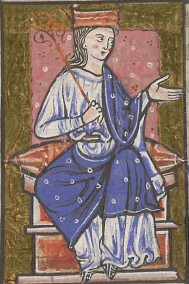
Though not a king, Æthelflæd deserves recognition for her critical role in the Anglo-Saxon period. The daughter of Alfred the Great and sister of Edward the Elder, Æthelflæd ruled Mercia after the death of her husband, Æthelred. Under her leadership, Mercia became a formidable force in the fight against the Vikings. Image: Æthelflæd (from The Cartulary and Customs of Abingdon Abbey, c. 1220)
Æthelflæd was the Lady of the Mercians, ruling Mercia in the English Midlands from 911 until her death in 918. She was the eldest daughter of Alfred the Great, King of Wessex, and his wife, Ealhswith. Æthelflæd played a key role in defending and governing Mercia during a critical period of Viking invasions, and she contributed significantly to the conquest of Viking territories in England.
When and under what circumstances was Æthelflæd born? How did Æthelflæd become the ruler of Mercia, and why was this significant?
Below, World History Edu takes an in-depth look at the life and reign of Æthelflæd:
Early Life
Æthelflæd was born around 870, during a period of intense Viking invasions in England. She was the eldest daughter of Alfred the Great, King of Wessex, and his wife Ealhswith. Her childhood was marked by the constant threat of Danish Viking raids and invasions, which profoundly shaped her early years and the world around her. At the time of Æthelflæd’s birth, England was fractured, with much of its territory under Viking control. East Anglia and Northumbria had already been overrun, and Mercia was divided between the Vikings and the English.
In 878, Alfred the Great achieved a decisive victory over the Viking forces at the Battle of Edington. This victory was a crucial turning point in the Viking wars and ensured the survival of the Anglo-Saxon kingdoms. Following the battle, Alfred established a treaty with the Vikings, resulting in the partition of Mercia. The western part of Mercia, still under English control, came under the rule of Æthelred, Lord of the Mercians, who accepted Alfred as his overlord. This alliance helped solidify Alfred’s claim to be King of the Anglo-Saxons, a title that asserted his authority over all the Anglo-Saxon people not living in Viking-controlled areas.
To strengthen the bond between Wessex and Mercia, Æthelflæd was married to Æthelred in the mid-880s. The union was not just a personal alliance but a strategic one, reinforcing the unity between the two remaining English strongholds and ensuring a coordinated defense against further Viking incursions.
How did Alfred the Great handle the threat of the Great Heathen Army?
Rise to Power
Æthelflæd’s marriage to Æthelred of Mercia was a partnership that saw both individuals playing key roles in the defense and governance of their territories. During the 890s, renewed Viking raids put immense pressure on the Anglo-Saxon kingdoms. Æthelred and Æthelflæd worked alongside Æthelflæd’s brother, Edward (later known as Edward the Elder), to repel these Viking attacks. The couple fortified key cities, including Worcester, and made significant donations to Mercian churches, strengthening both their defenses and their spiritual influence.
The health of Æthelred began to deteriorate in the early 900s, leading Æthelflæd to assume more responsibility in the governance of Mercia. Æthelflæd’s role as a leader became increasingly prominent, and she is believed to have taken over many of the duties traditionally assigned to her husband. During this time, Æthelflæd proved herself to be a capable ruler, adept at both governance and military strategy.
After Alfred’s death in 899, Æthelflæd’s brother Edward succeeded as King of the Anglo-Saxons. By this time, Æthelflæd had already established herself as a leader in Mercia, and her cooperation with Edward in military campaigns became a defining feature of the period. In 909, Edward launched a raid on the northern Danelaw, the Viking-controlled region of England. The raid was a success, and the West Saxon and Mercian forces returned with the relics of Saint Oswald, a royal Northumbrian saint, which were placed in a newly built minster in Gloucester. This act further cemented Æthelflæd’s influence over Mercia and bolstered her reputation as a pious and capable ruler.
Lady of the Mercians
Æthelred died in 911, and Æthelflæd became the sole ruler of Mercia, taking the title “Lady of the Mercians.” Her rise to power as a female ruler during a time when male dominance was the norm in leadership positions was extraordinary. Historian Ian Walker described her ascent as “one of the most unique events in early medieval history.” Unlike her mother, Ealhswith, who was largely a background figure in Wessex, Æthelflæd took an active and authoritative role in both the military and political affairs of her territory.
Æthelflæd was not a ruler in name only. She played a critical role in leading military campaigns and fortifying Mercia’s defenses. Following in the footsteps of her father, Alfred, who had built a network of fortified towns known as burhs, Æthelflæd embarked on an ambitious program of extending and strengthening these fortifications. The burh system was central to Anglo-Saxon defense strategy, providing safe havens for the local population and acting as bases from which to launch counterattacks on Viking forces.
During her reign, Æthelflæd fortified several key towns, including Wednesbury, Bridgnorth, Tamworth, Stafford, Warwick, Chirbury, and Runcorn. These fortifications were vital in protecting Mercia from Viking raids and securing the surrounding areas. Æthelflæd’s leadership in these efforts demonstrated her strategic acumen and her ability to protect her people in a time of constant threat.
Military Campaigns and Triumphs
Æthelflæd’s reign was marked by several significant military victories, most notably her campaigns against the Vikings in the Danelaw. The Danelaw was a region of England under Viking control, and it consisted of several strongholds known as the Five Boroughs: Derby, Leicester, Lincoln, Nottingham, and Stamford. These cities were important Viking power centers, and their capture was crucial to the reconquest of Viking-controlled territory.
In 917, Æthelflæd launched an offensive against the Danelaw, starting with the capture of Derby. Derby was one of the Five Boroughs, and its conquest was a major victory for Æthelflæd and the English forces. Historian Tim Clarkson described the capture of Derby as “her greatest triumph.” The victory was not easily won, and Æthelflæd’s forces suffered casualties, but the capture of Derby was a turning point in the reconquest of the Danelaw.
Following the fall of Derby, Æthelflæd’s forces continued their advance. In 918, Leicester, another of the Five Boroughs, surrendered to Æthelflæd without a fight. This peaceful surrender highlighted Æthelflæd’s growing power and the respect she commanded, even among her enemies.
Shortly after the surrender of Leicester, Viking leaders in York, one of the most important Viking cities in England, offered their loyalty to Æthelflæd. This offer was a remarkable testament to Æthelflæd’s leadership and the strength of her military campaigns. However, Æthelflæd died on 12 June 918 before she could fully capitalize on this opportunity. Her death marked the end of a remarkable reign, but her military successes paved the way for further reconquests by her brother, Edward.
Æthelflæd’s Death and Legacy
After Æthelflæd’s death, her daughter Ælfwynn succeeded her as Lady of the Mercians. However, Ælfwynn’s rule was short-lived. In December of 918, King Edward took direct control of Mercia and removed Ælfwynn from power, taking her to Wessex. The annexation of Mercia by Wessex ended its independence, but Æthelflæd’s legacy endured.
Æthelflæd’s reign as Lady of the Mercians was one of the most remarkable in early medieval history. Her leadership, both in governance and in military matters, set her apart from many of her contemporaries. She was a woman who defied the gender norms of her time, taking on the responsibilities and challenges traditionally reserved for men. Her success as a ruler and military commander earned her the respect of her people and her enemies alike.
Historians have long debated the nature of Mercia’s independence under Æthelred and Æthelflæd. Some argue that Mercia was effectively a client state of Wessex, while others contend that Æthelflæd ruled as an independent sovereign. Regardless of this debate, Æthelflæd’s contributions to the defense and expansion of the Anglo-Saxon kingdoms are undeniable.
Historians’ Views
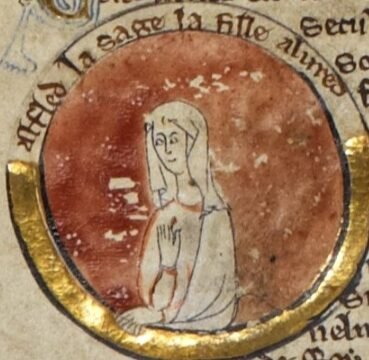
Æthelflæd, Lady of the Mercians (911–918), was a skilled military leader and diplomat, working closely with her brother to secure the lands of southern England. She led successful campaigns to recapture Derby and Leicester from Viking control, making her one of the few female rulers to play such an influential role in medieval military history. Image: Æthelflæd appears in the thirteenth-century Genealogical Chronicle of the English Kings, preserved in the British Library’s Royal MS 14 B V.
Æthelflæd has been praised by numerous chroniclers and historians. The Anglo-Norman historian William of Malmesbury described her as “a powerful accession to [Edward’s] party, the delight of his subjects, the dread of his enemies, a woman of enlarged soul.” Her combination of piety, intelligence, and military prowess made her a figure of admiration in both her time and later centuries.
Historian Pauline Stafford likened Æthelflæd to Queen Elizabeth I, noting that she became a wonder to later generations. Like Elizabeth, Æthelflæd was a female ruler who defied contemporary expectations and left a lasting impact on her kingdom. Both women were celebrated for their strength, leadership, and ability to navigate the complex political and military challenges of their time.
However, some modern historians, such as Nick Higham, have noted that Æthelflæd’s reputation has sometimes overshadowed the achievements of her brother, Edward the Elder. While Æthelflæd’s accomplishments are certainly deserving of recognition, Higham argues that Edward’s contributions to the reconquest of Viking territories and the consolidation of Anglo-Saxon power have been unfairly downplayed in comparison.
How did the formation of Great Britain and the United Kingdom happen?
Q&A on Æthelflæd, Lady of the Mercians
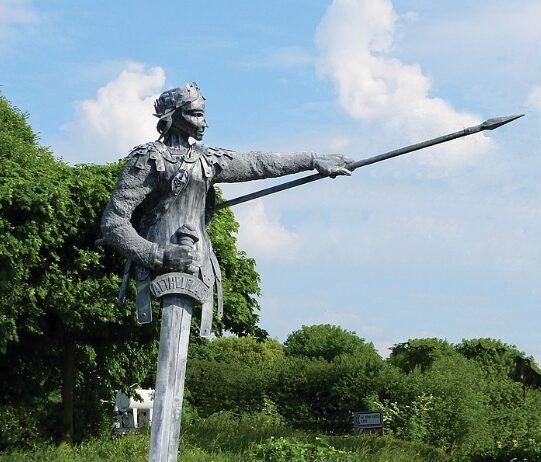
Æthelflæd’s contributions to the defense and unification of England solidified her place as a key figure in Anglo-Saxon history, though her legacy is often overshadowed by her male counterparts. Image: A statue of Æthelflaed at Tamworth Station commemorates 1,100 years since her death, guiding visitors towards the town.
When and under what circumstances was Æthelflæd born?
Æthelflæd was born around 870, during a time when Viking invasions were sweeping across England. By 878, much of the country had fallen under Danish control, with East Anglia and Northumbria overtaken and Mercia divided between the Vikings and the English.
How did Æthelflæd’s father, Alfred the Great, respond to the Viking threat?
Alfred the Great achieved a pivotal victory against the Vikings at the Battle of Edington in 878, which marked a turning point in the conflict. Following this victory, Alfred became the overlord of western Mercia, which was still under English control, and claimed the title of King of the Anglo-Saxons, asserting his authority over all Anglo-Saxon territories not ruled by the Vikings.
Who did Æthelflæd marry, and what was the significance of this marriage?
Æthelflæd married Æthelred, Lord of the Mercians, in the mid-880s. This marriage helped solidify the alliance between Wessex and Mercia, strengthening their defense against Viking incursions and ensuring closer ties between the two English kingdoms.
What contributions did Æthelflæd and Æthelred make to Mercia’s defense?
Æthelred and Æthelflæd played important roles in defending Mercia during renewed Viking raids in the 890s. They fortified Worcester, made donations to Mercian churches, and established a new minster in Gloucester. Æthelflæd increasingly took on leadership responsibilities, especially as Æthelred’s health declined in the early 900s.
How did Æthelflæd become the ruler of Mercia, and why was this significant?
Æthelflæd became the Lady of the Mercians after Æthelred’s death in 911. Her rise to power as a female leader in early medieval England was remarkable, and historian Ian Walker called it “one of the most unique events in early medieval history.”
What defensive strategies did Æthelflæd employ during her rule?
Following the defensive strategies of her father, Alfred, Æthelflæd expanded the network of fortified towns, or burhs, in the 910s. She built defenses in key towns like Wednesbury, Bridgnorth, Tamworth, Stafford, Warwick, Chirbury, and Runcorn, fortifying Mercia against Viking attacks.
What military victories did Æthelflæd achieve during her rule?
One of Æthelflæd’s greatest victories came in 917 when her army captured Derby, one of the Five Boroughs of the Danelaw. The following year, Leicester surrendered to her without a fight, and shortly after, Viking leaders in York offered her their loyalty.
What happened to Æthelflæd after her military successes in 918?
Æthelflæd died on 12 June 918, before she could fully capitalize on the Viking leaders’ offer of loyalty in York. After her death, her daughter Ælfwynn briefly succeeded her, but by December of 918, King Edward, Æthelflæd’s brother, took direct control of Mercia and brought Ælfwynn to Wessex.

While her reign was relatively short, Æthelflæd left a lasting legacy as one of the most important female rulers in early English history. Her accomplishments were celebrated by contemporaries and chroniclers alike, and she remains a figure of admiration to this day. Image: A statue of Æthelflæd and her nephew Æthelstan, erected in 1913, commemorates 1,000 years since Tamworth’s fortification.
What impact did Æthelflæd have on the conquest of Viking territories?
Æthelflæd played a crucial role in the conquest of Viking territories, particularly in the Danelaw. Her leadership, military strategy, and fortification efforts helped reclaim large parts of Viking-controlled England. Historians widely recognize her as an effective and influential ruler.
How did later chroniclers and historians view Æthelflæd?
Æthelflæd was praised by chroniclers such as William of Malmesbury, who described her as “a powerful accession to [Edward’s] party, the delight of his subjects, the dread of his enemies, a woman of enlarged soul.” Historian Pauline Stafford compared her to Queen Elizabeth I, stating that she became a figure of wonder to later generations.
How has Æthelflæd’s legacy compared to that of her brother, King Edward the Elder?
Some modern historians argue that the focus on Æthelflæd’s achievements has sometimes led to an unfair comparison with her brother, King Edward. While Æthelflæd’s accomplishments have been celebrated, this may have overshadowed Edward’s own significant contributions during their reigns.